


Phoenix
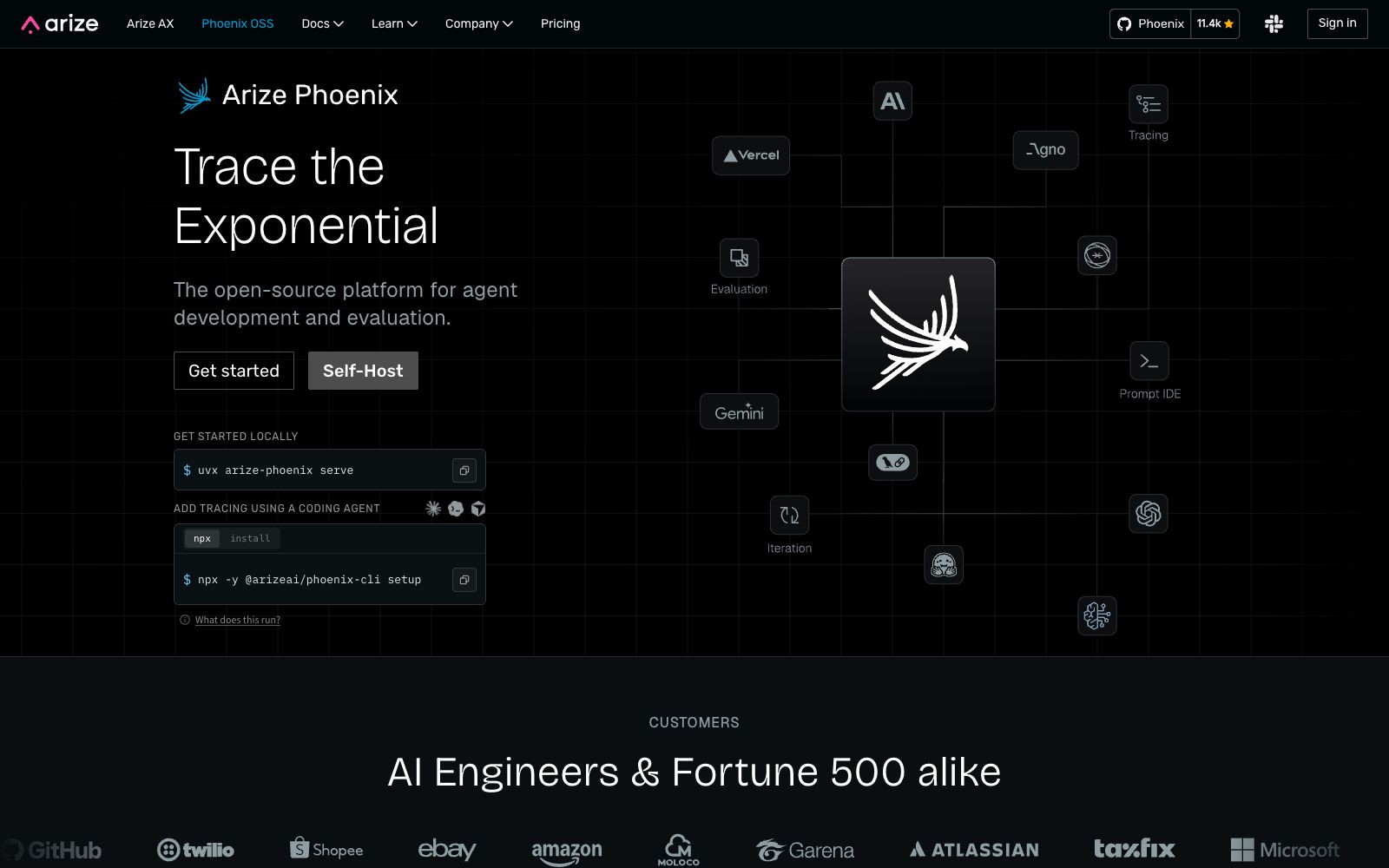
Phoenix is an open-source Agent development and evaluation platform by Arize: visualize every step of the calls, prove the effectiveness of changes through experiments, start locally with one command, support self-hosting, and provide a solid basis for improving Agent quality.
Updated: 2026-10-26
What is Phoenix?
Phoenix is an open-source platform launched by Arize, with the official slogan "Track Exponential Growth" and positioned as an open platform for Agent development and evaluation. Its core idea is simple: without tracing, you are flying blind. In addition to visualizing each step of the Agent's calls, it emphasizes using experiments to verify whether modifications truly improve quality. Officially, it is said to be used jointly by AI engineers and Fortune 500 companies. For Agent teams that pursue "letting data speak for themselves", it weaves tracing, evaluation and experiments into a workflow instead of a collection of scattered tools.
Who is it for?
- Developers who iterate on Agent quality and need to quickly compare the effects of different versions; teams that want to run locally before deploying to the cloud; engineering organizations that need full visibility into production Agents; and teams that need to prove system quality to customers or compliance parties—persistent traces serve as ready-made evidence.
Key features
8Distributed Tracing
Visualizes every step of calls made by Agents and LLM applications, enabling direct pinpointing of the exact step where an error occurs, eliminating guesswork.
PXI Interaction
You can directly converse, add annotations, and run experiments on a specific trace, turning the debugging process into a conversation for greater efficiency.
Evaluation and Experimentation
Systematically measure Agent quality, judge whether modifications are effective based on evidence rather than intuition, and form an improvement closed loop.
Local Startup
Run the command `uvx arize-phoenix serve` to start it locally with just one line, get started in seconds, and no complex configuration required.
Self-hostable
The open-source version can be deployed in your own environment. The official states that it can be deployed anywhere in seconds, giving you full control over your data and tech stack.
Agent-Native
Designed for Agent scenarios, not a simple port of traditional APM, capable of keeping up with the complexity of multi-step calls.
Experiment Comparison
Run multiple versions or models for the same problem, intuitively compare differences in output quality, and support decision-making on modifications.
Multi-framework Compatibility
Supports integration with mainstream LLM and Agent frameworks, with diverse access paths.
How to use Phoenix
- The experience of starting with a single local command is ideal for the evaluation phase.
- It is recommended to make "reviewing the trace first and then revising the prompts" a fixed workflow.
- otherwise, it's easy to fall into a cycle of adjustments based on intuition.
- Archive the evaluation results of each round of experiments, and after several rounds, you will be able to identify which modifications are actually effective.
- For team collaboration, it is advisable to agree on a unified evaluation dataset and scoring criteria.
- otherwise, the results developed by different members cannot be compared horizontally.
- The official page also includes usage reviews from multiple practitioners, which are worth reading.
Things to know
Traffic & popularity
Data month Sep 2026
Phoenix receives about 1.6K visits per month.
Monthly visits
12 monthsTraffic sources
- Search48.3%
- Direct38.5%
- Referrals7.2%
- Social4.5%
- AI assistants1.5%
Top countries
- Sweden33.8%
- Tunisia30.9%
- United States11.7%
- India10.6%
- China6.5%
Estimated from third-party traffic data.
Similar tools
 LangfuseAn open-source (MIT) LLM engineering platform that integrates tracing, evaluation, prompt management and datasets in one place. Based on OpenTelemetry, it continuously improves AI applications with production data and is self-hostable.
 LatitudeLatitude is an open-source AI Agent observability and monitoring platform that tracks production traces, clusters failure patterns and dispatches repair tasks to coding Agents. The official version states that it is compatible with OTEL and supports custom signals.
 Helicone AIHelicone is an open-source LLM observability and AI gateway platform: request logs, monitoring alerts, policy routing, multi-dimensional segmentation and HQL analysis, access with one line of base_url modification, used by the fastest-growing AI companies.
 MLflowMLflow is the largest open-source AI engineering platform, covering Agents, LLMs and traditional models: it integrates link monitoring, system evaluation, prompt optimization, AI gateways and model deployment into one solution, making AI iteration ten times faster.
 AdalineAdaline is an observability and evaluation platform for AI Agents. It transforms production trajectories into behavior graphs, automatically generates evaluations and synthetic data, and drives autonomous improvement of Agents. According to its official website, it supports release after team approval.
 Hermes AgentNous Research's open-source and self-hostable AI agent, officially available for free under the MIT license, supports persistent memory, automatic skill generation, multi-platform access, and isolated sandboxes. It can be downloaded for desktop or terminal installation.