


Langfuse
An open-source (MIT) LLM engineering platform that integrates tracing, evaluation, prompt management and datasets in one place. Based on OpenTelemetry, it continuously improves AI applications with production data and is self-hostable.
Updated: 2026-10-26
What is Langfuse?
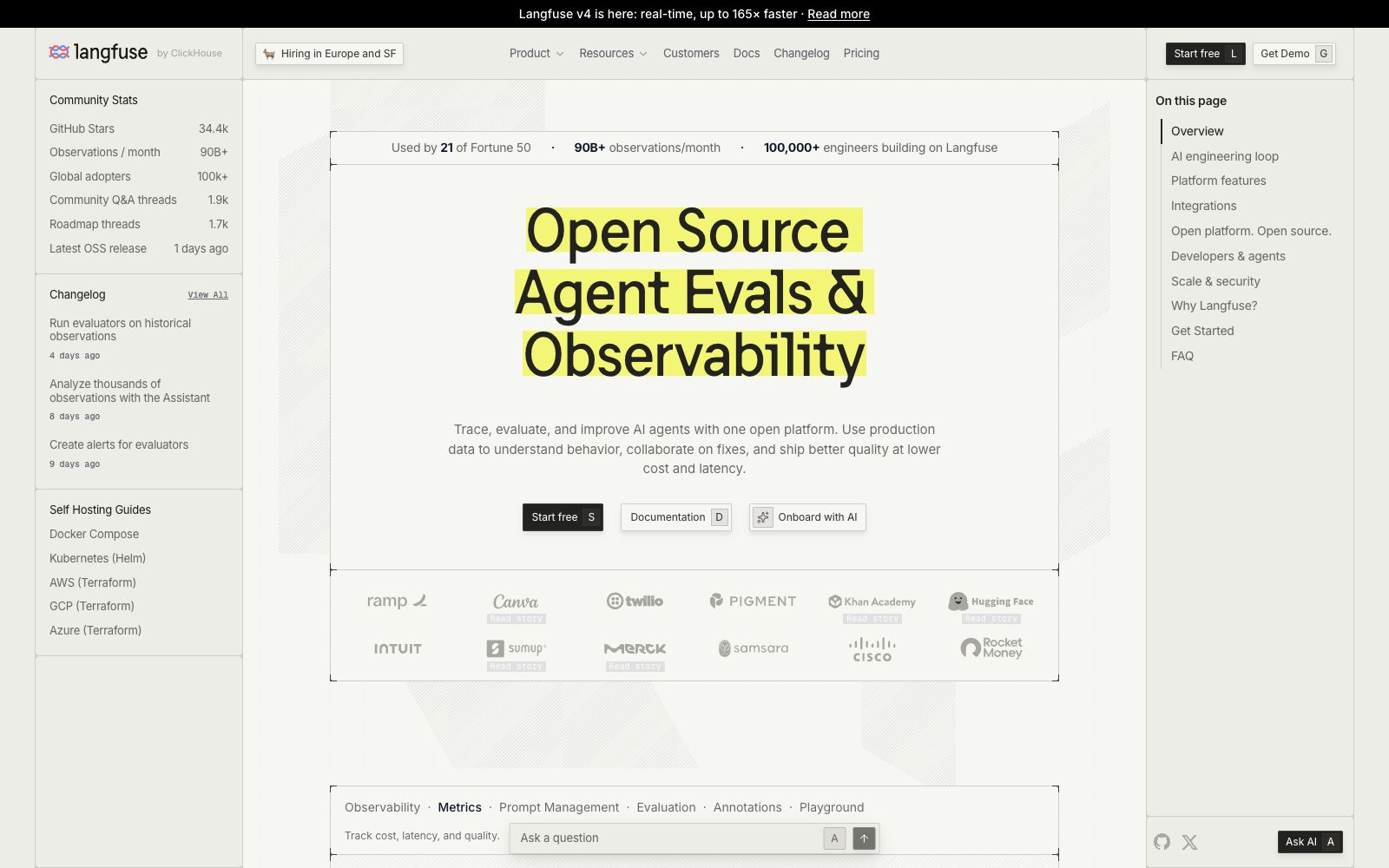
Langfuse is an open-source (MIT) LLM engineering platform, officially positioned as an open platform for "tracking, evaluating and improving AI Agents" (Open Source Agent Evals & Observability). Its approach is to first record real online requests, then use this production data to understand behavior and collaboratively fix issues, thereby delivering higher-quality versions at lower cost and latency. The official summarizes this cycle as "Launch, observe, improve — repeat". The company discloses that 21 Fortune 500 companies use it, processing over 90 billion observation data records monthly and supporting over 100,000 engineers in building on it. It is also described as "Made for developers, loved by agents", with sufficient production validation.
Who is it for?
- Engineering teams that deploy LLM applications to production and require an observability and evaluation closed loop; enterprises with high data compliance requirements that prefer self-hosting; and technical teams that need to centrally manage multiple LLM applications and build an organizational-level observability platform.
Key features
5End-to-End Tracing
Fully record LLM calls, tool calls and Agent steps, and use Metrics to understand the behavior, latency and cost of each request to quickly locate issues.
Evaluation System
Supports dataset regression, LLM-as-a-judge, and human annotation scoring (Annotations), turning "good or bad" into quantifiable metrics.
Prompt Management
Versioning, comparison and rollback of prompts, decoupled from code; built-in Playground for convenient debugging and experimentation.
Native OpenTelemetry
Collected based on the OTel standard, compatible with 100+ integrations, and the official emphasizes that it works with any stack.
Self-hosted or Cloud
The open-source version can be deployed on your own, keeping your data in your hands; it has async by default, enabling it to support high-throughput production loads.
How to use Langfuse
- First, connect the tracking to see the real traffic and failure patterns, then build the evaluation dataset for regression analysis, and only then optimize the prompts – reversing the order will lead to judgments based on noise.
- The evaluation cases are recommended to be selected from real failed requests, which are more useful than those created out of thin air.
- when collaborating in a team, run a closed loop of annotation, repair and rollback, so that the platform value can truly be realized.
- The official also provides an AI assistant (Langfuse Assistant) to assist with integration and troubleshooting.
- If you encounter burying point problems, you can take this path first.
- even if only a small number of key applications are integrated, you can immediately get a clear visible view of calls and failures.
Things to know
Traffic & popularity
Data month Sep 2026
Langfuse receives about 309.5K visits per month and ranks #122,512 worldwide.
Monthly visits
12 monthsTraffic sources
- Direct60.9%
- Search23.4%
- Referrals7.2%
- Social3.4%
- AI assistants1.9%
- Other3.1%
Top countries
- China14.8%
- United States13.0%
- India12.6%
- Germany6.2%
- Vietnam5.9%
Estimated from third-party traffic data.
In these collections
Similar tools
 PromptLayerPromptLayer is a prompt management and observability platform for AI teams, supporting prompt versioning, LLM evaluation and production tracking, and connecting tracking, logs and regression tests to improve quality.
 AdalineAdaline is an observability and evaluation platform for AI Agents. It transforms production trajectories into behavior graphs, automatically generates evaluations and synthetic data, and drives autonomous improvement of Agents. According to its official website, it supports release after team approval.
 PhoenixPhoenix is an open-source Agent development and evaluation platform by Arize: visualize every step of the calls, prove the effectiveness of changes through experiments, start locally with one command, support self-hosting, and provide a solid basis for improving Agent quality.
 Helicone AIHelicone is an open-source LLM observability and AI gateway platform: request logs, monitoring alerts, policy routing, multi-dimensional segmentation and HQL analysis, access with one line of base_url modification, used by the fastest-growing AI companies.
 LatitudeLatitude is an open-source AI Agent observability and monitoring platform that tracks production traces, clusters failure patterns and dispatches repair tasks to coding Agents. The official version states that it is compatible with OTEL and supports custom signals.
 MLflowMLflow is the largest open-source AI engineering platform, covering Agents, LLMs and traditional models: it integrates link monitoring, system evaluation, prompt optimization, AI gateways and model deployment into one solution, making AI iteration ten times faster.