


Adaline
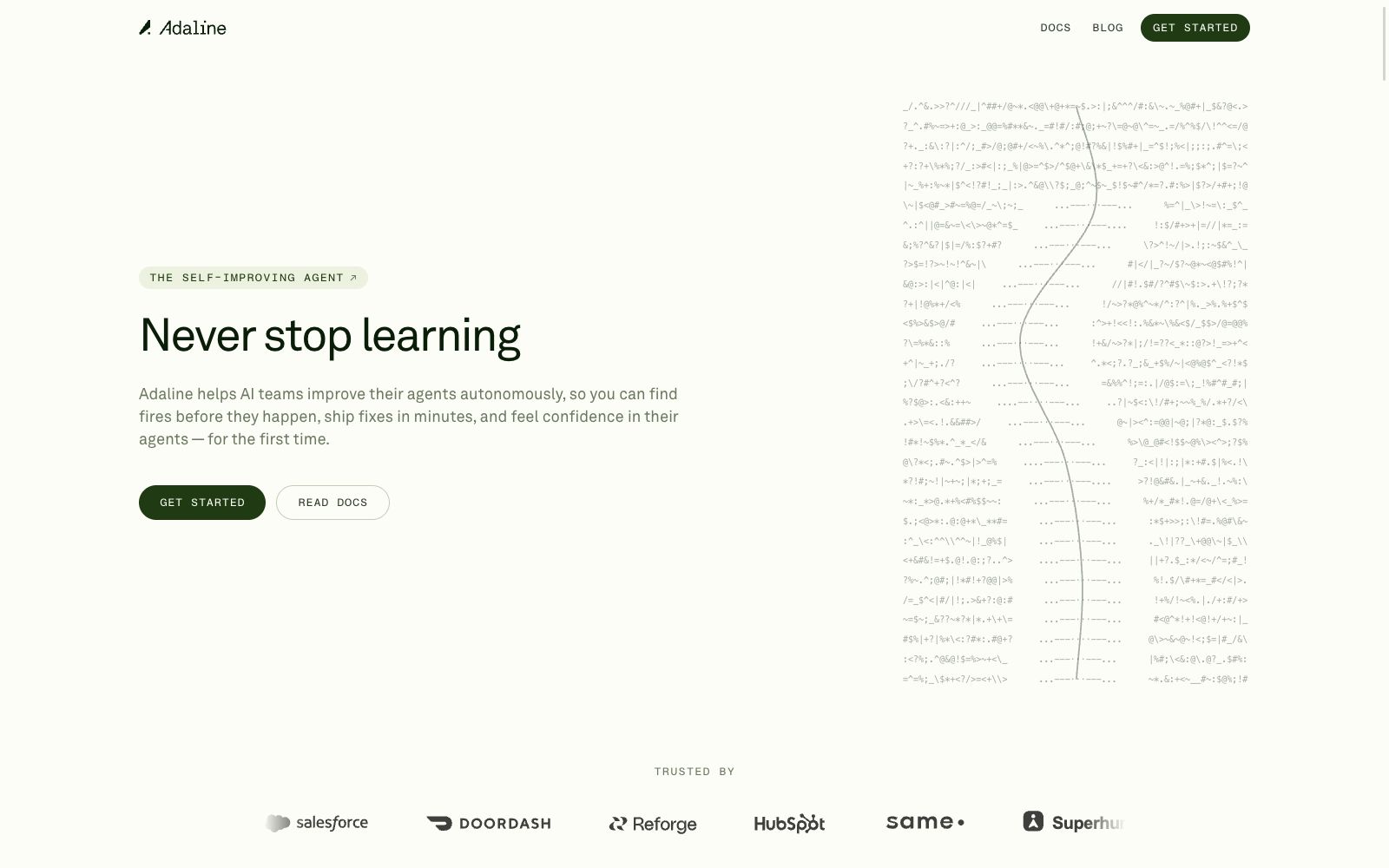
Adaline is an observability and evaluation platform for AI Agents. It transforms production trajectories into behavior graphs, automatically generates evaluations and synthetic data, and drives autonomous improvement of Agents. According to its official website, it supports release after team approval.
Updated: 2026-10-30
What is Adaline?
Adaline is an observability and evaluation platform for AI Agents. Its official website states that it helps teams enable Agents to "self-improve": transforming production environment traces into behaviors, evaluations, synthetic data, and verifiable improvements that teams can approve before release. Positioned as the feedback loop behind "self-improving Agents," it identifies issues based on real signals, generates tests, and drives fixes—rather than relying on manual review line by line. The official website cites usage feedback from teams such as McKinsey, OpenAI, and Salesforce.
Who is it for?
- Teams that have already deployed AI Agents and wish to continuously improve them using real signals instead of manual audits.
- Algorithm engineers who need to convert behavioral patterns into evaluations and tests to improve reliability.
- Enterprise organizations that are concerned with change safety and require improvements to be reviewed and approved before deployment.
- Product teams that want to shorten the iteration cycle of prompts and Agents and reduce the risk of regression.
- Teams that need to involve non-technical experts in evaluation and cross-functional collaboration.
Key features
6Understand Agent Behavior
Ingest production traces, aggregate recurring Agent patterns into inspectable behavior graphs.
Automatically Generate Evaluations
Generate evaluation sets from detected behaviors and user feedback to intercept regressions before Agent changes are launched.
Synthetic Test Data Generation
Generate production-aligned synthetic data to supplement coverage for both known and unknown edge scenarios.
Agent Automatic Improvement
As an ML layer that connects traces with Agent diffs, it enables continuous improvement without human intervention.
Enterprise-Grade Governance
The official website emphasizes enterprise-grade control capabilities for self-improving Agents, supporting team approval before release.
Feedback Loop
Converts real user interaction signals into evaluations and improvements, reducing the cost of manual review line by line.
How to use Adaline
- First integrate production traces to build behavior graphs, then enable automated evaluation and synthetic data generation.
- For automatic improvements involving code or prompt changes, be sure to retain a manual approval step before release.
- The collection of user data must comply with privacy and compliance requirements, subject to the official instructions.
- Official features and enterprise-grade governance capabilities will evolve.
- double-check the current supported items before making an official selection.
- The evaluation set should cover real edge cases and avoid missing judgments caused by only testing common paths.
- When you start using it, it is recommended to first use the free quota to run through the core workflow once, confirm that the output quality meets your expectations, and then evaluate whether it is worth upgrading to a paid plan.
Traffic & popularity
Data month Sep 2026
Adaline receives about 163.8K visits per month and ranks #200,263 worldwide.
Monthly visits
12 monthsTraffic sources
- Direct64.7%
- Search17.7%
- Referrals13.5%
- Social1.6%
- Display ads1.5%
- Other1.0%
Top countries
- United States27.7%
- India16.6%
- Brazil5.0%
- Nigeria3.3%
- Germany3.1%
Estimated from third-party traffic data.
Similar tools
 LatitudeLatitude is an open-source AI Agent observability and monitoring platform that tracks production traces, clusters failure patterns and dispatches repair tasks to coding Agents. The official version states that it is compatible with OTEL and supports custom signals.
 PromptLayerPromptLayer is a prompt management and observability platform for AI teams, supporting prompt versioning, LLM evaluation and production tracking, and connecting tracking, logs and regression tests to improve quality.
 LangfuseAn open-source (MIT) LLM engineering platform that integrates tracing, evaluation, prompt management and datasets in one place. Based on OpenTelemetry, it continuously improves AI applications with production data and is self-hostable.
 PhoenixPhoenix is an open-source Agent development and evaluation platform by Arize: visualize every step of the calls, prove the effectiveness of changes through experiments, start locally with one command, support self-hosting, and provide a solid basis for improving Agent quality.