


MLflow
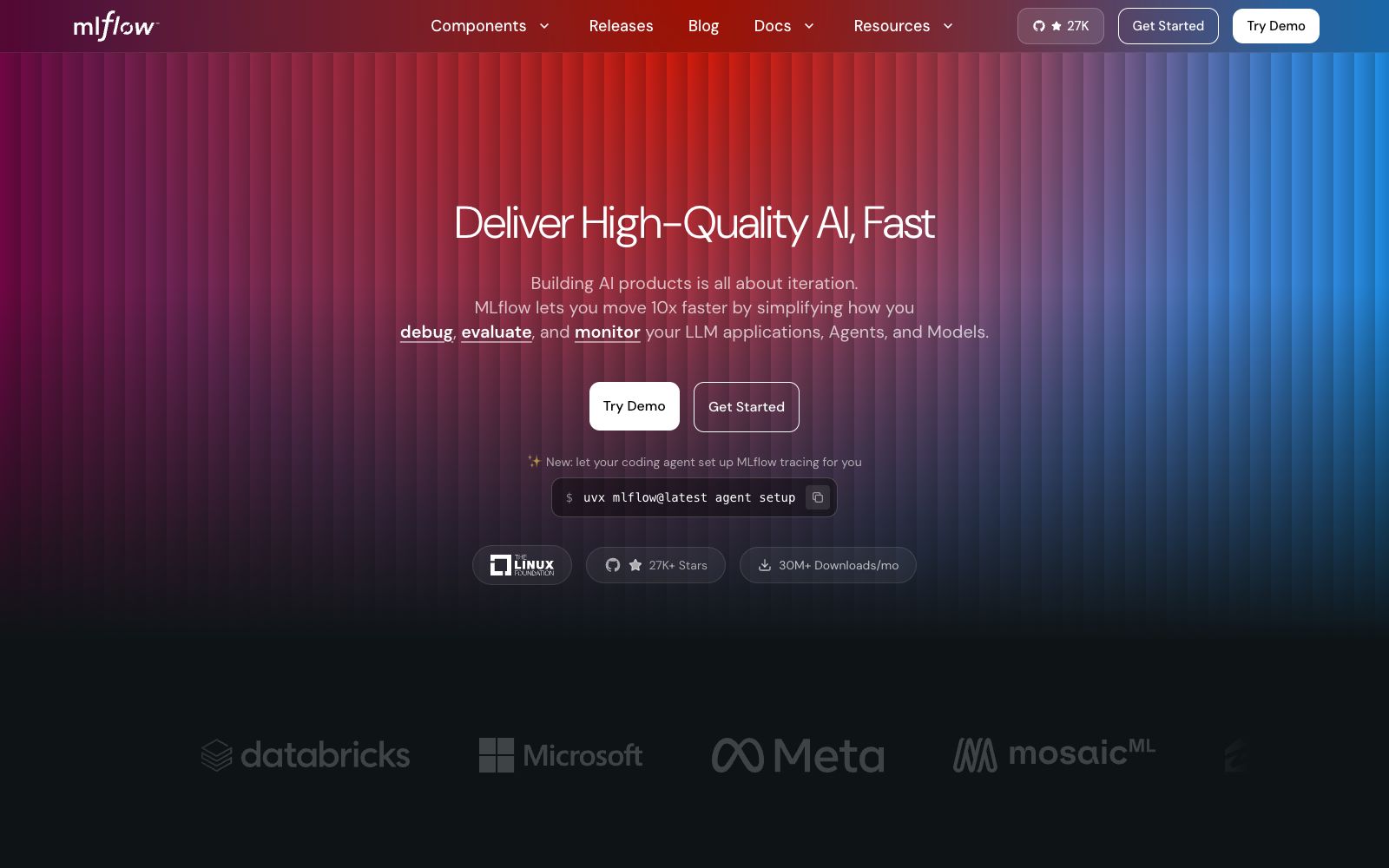
MLflow is the largest open-source AI engineering platform, covering Agents, LLMs and traditional models: it integrates link monitoring, system evaluation, prompt optimization, AI gateways and model deployment into one solution, making AI iteration ten times faster.
Updated: 2026-10-26
What is MLflow?
MLflow bills itself as the "largest open-source AI engineering platform," covering Agent, LLM, and traditional ML models. Its core proposition is that building AI products is essentially iteration, and the platform's value lies in simplifying the three tasks of debugging, evaluation, and monitoring, thereby making iteration ten times faster. Official data shows it has over 27K stars on GitHub and more than 30 million monthly downloads. It continues to extend its capabilities to LLM and Agent scenarios, covering the entire pipeline from experimentation to production. For teams, its biggest appeal lies in "managing everything on one platform"—no need to transfer experiment records and evaluation results between multiple tools.
Who is it for?
- Teams that have both traditional machine learning and LLM applications and want to unify their management platforms; teams already using MLflow for ML experiment management with the lowest upgrade costs; engineering organizations that need to add observation and evaluation capabilities to Agents are also suitable for teams that are just getting started with LLM engineering and hope to use a mature platform to avoid pitfalls.
Key features
7Observability
Captures the complete call chain of LLM applications and Agents based on OpenTelemetry, and the official claims to support any model providers and Agent frameworks.
Evaluation
Conduct systematic evaluations of models and applications, driving iteration with data rather than intuition. The official team also offers a new feature: "Let coding Agents help you one-click integrate tracing."
Prompt Engineering & Optimization
Tools for prompt version management and optimization, to accumulate high-quality templates and continuously improve them.
AI Gateway
Unifies the access to and governance of different model providers, centralizes API keys, optimizes routing and reduces costs, simplifying the management of multiple models.
Agent Server
The deployment and hosting capabilities for Agents, bringing intelligent agents from experimentation to production.
Traditional ML Support
Experiment tracking, model registration and deployment are its forte, and a single platform covers both old and new workflows.
Open Source & Self-Hosting
Core capabilities are open-source and can be deployed in your own environment, suitable for organizations with data sovereignty requirements.
How to use MLflow
- Start with a specific pain point (usually tracing LLM adjustments), get it up and running first, then gradually enable evaluation and gateways to avoid configuring all modules at once.
- Integrate evaluation results into the iteration process, so every prompt or link change can be backed by data—that’s where its "10x speed" comes from.
- Feel free to try new official capabilities like agent setup, which can save a lot of repetitive manual integration work.
Things to know
Traffic & popularity
Data month Sep 2026
MLflow receives about 61.6K visits per month and ranks #725,569 worldwide.
Monthly visits
12 monthsTraffic sources
- Search49.4%
- Direct33.1%
- Referrals11.8%
- Social2.6%
- AI assistants2.3%
- Other0.7%
Top countries
- United States18.1%
- India14.3%
- Taiwan, China5.0%
- France4.5%
- Netherlands4.2%
Estimated from third-party traffic data.
Similar tools
 PhoenixPhoenix is an open-source Agent development and evaluation platform by Arize: visualize every step of the calls, prove the effectiveness of changes through experiments, start locally with one command, support self-hosting, and provide a solid basis for improving Agent quality.
 LangChainAn open-source agent engineering platform for building LLM applications. With LangSmith Engine, it covers development, testing, deployment, and monitoring across the full lifecycle while keeping model, context, and execution-framework choices open.
 LangfuseAn open-source (MIT) LLM engineering platform that integrates tracing, evaluation, prompt management and datasets in one place. Based on OpenTelemetry, it continuously improves AI applications with production data and is self-hostable.
 ManifestOpen-source LLM router and gateway that uses a single OpenAI-compatible endpoint to access subscription-based, pay-as-you-go, local models and custom providers, automatically fixes erroneous requests, and switches to backup models in case of failures.
 DifyDify is an open-source LLM application development platform for production-grade Agentic workflows. It enables the building of Agents, knowledge pipelines (RAG) and workflows on a unified canvas, and supports cloud, VPC or self-hosted deployment.
 BentoMLBentoML is a model inference platform for production environments. It supports the deployment of any model, customized inference optimization and elastic scaling. It also provides an open-source model serving framework, focusing on speed and controllability.