


MiroMind
Positioned as a general-purpose AI research platform, the open-source MiroThinker series focuses on long-chain reasoning. The official claims that it has achieved an average score of 60.2% on the GAIA benchmark, outperforming open-source models.
Updated: 2026-10-26
What is MiroMind?
MiroMind positions itself as a "general-purpose solver", focusing on in-depth research and prediction tasks that require multi-step reasoning, rather than one-question-one-answer interactions. Its core assets are the open-source MiroThinker series of models and a runtime environment called MiroMind OS: the former is responsible for maintaining stability across a reasoning chain of over a hundred steps, while the latter ensures the continuity of memory. The official stated that MiroThinker achieved an average score of 60.2% on the GAIA benchmark, outperforming all open-source models.
Who is it for?
- Analysts and assistants engaged in industry and company research who need to string public information into reasoning chains and process long documents in batches
- For research teams, who can entrust hypothesis generation and experimental design to the model for an initial run
- Legal and compliance teams conduct contract clause comparison and regulatory mapping
- Quantitative analysis and risk control, conducting scenario simulation and risk modeling
- Developers who want to build research-oriented agents based on open-source models
Key features
6Open-Source Deep Research Model
The official statement says that the MiroThinker series is the open-source State-of-the-Art (SoTA) deep research model, achieving an average score of 60.2% on Avg@8 of the GAIA benchmark, and it is emphasized to outperform all other open-source models.
Long-chain reasoning
The focus of the official description is not on a single-point score, but on maintaining stability and accuracy in DAG reasoning with more than 100 steps.
MiroMind OS
The official description states that this is a runtime system designed to mirror human intelligence, with the core being the continuity of memory, which ensures that research across sessions does not lose context.
Industry Application Scenarios
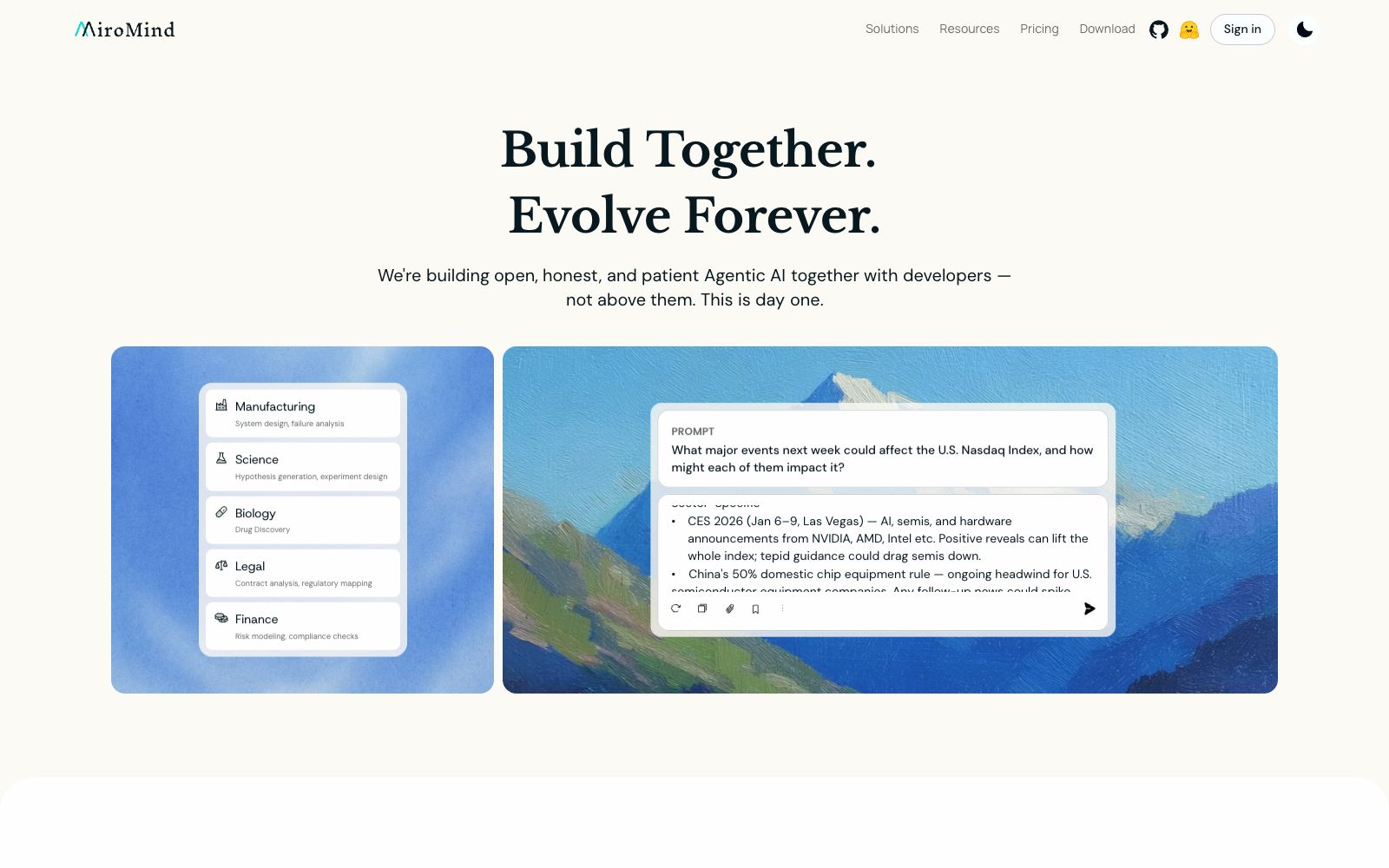
The page lists manufacturing (system design, failure analysis), scientific research (hypothesis generation, experimental design), biotechnology (drug discovery), law (contract analysis, regulatory mapping), and finance (risk modeling, compliance checks).
Downloadable and Self-Deployable
The official website provides a download portal, and the model weights are open-sourced on GitHub and HuggingFace. You can build your own deployment, perform secondary fine-tuning, or integrate it into your own research pipeline.
Predictive Querying
In demonstrations, it is used to break down questions like "What events will affect the Nasdaq next week?" and provide impact paths for each event one by one.
How to use MiroMind
- First, check the model card on HuggingFace to confirm the VRAM and deployment requirements.
- for self-deployment, run it on a small scale first before scaling up the concurrency, as these tasks come with significant VRAM and time overhead.
- Deep research takes a long time, so set timeouts and cost caps.
- break down complex problems into subproblems before feeding them to it, as long-chain reasoning heavily relies on the structure of task descriptions.
- Its output is a reasoning path rather than a conclusion.
- Trace key facts back to their original sources before citing them.
- check open-source licenses before commercial use, as the terms may vary across different models.
- For predictive questions, distinguish between "event lists" and "impact judgments".
- the latter relies on assumptions and should not be treated as definitive conclusions.
- When using it for external reports, export and file the reasoning chain to facilitate colleagues' gradual review, rather than just presenting a conclusion.
Traffic & popularity
Data month Sep 2026
MiroMind receives about 121.1K visits per month and ranks #174,612 worldwide.
Monthly visits
12 monthsTraffic sources
- Direct60.6%
- Search19.8%
- Referrals16.6%
- AI assistants1.7%
- Social0.8%
- Other0.5%
Top countries
- China70.6%
- United States11.2%
- India6.9%
- Egypt3.3%
- South Korea2.2%
Estimated from third-party traffic data.
Similar tools
 OpenLens AIAn fully automatic multimodal scientific research agent for health informatics research. Upon inputting a research question, it can automatically complete literature review, data analysis, experimental design and code execution, and generate LaTeX-format PDF papers through multi-agent collaboration.
 OpenScienceAn open-source AI scientific research workbench, which the official says can read papers, write code and run experiments. It has built-in free models and also supports connecting to models from any manufacturer, and links to more than 40 scientific databases such as UniProt and PDB.
 Outset.aiAn AI interview platform for corporate research teams, with AI hosts conducting real-time follow-up questions based on responses. The official states that it can process thousands of interviews in parallel and summarize them instantly, covering market strategies, user profiles, and concept testing.
 CuspAIA UK research company that uses AI to accelerate the discovery of new materials, registered in Cambridge, focuses on semiconductors, energy and climate. It partners with laboratories and industrial counterparts for collaboration through application.
 NovixAn AI collaborative scientist for researchers, officially said to support from formulating research hypotheses all the way to experimental verification, covering literature sorting, experimental design, data analysis and visualization.
 WisPaperAI academic search tool, officially said to help researchers find relevant literature faster through deep retrieval, track trends by research direction and subscribe to personalized paper Feeds, reducing repeated trial and error in keywords.