


OpenScience
An open-source AI scientific research workbench, which the official says can read papers, write code and run experiments. It has built-in free models and also supports connecting to models from any manufacturer, and links to more than 40 scientific databases such as UniProt and PDB.
Updated: 2026-10-26
What is OpenScience?
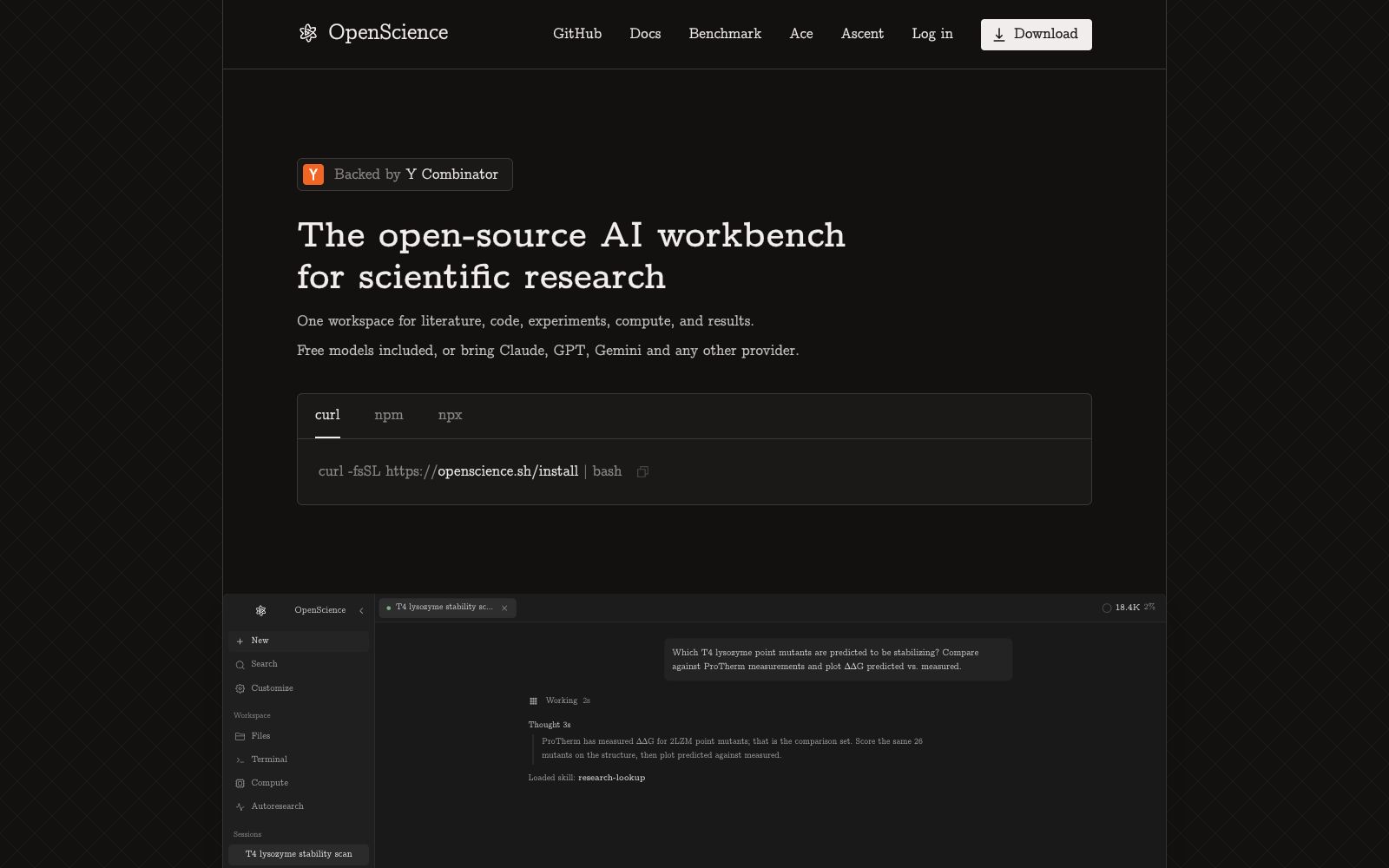
OpenScience is an open-source AI research workbench, which, according to its official statement, is supported by Y Combinator. Positioned as an AI co-scientist, it is a research collaboration agent that can read papers, write code, and run experiments with you, integrating literature, code, experiments, computing power, and results into a single workspace. It does not lock users to a specific model vendor: it comes with free built-in models, and also allows access to any vendor's models such as Claude, GPT, Gemini, as well as your own API keys. Compared with ordinary conversational AI, its difference lies in that it can directly perform hands-on operations in your workspace such as retrieval, script running, and image generation, instead of only providing text suggestions.
Who is it for?
- Graduate students and postdocs in experimental disciplines who need to read papers in batches and conduct data cross-verification
- Researchers in bioinformatics, chemistry, pharmacy and other fields that rely on data retrieval and comparison from public databases
- University research teams that want to streamline literature searching, script writing, analysis running, and figure generation into a single workflow
- Authors who need to quickly draft methodology sections with proper citations
- A computing platform administrator who is used to command-line and script workflows and wants to equip the lab with a self-hostable assistant
Key features
5Literature Reading & Verification
The official states that the Agent can read papers and search scientific databases. In the interface examples, it first locates and compares datasets, then cross-checks literature entries, finally provides conclusions with citations, and proactively suggests independent verification methods for the next step.
Code and Experiment Execution
The workspace has built-in file, terminal and computing power panels. The Agent can directly run scripts to process structural files and generate charts. The official claims that it covers the entire process from hypothesis to chart generation.
Access to Scientific Databases
The official states that it has built-in more than 40 scientific databases such as UniProt, PDB, ChEMBL, PubChem, and arXiv, which serve as ready-made data sources for the Agent to verify facts and retrieve data without having to configure interfaces one by one.
Free Access to Multiple Models
Model-agnostic architecture, free models are ready to use out of the box. It also supports connecting to models from any vendor and using your own API keys, allowing you to switch models according to task difficulty.
Integrated Workspace
Panels for search, workspace, files, sessions, computing power and Autoresearch are centralized on the same interface. Results can be copied and forked, facilitating re-running and iteration.
How to use OpenScience
- The official website provides a one-click installation script and an npm installation method.
- First, use the official sample tasks, such as comparing the measured values of the database for stability prediction, to familiarize yourself with the Agent's retrieval and plotting methods, and then switch to your own research topics
- When describing a task, specify the comparison datasets, samples, and expected outputs.
- This will make the Agent's analysis more aligned with your needs and reduce the need for back-and-forth clarifications.
- The values and citations provided by the Agent must be verified against the original databases or papers before being written into the official manuscript.
- machine-generated results cannot be directly treated as research conclusions.
- It is recommended to include results and scripts in your own version control.
- if the project is open-source and involves sensitive data, you can deploy it yourself instead of using a public environment.
- Use computing power and session resources on demand.
- break long tasks into smaller tasks with clear objectives to facilitate checking intermediate results.
Traffic & popularity
Data month Sep 2026
OpenScience receives about 1.6K visits per month and ranks #13,312,261 worldwide.
Monthly visits
7 monthsTraffic sources
- Direct39.6%
- Search30.2%
- Referrals12.9%
- Social6.1%
- Display ads4.1%
- Other7.1%
Top countries
- Switzerland71.7%
- Singapore15.5%
- Germany10.2%
- India2.6%
Estimated from third-party traffic data.
Similar tools
 OpenLens AIAn fully automatic multimodal scientific research agent for health informatics research. Upon inputting a research question, it can automatically complete literature review, data analysis, experimental design and code execution, and generate LaTeX-format PDF papers through multi-agent collaboration.
 NovixAn AI collaborative scientist for researchers, officially said to support from formulating research hypotheses all the way to experimental verification, covering literature sorting, experimental design, data analysis and visualization.
 MiroMindPositioned as a general-purpose AI research platform, the open-source MiroThinker series focuses on long-chain reasoning. The official claims that it has achieved an average score of 60.2% on the GAIA benchmark, outperforming open-source models.
 WisPaperAI academic search tool, officially said to help researchers find relevant literature faster through deep retrieval, track trends by research direction and subscribe to personalized paper Feeds, reducing repeated trial and error in keywords.
 CuspAIA UK research company that uses AI to accelerate the discovery of new materials, registered in Cambridge, focuses on semiconductors, energy and climate. It partners with laboratories and industrial counterparts for collaboration through application.
 TroolyAn AI-led in-depth interview research platform that uses multimodal voice agents to complete recruitment, interviews and quality control. The official claims it is about 12 times faster than traditional institutions and costs 60% less, with respondents covering 25 countries.