


DiffMind
A multi-model AI workbench for academic research: send one question to several models side by side and get consensus, disagreements and items to verify marked on the answers, or hand a task to multiple AIs that split the analysis, revision and checking. Knowledge-base grounding keeps answers on your own papers.
Updated: 2026-10-29
What is DiffMind?
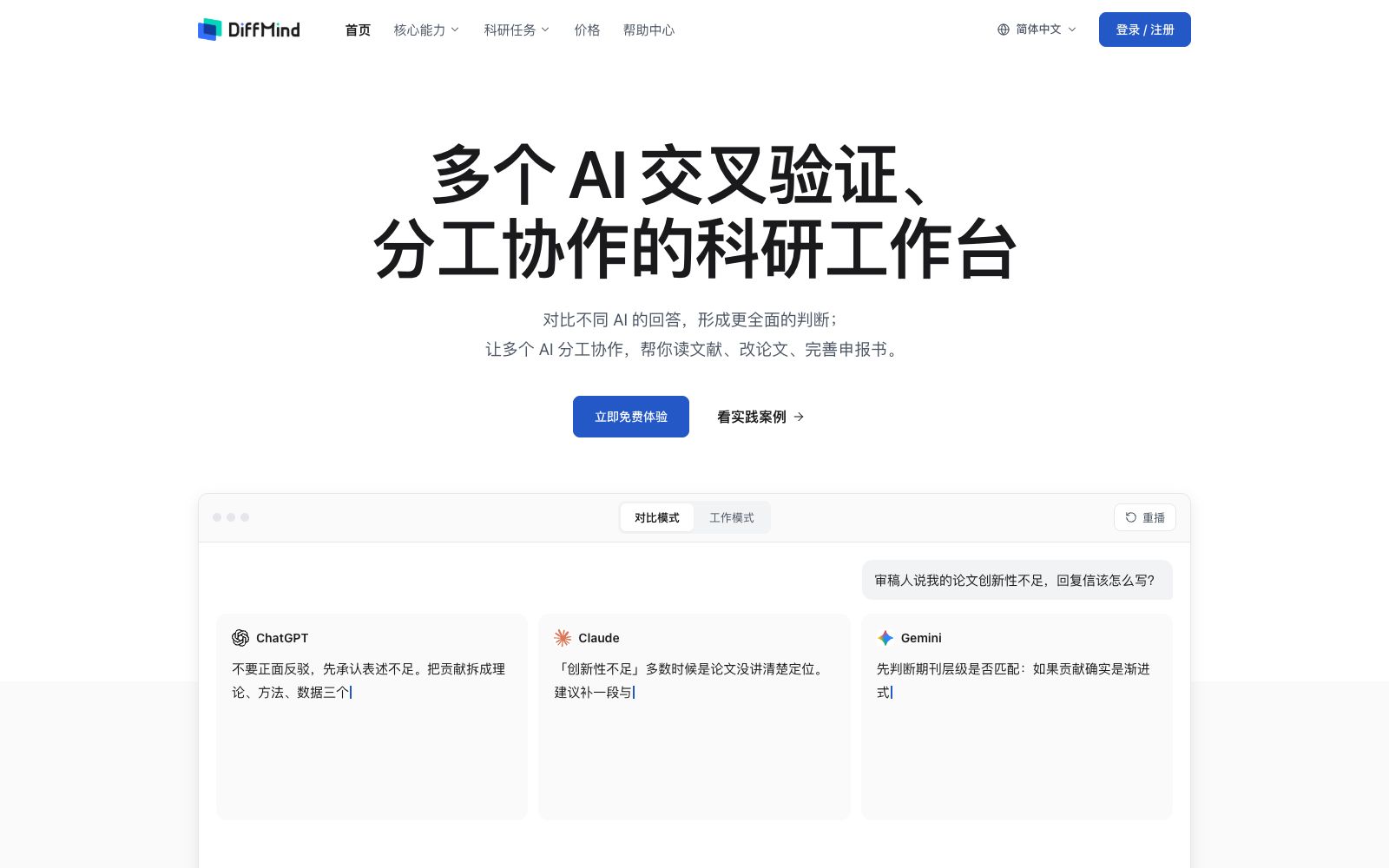
DiffMind is a multi-model AI workbench for academic research, described by its maker as "a research workbench where multiple AIs cross-check and divide the work." A single question is sent to ChatGPT, Claude, Gemini, Kimi, GLM and DeepSeek at once, answers appear side by side, and the consensus, disagreements and open points are condensed into one comparable conclusion. A task can also be handed to several models that split the analysis, revision and checking. Unlike general assistants built around a single chat box, the focus here is on making each judgment checkable: every edit carries a reason, every citation can be traced back to the source.
Key features
5Compare mode
one question goes to several models at once, with answers shown side by side, up to six models answering together in a multi-pane layout; a one-click summary marks consensus, disagreements and items still to verify directly on the answers.
Work mode (agent)
state the goal and the materials, and different models take on analysis, revision and checking, then combine the results into something you can keep working with, for example a pre-submission self-check against the target journal's requirements that exports a DOCX report. If a step fails, it says which step failed and the earlier results stay viewable.
Knowledge-base grounding
upload papers, data and drafts, and answers stay on the selected material with the source of each judgment marked so you can check the original. The maker says knowledge-base documents are stored encrypted, visible only to you and not used to train models.
Six research tasks
manuscript revision and resubmission, literature review, grant and project applications, topic selection and proposal writing, research figures, and academic slides, plus literature search.
Academic toolbox and reversible edits
the help center lists close reading (two models split one paper and check each other), citation checking (several models check references independently and flag inconsistencies), research figures and format conversion, described as 7 experts and 23 skills in total. All edits are shown as tracked marks with the original kept, accepted or withdrawn one by one; the maker states it will not replace your files automatically.
Things to know
Who it is for
- Master's and PhD students and early-career researchers who revise repeatedly and write response letters: map each reviewer comment to the paragraph it concerns, then verify that the response matches the change.
- Researchers writing a literature review: have several models compare the methods and conclusions of one set of papers, then reconcile and map out the field.
- Researchers preparing grant or project proposals: check whether the research question, the rationale and the plan actually support each other.
- Research groups that need a technical roadmap, a mechanism diagram or slides for a group meeting: compare several figure options before settling on one.
Usage tips
- Start with compare mode, then move to work mode: compare mode costs less and shows results immediately, so it quickly tells you whether this model mix is good enough for your field; hand a whole manuscript to work mode only after that.
- Put materials in the knowledge base before asking: add the draft, the review comments and the key papers first so answers are grounded in your project; without uploaded material the answers tend to stay generic.
- Consensus is not correctness: the maker itself notes that several AIs agreeing only means they agree, not that the conclusion is right, so figures, citations and years still need checking against the original source. The product is also positioned as an aid for organizing, checking and polishing rather than a tool that generates application materials outright.
- Points and plans: a sign-up grants trial points, and paid plans are billed in points, with Plus, Pro and Max at 10,000, 25,000 and 65,000 points per month, and annual billing working out to 12.9, 25.8 and 64.9 USD per month; unused points roll over, payment is in USD via Alipay or bank card. Confirm you hold the rights to any material you upload and that it complies with your institution's rules.
Traffic & popularity
Data month Sep 2026
DiffMind receives about 4.5K visits per month and ranks #5,162,842 worldwide.
Monthly visits
12 monthsTraffic sources
- Direct63.5%
- Search23.1%
- Referrals5.1%
- Mail3.3%
- AI assistants3.1%
- Other1.9%
Top countries
- China90.7%
- Hong Kong, China9.3%
Estimated from third-party traffic data.
Similar tools
 PaperguideAn AI-native platform for scientific research and evidence synthesis integrates literature discovery, reference management, cross-paper comparison, data extraction, citation writing, and auditable systematic reviews into a single research workflow.
 FindinAn AI agent for the entire research process, its official website lists capabilities such as literature review, literature tabulation, scientific research drawing, literature Q&A, note extraction and topic classification. Basic functions are free, and AI capabilities are redeemed with flying beans.
 Ponder AIPonder is an AI workspace for academic research and literature review. It can retrieve over 320 million academic papers, draw citation networks, and write reviews with traceable citations, targeting rigorous scientific research.
 SheyantongAcademic Research Workbench. Its official website lists entrances such as document download and retrieval, bilingual contrastive translation, multi-model AI dialogue, academic writing and technical roadmap, and it is billed by points and tokens.
 MedPeerOne-stop scientific research service platform, officially covering literature research, fund project inquiry, thesis and declaration writing, scientific research drawing, knowledge base and intelligent translation, adopting a billing method of membership plus research points.
 LinerAn AI search and research tool for professionals, providing answers with cited sources, academic paper retrieval and comparison, and literature reviews. It supports searching, writing, and editing in the same window.