


SEAL LLM Leaderboard
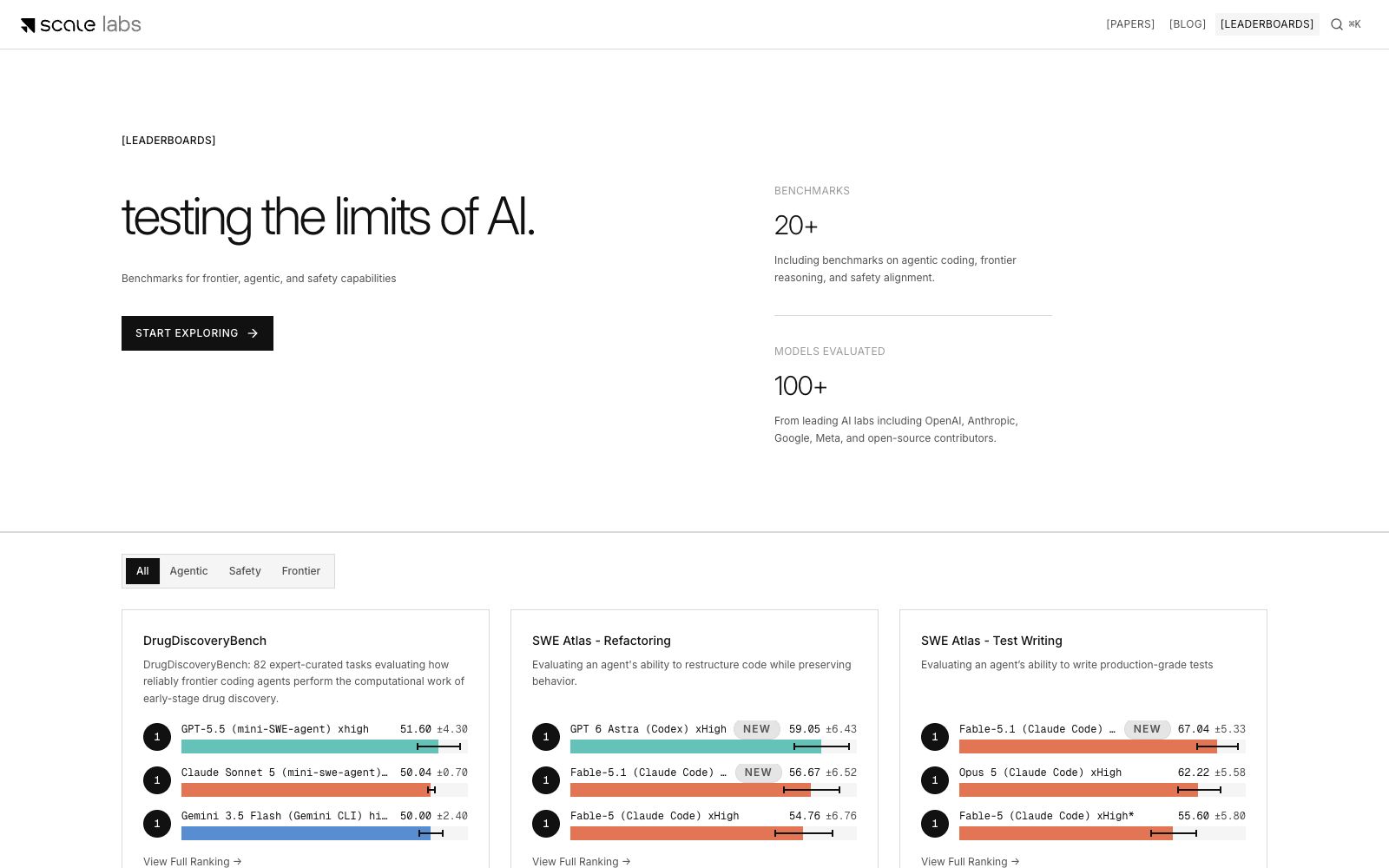
The expert-driven evaluation list produced by the labs under Scale AI covers more than 20 benchmarks and over 100 models including agent programming, cutting-edge reasoning and safety alignment. It can be browsed by capability tiers and is continuously updated.
Updated: 2026-10-26
What is SEAL LLM Leaderboard?
The SEAL LLM Leaderboard is a collection of AI model evaluation rankings launched by Scale Labs, a subsidiary of Scale AI, with the positioning of "testing the limits of AI". Unlike benchmarks that rely purely on automatic scoring, it emphasizes expert-driven evaluation: evaluation tasks are designed and annotated by domain experts, reducing the "score padding" problem that is common in automatic benchmarks. Currently, it includes more than 20 benchmarks and evaluates over 100 models, covering areas such as agent programming, cutting-edge reasoning and safety alignment. The models come from major labs like OpenAI, Anthropic, Google, Meta, as well as open-source contributors.
Who is it for?
- Technical teams and architects who need to select models for their own scenarios; engineers and analysts who need to cite authoritative benchmark data to support selection reports; and researchers who focus on the real capability boundaries of cutting-edge models. The rankings can be browsed by All / Agentic / Safety / Frontier tiers, allowing quick location of the capability dimensions of interest.
Key features
6Expert-driven question creation
Benchmark tasks are designed and annotated by domain experts. For example, DrugDiscoveryBench includes 82 expert-curated tasks that evaluate the reliability of cutting-edge coding agents in executing computational tasks for early-stage drug discovery.
Agentic Programming Evaluation
Covers real-world codebase-focused benchmarks such as SWE-Bench Pro (divided into public and private datasets) and SWE Atlas (refactoring, test writing, codebase Q&A), testing the practical implementation capabilities of coding agents.
Frontier Reasoning Benchmarks
Includes high-difficulty general reasoning tests such as Humanity's Last Exam to explore the boundary of model capabilities.
Professional Domain Benchmarks
It features professional reasoning benchmarks for finance and law, as well as vertical tasks such as drug discovery, which are close to the real needs of the industry.
Agentic and Safety Focus
Includes agent-related evaluations such as HiL-Bench (Human-in-the-Loop Benchmark), MCP Atlas, and SciPredict, as well as capability validation for the Safety alignment direction.
Audio Multimodality
AudioMultiChallenge covers audio multi-turn dialogue and audio output capabilities.
How to use SEAL LLM Leaderboard
- The leaderboard has many benchmarks and a large amount of data.
- It is recommended to first filter by the capability dimensions you care about (such as agent programming or professional reasoning), and then check the specific rankings.
- The same benchmark usually has two versions: public dataset and private dataset.
- The difference in scores between the two is also important information, which can reflect the generalization and robustness of the model.
- When it comes to specific model selection, use the leaderboard as a tool to narrow down the candidate range, and then conduct a small-scale verification combined with your own real tasks.
Things to know
Traffic & popularity
Data month Sep 2026
SEAL LLM Leaderboard receives about 33.4K visits per month.
Monthly visits
11 monthsTraffic sources
- Search42.5%
- Direct35.4%
- Referrals10.2%
- Social7.8%
- AI assistants3.0%
- Other1.1%
Top countries
- United States37.0%
- Vietnam5.9%
- India5.4%
- Indonesia4.8%
- United Kingdom3.9%
Estimated from third-party traffic data.
Similar tools
 Artificial AnalysisA benchmark platform for independently evaluating AI models and API service providers, conducting horizontal comparisons based on intelligence indices, output speeds and single-task costs, and covering multi-category rankings such as coding, speech, image and video, as well as comparisons with search service providers.
 ArenaA crowdsourced AI model arena where two models compete anonymously and users vote to determine the winner. Based on the results, public leaderboards for LLM, image, and code models are generated. It comes with built-in task templates such as landing pages, dashboards, and mini-games that can be directly tested in practice.
 LLM StatsAn independent ranking that converts the intelligence level, speed and price of over 300 AI models into a single comprehensive score. The data is continuously updated from public benchmarks and real API metrics, supporting multi-task dimension ranking.
 AGI-EvalAGI-Eval is a large model evaluation community that provides evaluation leaderboards, evaluation datasets, human-machine competitions and Data Studio, helping selectors understand the strengths and weaknesses of various models with transparent and authoritative scores.
 DifyDify is an open-source LLM application development platform for production-grade Agentic workflows. It enables the building of Agents, knowledge pipelines (RAG) and workflows on a unified canvas, and supports cloud, VPC or self-hosted deployment.
 KaggleA data science and AI community platform under Google, it integrates public datasets, cloud-based Notebooks, algorithm competitions, pre-trained models and free courses, provides free GPU/TPU resources, and covers the entire process from entry-level learning to cutting-edge benchmarks.