


Outset.ai
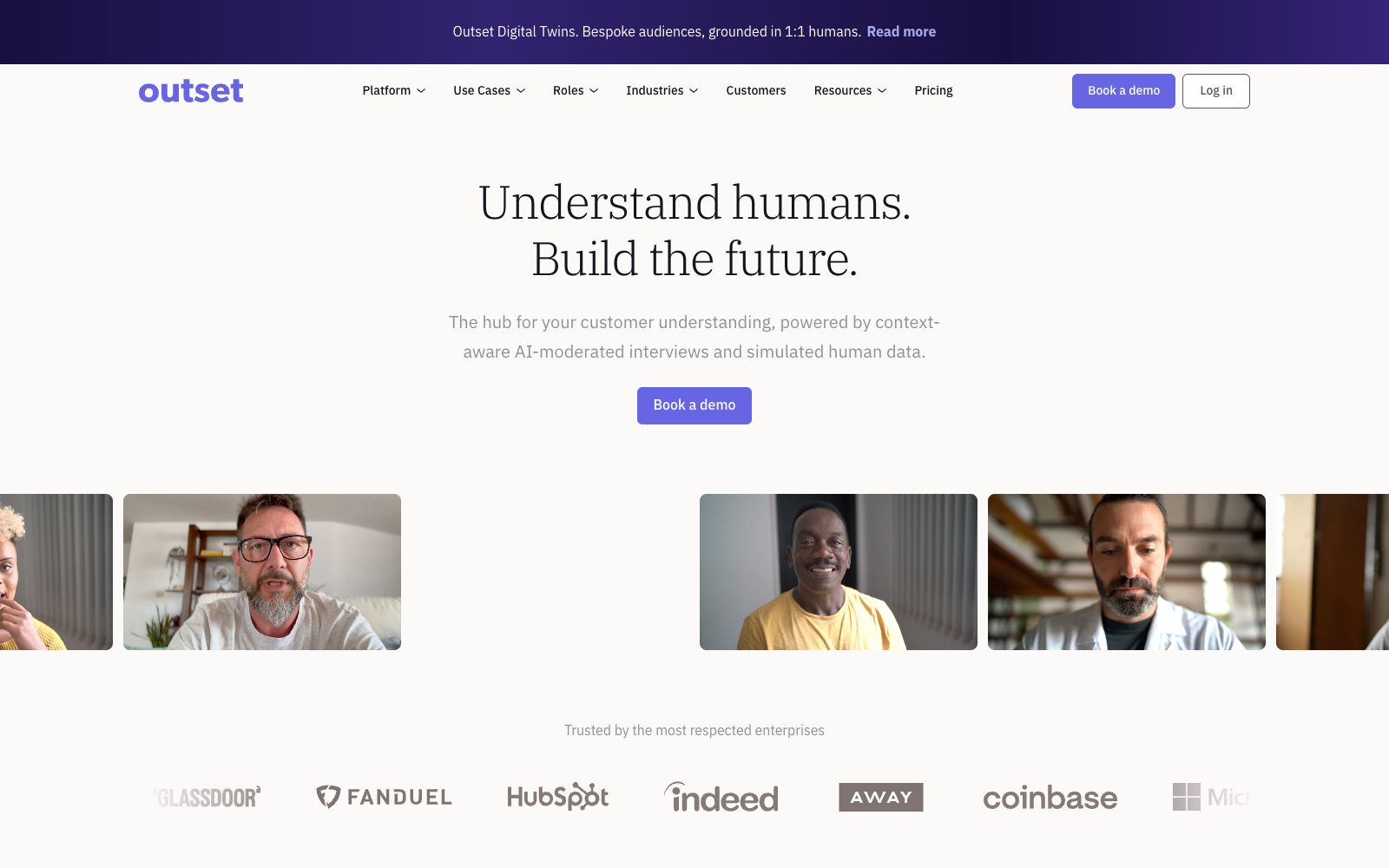
An AI interview platform for corporate research teams, with AI hosts conducting real-time follow-up questions based on responses. The official states that it can process thousands of interviews in parallel and summarize them instantly, covering market strategies, user profiles, and concept testing.
Updated: 2026-10-26
What is Outset.ai?
Outset is an AI-hosted interview research platform that officially aims to capture the depth of in-depth interviews with the speed and scale of questionnaires. What it replaces is not the interviews themselves, but the repetitive recruitment, questioning, and sorting work between interviews: an AI host asks follow-up questions in real time based on the interviewee's answers, and then synthesizes a large number of interviews into conclusions. Its positioning is a customer understanding hub within an enterprise, not just a voice questionnaire tool. Officially, it is positioned as a customer understanding hub, rather than merely an interview tool.
Who is it for?
- Corporate user research teams: Need to quickly validate concepts and information architecture.
- Brand and Marketing Departments: Conducting audience profiling and brand awareness research.
- Product teams: Test naming, packaging and price expressions before launch.
- Consulting and agency companies: Quickly collect consumers' original words in the early stage of projects.
- Growth teams: Validate the acceptance of pricing and subscription copy.
Key features
6Real-time Probing
The official claims that it does not rely on respondents' memories, but instead asks follow-up questions instantly based on what it hears and sees, reducing the discrepancy between what is said and what is actually done. The probing is based on the respondents' wording and emotions, rather than preset branches.
Large-scale Parallel Processing
The official states that it can handle thousands of interviews simultaneously and summarize them in real time, compressing qualitative research from weeks to a shorter timeframe; the scale of parallel processing is mainly limited by sample recruitment.
Real-time analysis during interviews
The official states that synthesis is conducted in real time during the interview process, eliminating the need to wait for the completion of all interviews for manual coding, and conclusions can be converged as the interviews progress.
Simulated Audience Data
The newly launched Digital Twins use simulated respondents to supplement real-person data, with the official emphasis still being on a foundation of one-on-one real individuals; simulated data is used to complement long-tail audiences.
Scenario Templates
The official lists research types such as market strategy, user profiling, brand research and concept testing, and provides ready-made structures based on questions; the templates come with outlines and analysis dimensions, and you can start using them by replacing with your own questions.
Enterprise-level Collaboration
The official states that the service targets respected corporate clients, and the page provides access to case studies and a booking portal for demos.
How to use Outset.ai
- Run a trial with a small sample first to check if the AI host's follow-up questions might lead the respondents astray.
- The interview outline should clearly list the mandatory questions.
- the AI's follow-up questions should be flexible but have a fallback.
- In terms of question order, open-ended questions should be placed first and sensitive questions last, and the outline should not be written like a questionnaire.
- Review the interim summary after each interview and adjust the outline in a timely manner, instead of reworking it after all interviews are completed.
- run the same outline for two different groups to clarify the source of differences.
- Simulated data is suitable for hypothesis generation, and key decisions should still be verified with real human samples, with the data sources clearly indicated in the report.
- When dealing with personal information and cross-border data, first confirm informed consent and compliance.
- for the functions and quotes of the enterprise version, you need to book a demo, and it shall be subject to the official description.
Traffic & popularity
Data month Sep 2026
Outset.ai receives about 145.3K visits per month and ranks #322,133 worldwide.
Monthly visits
12 monthsTraffic sources
- Referrals59.3%
- Direct28.5%
- Social5.2%
- Search5.1%
- Mail0.7%
- Other1.2%
Top countries
- United States77.8%
- United Kingdom4.9%
- Canada3.1%
- India1.7%
- Germany1.6%
Estimated from third-party traffic data.
Similar tools
 TroolyAn AI-led in-depth interview research platform that uses multimodal voice agents to complete recruitment, interviews and quality control. The official claims it is about 12 times faster than traditional institutions and costs 60% less, with respondents covering 25 countries.
 NovixAn AI collaborative scientist for researchers, officially said to support from formulating research hypotheses all the way to experimental verification, covering literature sorting, experimental design, data analysis and visualization.
 MiroMindPositioned as a general-purpose AI research platform, the open-source MiroThinker series focuses on long-chain reasoning. The official claims that it has achieved an average score of 60.2% on the GAIA benchmark, outperforming open-source models.
 WisPaperAI academic search tool, officially said to help researchers find relevant literature faster through deep retrieval, track trends by research direction and subscribe to personalized paper Feeds, reducing repeated trial and error in keywords.
 CuspAIA UK research company that uses AI to accelerate the discovery of new materials, registered in Cambridge, focuses on semiconductors, energy and climate. It partners with laboratories and industrial counterparts for collaboration through application.
 OpenLens AIAn fully automatic multimodal scientific research agent for health informatics research. Upon inputting a research question, it can automatically complete literature review, data analysis, experimental design and code execution, and generate LaTeX-format PDF papers through multi-agent collaboration.