


Zread
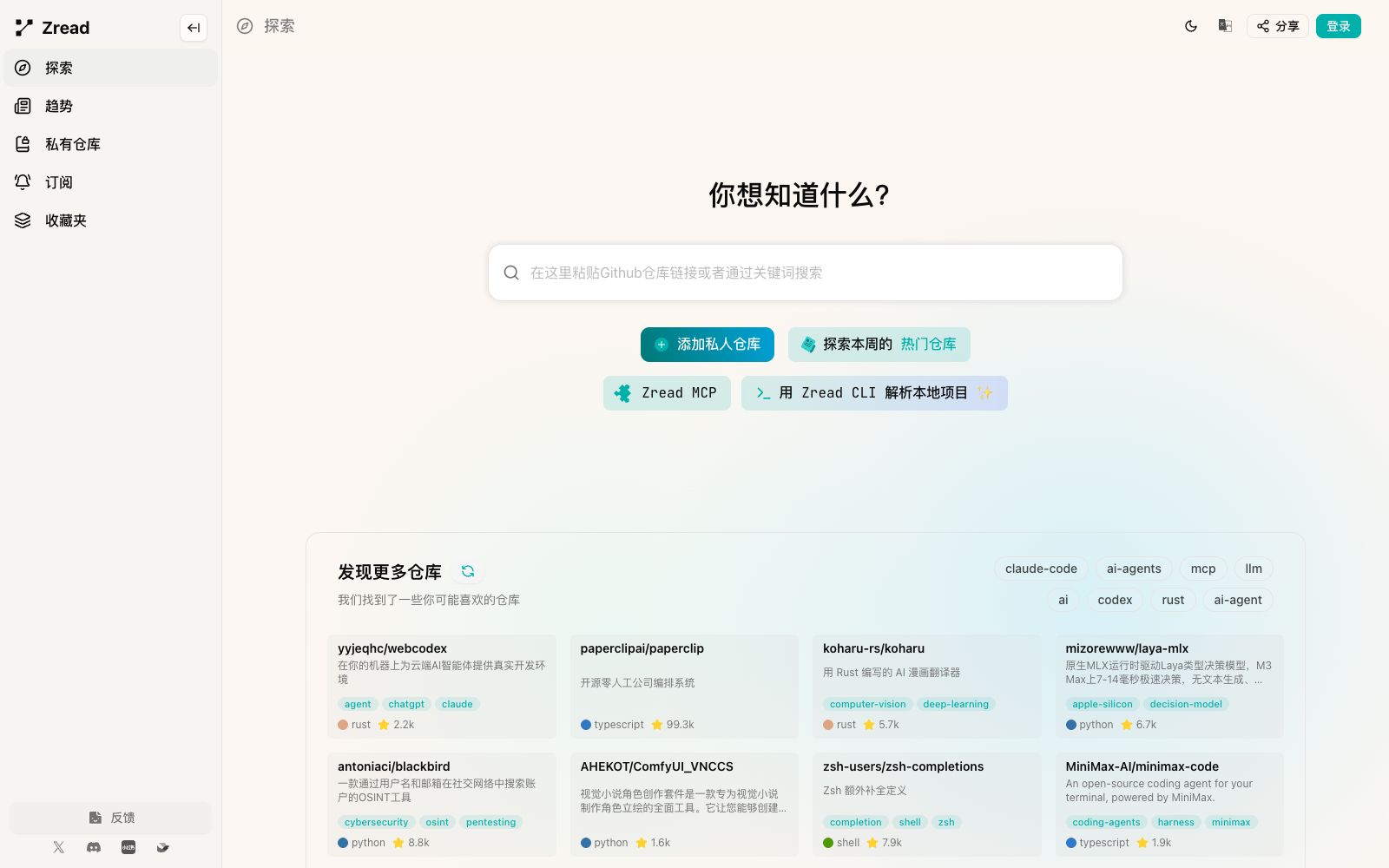
An AI document and code reading tool for code repositories, which automatically generates structured technical encyclopedias with chapter systems for open-source projects, is equipped with a source code-fact-based Q&A entry, and supports private repositories, command-line local projects, and MCP integration.
Updated: 2026-10-26
What is Zread?
Zread is an AI code encyclopedia that turns code repositories into readable documents. Its official website describes it as a code wiki with multi-language guides, architectural insights and community popularity, allowing people to quickly dive into any open-source project. Unlike making people go through the source code from scratch, it first provides a structured overview and module breakdown, then offers an entry point for questions based on the repository content, making it suitable for those who take over unfamiliar projects.
Who is it for?
- Newly recruited engineers who have just taken over a project written by others and need to clarify the module boundaries within a few days.
- Technical decision-makers who want to quickly evaluate whether an open-source library is worth introducing but don't have time to read through the source code.
- Team leaders who maintain internal code documentation and wish to automatically generate first drafts for subsequent manual polishing.
- Technical writers who want to provide Chinese technical materials of this project for Chinese readers.
Key features
8Repository and Technical Documentation Generation
Generates an overview, chaptered usage guides and localized implementation explanations for projects, and the official website states that it supports multi-language output.
Ask AI
Ask questions directly on the repository page, with prompts generated by AI that may contain errors.
Source Attribution
Each explanation is marked with the source file it is based on, making it easy to refer back to the actual code for verification.
Repository Structure
Provides a directory tree and module division, helping to build a holistic understanding faster than flipping through files directly.
Difficulty Grading
The repository page marks the entry level, making it easy to judge the onboarding cost.
Access Methods
The official website provides an entry for adding private repositories, a command-line tool for local projects, and MCP integration; there is also an option to add badges to the project homepage.
Discover & Trending
The official website provides a discovery portal and a leaderboard of popular repositories this week. You can start your search here and then compare similar projects.
Library & Subscription
The official website provides two entry points for the library and subscription, making it easy to keep the repositories you follow in your list for follow-up.
How to use Zread
- 1Treat automatically generated content only as an overview: When making actual design decisions, follow the source files marked on the page and go back to the code for verification.
- 2The Q&A entrance clearly indicates that errors may occur, so do not directly trust conclusions related to interface behavior and security.
- 3Before connecting a private repository, confirm your company's code confidentiality policy and do not push internal code to external services.
- 4Local projects can be processed using the command-line tool, which is suitable for scenarios where you do not want to expose the repository address.
- 5Before adding badges to an open-source project, check the maintainers' wishes and do not arbitrarily modify others' documentation files.
- 6The available languages and usage quotas may be subject to change; verify the official website before official use.
- 7First check the difficulty level and directory structure on the page before deciding whether to read its implementation explanation, which is much less labor-intensive than directly going through the source code.
Traffic & popularity
Data month Sep 2026
Zread receives about 52.5K visits per month and ranks #799,870 worldwide.
Monthly visits
12 monthsTraffic sources
- Direct78.3%
- Search8.7%
- Referrals7.8%
- Social4.3%
- AI assistants0.9%
Top countries
- China73.9%
- Singapore3.5%
- Hong Kong, China3.2%
- United States1.5%
- Brazil1.3%
Estimated from third-party traffic data.
Similar tools
 GitMCPReplace the domain name in any GitHub repository URL with gitmcp.io, and you will get a remote MCP service that allows AI assistants to directly read the documents and code in the repository.
 Code WikiA tool that automatically generates and continuously synchronizes documentation for codebases, which the official says allows for instant access to code insights, API references and architecture overviews, saving teams the cost of manually writing and maintaining documentation.
 GitingestTurn any Git repository into a plain text summary suitable for feeding to large models. Generate it by replacing URL keywords. It supports filtering rules, volume limits, and private repositories. It is open source and self-deployable.
 Codebuddy CodeThe terminal form of Tencent Cloud's official intelligent coding tool uses the command line to complete project understanding, code generation and refactoring, as well as test and document generation. The official states that code analysis is prioritized locally, making it suitable for daily development, code review and learning exploration.
 MacroscopeAn AI code review tool for R&D teams that checks the correctness, security, testing and regression risks of each change before merging, automatically generates PR descriptions and summarizes multi-repository changes, and also includes a cloud-based coding Agent.
 Maiya AIA one-stop AI collaborative development platform for product and R&D teams, officially covering four stages: requirement prototyping, professional documentation, code development, and testing and delivery. It offers AI prototyping, AI documentation writing, AI code writing, and AI automated testing.