


Gitingest
Turn any Git repository into a plain text summary suitable for feeding to large models. Generate it by replacing URL keywords. It supports filtering rules, volume limits, and private repositories. It is open source and self-deployable.
Updated: 2026-10-26
What is Gitingest?
Gitingest is a small and practical open-source tool. Its official website explains its usage in one sentence: replace "hub" with "ingest" in any GitHub URL to get a prompt-friendly plain text. "Turn any Git repository into a plain text summary suitable for feeding to large language models" — it solves the problem of "wanting the model to understand an entire codebase but not knowing how to feed it in". It converts the repository into a summary that LLMs can directly digest, eliminating manual copy-pasting and organization. The official emphasizes that it is useful for "feeding codebases to any LLM", whether it's Claude, GPT, or a local model, and the input format remains consistent.
Who is it for?
- Developers who want to hand over the entire codebase to AI for analysis, documentation writing or migration evaluation; AI users who want to quickly sort out the code context before asking questions; and scenarios where teams hope to process code locally and are unwilling to entrust the content of the repository to external services. For teams that need to regularly provide code context to AI, it is equivalent to a zero-cost context pipeline.
Key features
5One-click Conversion
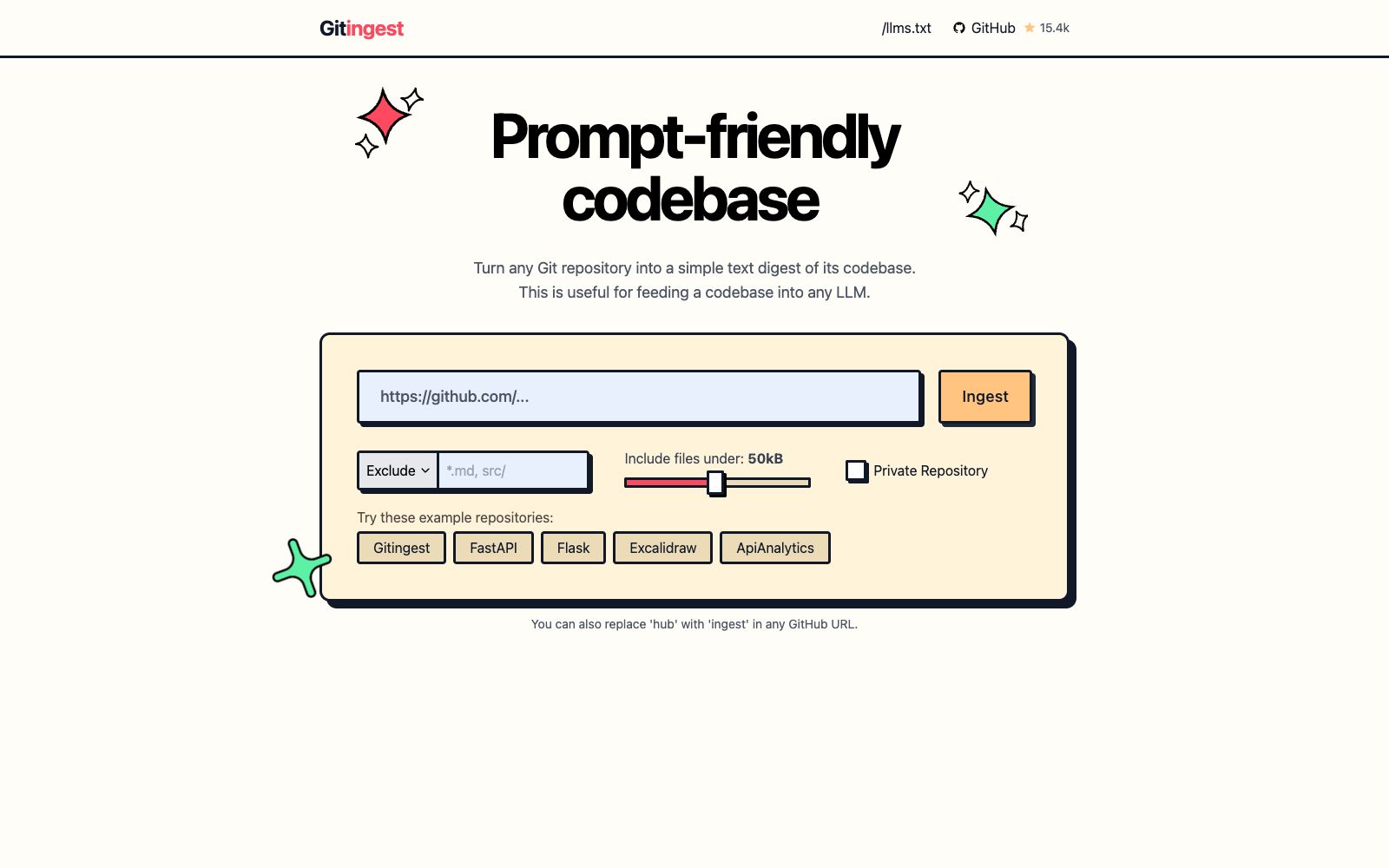
No installation required; generate a codebase summary by simply modifying a URL. You can also paste the repository address directly on the official website to perform the operation. The official also provides sample repositories such as FastAPI, Flask, and Excalidraw for trial runs.
Three-part output
The output includes a warehouse summary (Summary), a directory structure (Directory Structure), and file content (Files Content). First, let the model establish a global understanding, then provide details, which follows a reasonable order for large models to understand code.
On-demand filtering
Supports Exclude/Include rules, and can also limit inclusion to files smaller than a specified size (e.g., 50kB) to prevent dependencies and build artifacts from cluttering the context window.
Private Repository Support
The official provides an entry point for processing Private Repositories, and private code can also be converted and used.
Open-source and self-deployable
The project itself is open-source and can be self-deployed, keeping your code in your own hands, so sensitive projects do not need to go through third-party services.
How to use Gitingest
- First, run the official example repository to confirm the three-part output structure meets expectations.
- when working on real projects, configure exclusion rules (such as dependency directories, build artifacts, etc.) first before generating.
- when using summaries as conversation context, try to provide them together with specific questions, which is more focused than pasting the entire package.
- For continuously iterated projects, turn summary generation into a script to rerun regularly, ensuring the model always answers questions based on the latest code.
Things to know
Traffic & popularity
Data month Sep 2026
Gitingest receives about 37.1K visits per month and ranks #1,168,348 worldwide.
Monthly visits
12 monthsTraffic sources
- Direct77.4%
- Search13.6%
- Referrals5.5%
- AI assistants2.4%
- Social1.1%
Top countries
- India40.0%
- United States36.6%
- Israel3.0%
- Indonesia3.0%
- Brazil2.8%
Estimated from third-party traffic data.
Similar tools
 RepomixAn open-source tool that packages the entire codebase into an AI-friendly format, supports local and remote repositories, can output XML, Markdown, JSON or plain text, and has built-in token counting, compression and security filtering.
 ContinueOpen-source AI code assistant project, focusing on integrating any model for custom completion and conversation; the team has been acquired by Cursor, and the open-source code repository is still freely available for self-deployment and modification.
 aiderAn AI pair programming tool that runs in the terminal, automatically maps codebases, supports over 100 languages and multi-model access, directly commits every change to Git, and is fully traceable throughout the process.
 ZreadAn AI document and code reading tool for code repositories, which automatically generates structured technical encyclopedias with chapter systems for open-source projects, is equipped with a source code-fact-based Q&A entry, and supports private repositories, command-line local projects, and MCP integration.