


OpenAI Codex
OpenAI's Capabilities for Code Scenarios and Entry to Development Documentation. Developers can create API Keys, install SDKs to make their first successful calls, and learn about agent construction and multimodal model selection from here.
Updated: 2026-10-26
What is OpenAI Codex?
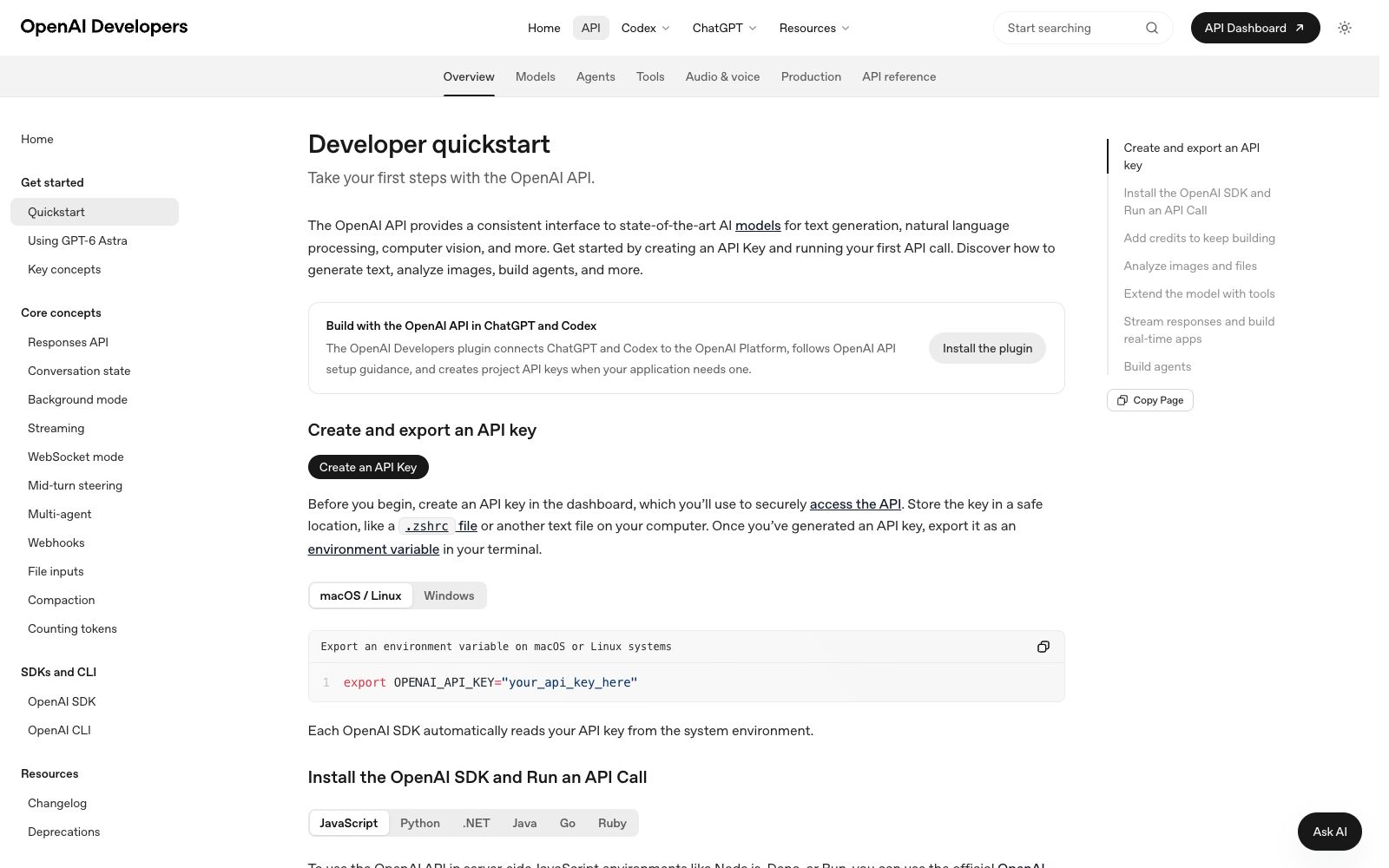
Codex is OpenAI's product line of coding agents for software development, and the link here points to the technical entry for developers: OpenAI Developer Quick Start Documentation. It explains how to create and export an API Key, install the SDK, make your first API call successfully, and outlines the complete path from model selection to agent construction. Officially, OpenAI API is described as providing a consistent interface for tasks such as text generation, natural language processing, and computer vision, serving as the starting point for developers to access OpenAI's coding capabilities.
Who is it for?
- Developers who want to integrate model capabilities into their code workflows themselves, technical decision-makers who want to understand which interfaces OpenAI offers in the fields of code and agents, as well as engineering teams that are preparing to build applications or internal tools based on the OpenAI API; it is also suitable for automation engineers who want to call model capabilities in scripts and CI processes.
Key features
5Get Started Quickly
From creating and exporting an API Key to installing the SDK and running your first request, all steps are provided, and you can complete your first call within minutes.
Model Selection Guide
The document differentiates between text and code, reasoning, image and video, real-time and audio, and specialized models, and provides instructions for prompts and reasoning usage to facilitate model selection based on tasks.
Agent Development
Provides Agents API, Agents SDK and ChatKit for building tool-augmented agents and expanding model capabilities into task-executable workflows.
Tools & Multimodality
Covers capabilities such as extending tools for models, streaming responses, building real-time applications, and image and file analysis; streaming responses are suitable for long text and real-time interaction scenarios, while image and file analysis enable models to process multimodal inputs.
Multi-language SDK and CLI
Supports integration with mainstream languages and provides command-line tools to meet the needs of different tech stacks and automation scenarios.
How to use OpenAI Codex
- Start with quickly getting a call up and running to understand the request and response structure, then select a model based on the task type: for daily code generation and completion, look at the text and code directions.
- for complex reasoning tasks, use reasoning models.
- for real-time interaction needs, check the real-time and audio directions.
- When building an agent, it is recommended to start with the Agents SDK.
- First, create a small agent with a single tool to verify the process, then expand it step by step.
- before team access, agree on the key management and quota allocation methods.
Things to know
Traffic & popularity
Data month Sep 2026
OpenAI Codex receives about 13.5M visits per month.
Monthly visits
12 monthsTraffic sources
- Direct54.2%
- AI assistants20.8%
- Search14.4%
- Referrals5.9%
- Social3.4%
- Other1.4%
Top countries
- United States23.2%
- India8.3%
- South Korea4.8%
- Brazil4.5%
- Italy4.1%
Estimated from third-party traffic data.
In these collections
Similar tools
 WindsurfThe original Windsurf AI editor has now been integrated into Cognition's Devin system. The official website directs to Devin Desktop, where multiple coding agents on local and cloud can be scheduled on a unified interface.
 SoraOpenAI's video generation model, according to the official website announcement, the web page and App have been discontinued as of April 26, 2026, and the API will be shut down on September 24, 2026. Users need to export their created content as soon as possible.
 GroqGroq's in-house LPU chip-powered inference cloud runs open-source models such as Llama and Mixtral with ultra-low latency. It has a low migration cost for OpenAI-compatible APIs, and the company claims it processes trillions of tokens per week.
 GitHub CopilotGitHub's official AI coding assistant spans editors, the terminal, desktop, and the GitHub website, supporting the full workflow from issues and code generation to PR review and merge, with multiple model and agent controls.
 PDF.aiA platform that supports PDF dialogue and provides PDF APIs, which can answer questions, generate summaries and find answers. It can also parse documents, extract data and split files in its own workflow. The official website provides online tools and interface documents.
 CursorAI-native coding agent that plans and executes multi-step changes in parallel, with multi-model support and cross-repo context. Available as desktop app and CLI.