


LM Studio
A desktop local AI application, now positioned as a Bionic agent for writing and programming, supports local model operation, document and code generation, and real-time speech transcription. The official states that cloud-based inference features zero data retention within the United States.
Updated: 2026-10-26
What is LM Studio?
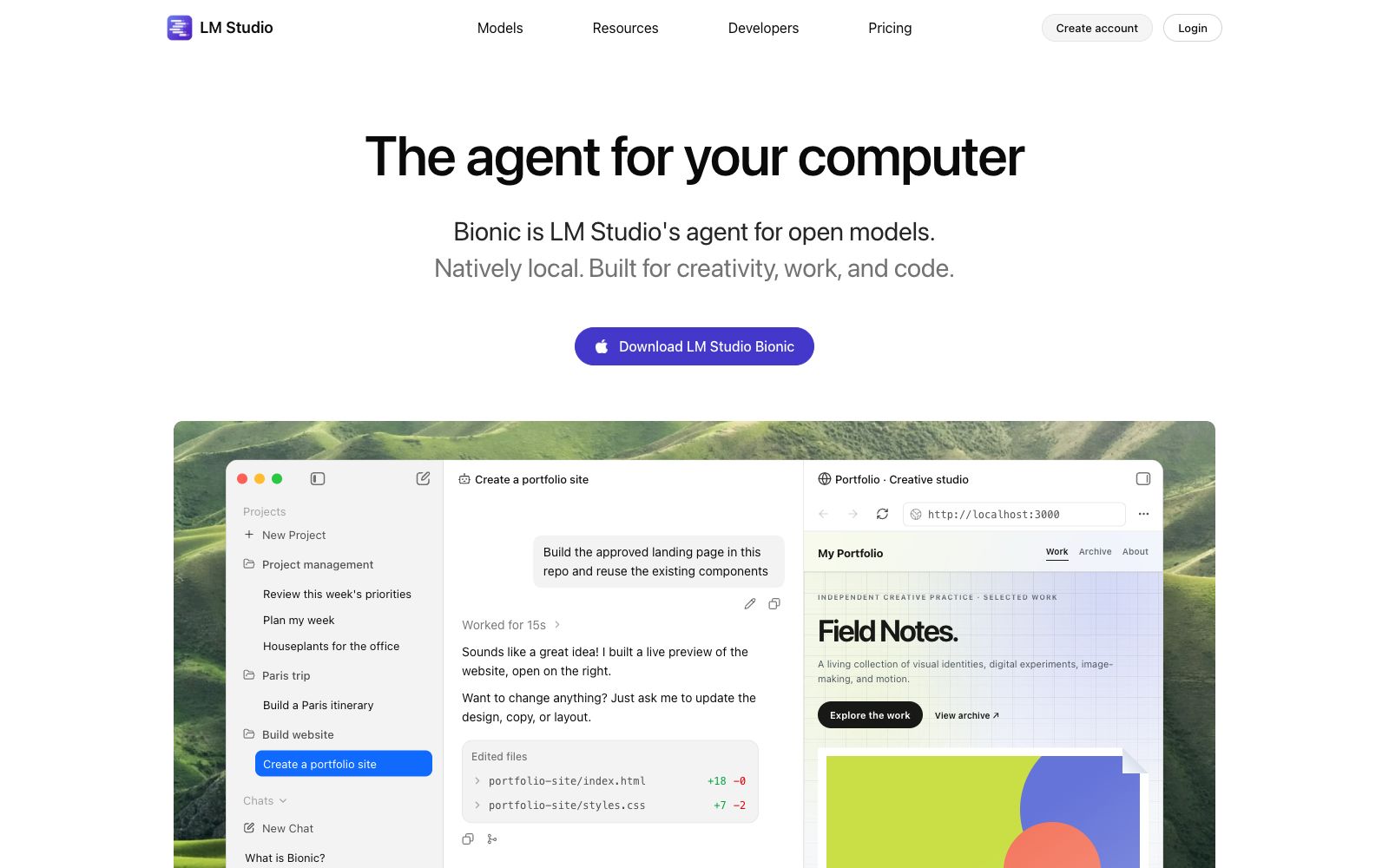
LM Studio is a desktop local AI application. The current title of its official website is "LM Studio Bionic - Agent for Work and Code", and theflagship Bionic is its intelligent agent for work and code. Its core focus has always been on running models locally; the official website states "Natively local", emphasizing that privacy is a core concept of LM Studio, and all its cloud services adopt Zero Data Retention (ZDR).
Who is it for?
- Developers and researchers who need to work with locally sensitive materials and are unwilling to send their code and documents to external parties.
- Office workers who need to write documents, create slideshows and generate PDFs can use it to complete routine outputs.
- Users who prefer to choose their own models can switch between local and cloud models within the app.
- Developers conducting local inference experiments use the official SDKs and CLI to use LM Studio as an inference backend.
Key features
6Document and Content Creation
Bionic can create and edit documents. The official website states that every change is automatically saved, allowing you to let it make revisions without worry.
Coding and Automation
Officially, Bionic is equally proficient in coding tasks, automation, and computer control.
Real-time Speech-to-Text
Speak and get real-time transcription. The official website clearly states that voice and audio data are processed locally and do not leave the device, and it supports multiple languages.
Local Model Execution
You can directly download the latest local LLMs within the app for simple chats or advanced agent tasks; officially, it is powered by the LM Studio runtime, with MLX and llama.cpp as the underlying technologies.
Cutting-edge open-source models
The official website specifies that it can run cutting-edge open-source models such as GLM 5.2, Kimi K3, and DeepSeek V4 Pro.
Developer Entry Point
The official team provides lmstudio-js, lmstudio-python, LM Studio CLI (lms), and llms.txt.
How to use LM Studio
- Official Pricing: The Free tier costs $0, supporting Bionic Agent, local models and offline speech-to-text, with LM Link for up to 5 devices and limited web search.
- Bionic+ costs $20/month, including open-source models within the US, discounted tokens, web search and page extraction.
- Pro costs $100/month with a usage cap 5 times higher, plus early access to new features.
- The official website clearly reminds: Although web search features Zero Data Retention, querying and processing data from the network itself carries inherent privacy and security risks.
- Do not include sensitive information in your search queries, and treat the retrieved web content as untrusted input.
- Cloud inference is hosted within the United States.
- if your team has data residency requirements, please confirm this point before making a selection.
- The memory usage (VRAM and RAM) of local models varies.
- If a model fails to run, switch to a smaller one first.
- in privacy mode, also pay attention to the storage locations of local files and logs.
Traffic & popularity
Data month Sep 2026
LM Studio receives about 4.4M visits per month and ranks #13,534 worldwide.
Monthly visits
12 monthsTraffic sources
- Search55.5%
- Direct26.3%
- Referrals8.4%
- AI assistants4.6%
- Social3.3%
- Other1.8%
Top countries
- United States19.0%
- China7.2%
- India6.1%
- Russia5.7%
- Germany4.8%
Estimated from third-party traffic data.
Similar tools
 AntigmaAntigma is a terminal coding agent and agent runtime: a single command to install a single-file program, switch between cloud or local models in a session, built with Rust and with no external runtime dependencies.
 Jan.aiAn open-source local AI chat client, which the official says can run open-source models locally and also connect to cloud models, supports multi-model switching and memory, is developed by Menlo Research, and is free and open-source on the desktop version.
 SigmaA privacy-focused AI browser, its official website states that it has built-in offline models running locally, keeping sensitive data on the device, and also offers capabilities such as web chat, in-depth research, image generation, and built-in ad blocking.
 MstyA private AI workbench for individuals and teams integrates private workspaces, restricted Agents, a unified model gateway, and controllable knowledge bases into a single system. It supports both local and cloud-based models, balancing efficiency and data control.
 InworldA real-time voice platform for consumer-grade applications that provides text-to-speech, speech recognition, and voice-to-voice models, and hosts open-source large models. The official claims that the audio delay for the first word can be as low as 50 milliseconds, making it suitable for voice companion, oral practice, and real-time dialogue products.
 tabnineAn enterprise-level AI code assistant focusing on code privacy and compliance, offering completion and agent capabilities. It can be deployed controllably in the enterprise's own environment through an enterprise context engine and has been acquired by Tricentis.