


Tiden
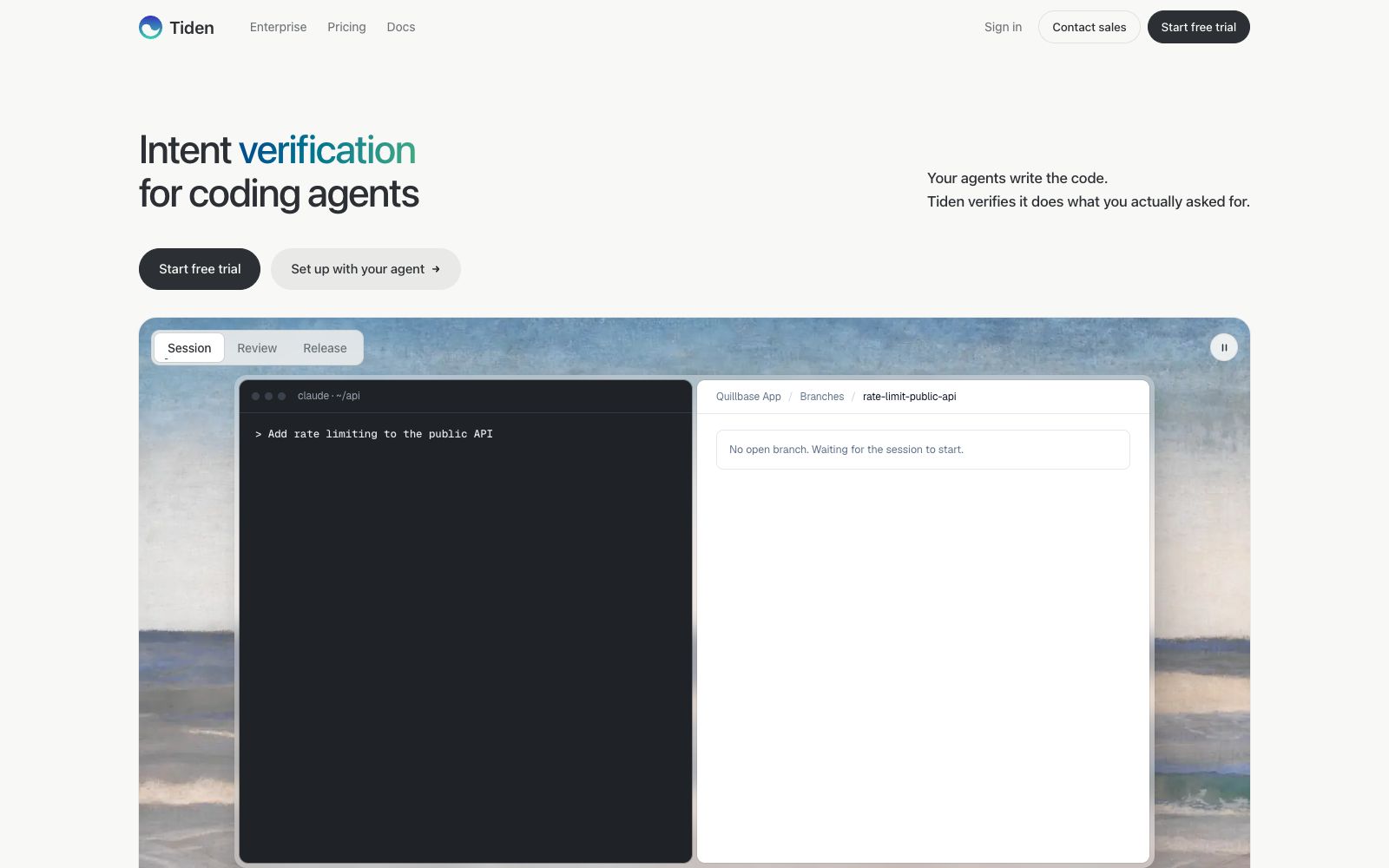
An intent verification platform for coding agents, officially said to capture requirements into versionable specifications and require each change to be proven by tests to prevent requirement deviations caused by agents' self-verification.
Updated: 2026-10-27
What is Tiden?
Tiden, developed by the Qase team, addresses the problem that while agents are getting faster at writing code, deliveries may not keep pace. The official website points out that requirements often disappear with the end of a session, and agents tend to generate tests using the code they just wrote. Even if all tests pass, the results may deviate from the real intent. Tiden captures the user's pre-session requirements as specifications and manages them by version, ensuring that every change must be verified by tests.
Who is it for?
- Teams that extensively use tools like Claude Code, Cursor, Copilot, and Codex for coding.
- Engineering leaders who need agents to produce deliverables that are verifiable and reviewable.
- R&D teams already using Git, GitLab, Jira, Linear, Notion or Azure DevOps.
- Engineering teams that want to formalize the "requirements-testing-release" pipeline into traceable specifications.
Key features
6Intent Capture
Record the commitment to be delivered at the start of a session, such as API rate-limiting behavior, to form a verifiable intent.
Specification Mapping
Reads the code and documents the specifications for each component of the product, marking which specifications have not yet been verified by tests, covering components such as Web, API, and billing.
Close the Access Gate
It checks the delta when a session is about to end, rejects the closure for unvalidated commitments, and requires the corresponding tests to be completed.
Specification Updates with Code
Tiden drafts specification updates with every merge, and synchronizes the requirement documents against changes even if the modifications were not made through Tiden.
Review View
For each branch, it simultaneously shows what was changed and what tests validate it; code reviews remain the responsibility of reviewers.
Release Ruling
Provide verification conclusions for each release by component, trace production errors back to the release, and prompt the agent to supplement missing tests.
How to use Tiden
- The official version states that it can be used in conjunction with Claude Code, Cursor, Copilot, Codex, and Gemini CLI.
- Before integration, select the corresponding installation method according to the existing toolchain.
- Before starting an agent session, use `tiden intent start` to clarify the requirements for this session first, making the commitment exist before the code.
- Treat "session closure" as a quality gate.
- for unqualified deltas, continue to supplement tests instead of letting the agent prove itself.
- Use the specification view to regularly check which components lack test coverage, and prioritize supplementing verification for high-risk business rules.
- Update specifications along with merges, and regard Tiden's drafts as part of the requirement review, not just looking at diffs.
Traffic & popularity
Data month Sep 2026
Tiden receives about 4.2K visits per month and ranks #3,507,689 worldwide.
Monthly visits
3 monthsTraffic sources
- Direct35.5%
- Search33.7%
- Referrals11.7%
- Social6.5%
- Display ads4.2%
- Other8.4%
Top countries
- India100.0%
Estimated from third-party traffic data.
Similar tools
 MacroscopeAn AI code review tool for R&D teams that checks the correctness, security, testing and regression risks of each change before merging, automatically generates PR descriptions and summarizes multi-repository changes, and also includes a cloud-based coding Agent.
 MySpecMySpec is a specification generation tool for coding agents: it first clarifies the scope, user flows and boundary conditions through structured interviews, then produces four specification documents for coding agents to follow, and supports export and interface integration.
 opcodeA desktop client built for Claude Code, officially described as managing Claude sessions through a graphical interface, creating custom Agents, tracking usage, and transforming command-line operations in the terminal into visual panels.
 CodeBuddyTencent Cloud has launched an AI full-process intelligent programming tool, which the official says is available in three forms: IDE, editor plug-ins and CLI. Based on conversational large models such as Hunyuan, it covers demand analysis, design draft to code conversion, code completion and one-click deployment.
 BugsterBugster is an AI testing agent platform. You can describe the process in natural language to generate and execute end-to-end tests in a real browser. It supports merge request triggering, multi-environment running and screen recording on failure, making it suitable for R&D teams that lack personnel to maintain scripts.
 PlayerZeroAn AI engineering collaboration platform for production environments, which builds an engineering world model using code, work orders and observability data, enabling agents in support, SRE, R&D and QA to collaborate on triage, locate faults and conduct pre-release simulation.