


Builder.io
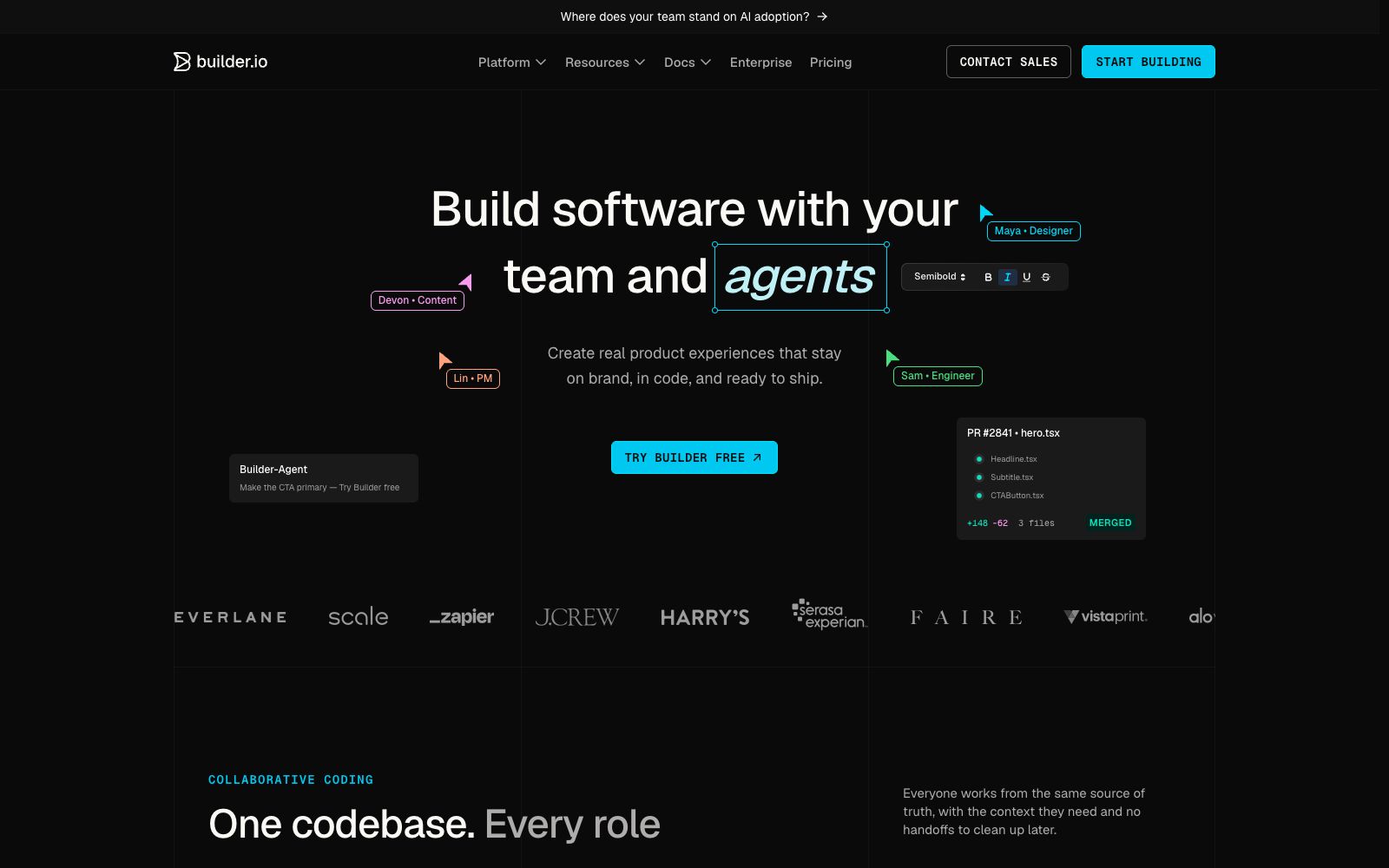
Builder.io is a collaborative AI building platform for product and R&D teams. According to the official statement, engineers, designers, PMs, and marketing personnel share the same code source. Revisions can ensure consistency between the brand and the code, reducing the loss of handover.
Updated: 2026-10-26
What is Builder.io?
Builder.io is a collaborative AI building platform for product teams. Officially, it allows engineers, designers, product managers, and marketers to share the same codebase. Instead of passing design drafts to developers for rework, it integrates visual editing directly into real components and design systems. Modifications can maintain brand consistency and code consistency, reduce losses caused by handovers across roles, and enable different functions to collaborate within the same real application.
Who is it for?
- R&D teams where engineers, designers, PMs, and marketing need to deliver on the same pipeline.
- The marketing side that needs to frequently update landing pages and event pages and cannot wait for the next iteration.
- Enterprises that already have a set of component libraries and design systems and hope that AI will not break the specifications.
- Teams that use frameworks like React, retain Git workflows, and want visual editing capabilities.
- R&D teams that need unified coverage of three scenarios: prototyping, application development, and marketing websites.
- Marketing collaborators in content and e-commerce operations who need to control the pace of page publishing themselves.
Key features
9Unified Code Source
Teams of all roles collaborate based on a single source of truth, reducing the communication and waiting costs associated with repeated handoffs.
Collaborative Coding
Code in Builder or your own AI tools, push branches, and others make fine-tuning in the real application.
Design Fidelity Restoration
Refine the interface in the real product where the design system is integrated, ensuring that details are not easily lost during delivery.
Visual Editor
A canvas that directly connects components and design tokens, with changes always production-ready.
Agentic CMS
Publish dynamic content using prompts, enabling the marketing team to update pages self-service.
MCP Integration
Extend through MCP connectors to integrate with the team's existing tools and service ecosystem.
Slack and Jira Triggers
Directly respond to customer feedback and stakeholder requests; no need to wait for the next iteration after review and approval.
Dual-product system
Two types of products are provided to cover multiple scenarios from ideation to production.
Compatible with Existing Tech Stack
The official states that it can integrate with the frameworks and workflows that the team is already using.
How to use Builder.io
- 1First connect the design system and components properly, then let AI generate within the constraints to avoid outputs that deviate from the specifications.
- 2Have designers and PMs edit copy and pixels in real branches, with regular reviews before merging.
- 3When connecting internal systems via MCP, pay attention to permission scopes to prevent the AI from performing unauthorized read and write operations.
- 4The official capabilities are continuously evolving; double-check the platform documentation and quotas before large-scale adoption.
- 5The company claims it can boost development productivity by about 20%, and it is recommended to verify the benefits using your team's actual iteration data.
Traffic & popularity
Data month Sep 2026
Builder.io receives about 202.7K visits per month and ranks #219,597 worldwide.
Monthly visits
12 monthsTraffic sources
- Direct38.9%
- Search37.0%
- Referrals9.2%
- Display ads6.7%
- Social4.8%
- Other3.4%
Top countries
- United States39.9%
- India9.7%
- United Kingdom3.5%
- Indonesia1.8%
- Canada1.7%
Estimated from third-party traffic data.
Similar tools
 Maiya AIA one-stop AI collaborative development platform for product and R&D teams, officially covering four stages: requirement prototyping, professional documentation, code development, and testing and delivery. It offers AI prototyping, AI documentation writing, AI code writing, and AI automated testing.
 Magic PatternsMagic Patterns is a design tool that directly turns requirements into high-fidelity interfaces. It can read your components and design specifications, compare multiple schemes side by side on an infinite canvas, and then hand the selected version to the coding agent, making it suitable for product teams to create functional prototypes.
 ClineOpen-source AI programming agent, officially said to adopt the Plan-then-Act mode to modify code across files and execute bash commands in editors and terminals, supporting MCP extensions and multi-Agent collaboration.
 CreatelyCreately is a business-oriented AI visual collaboration platform. It offers products such as workspaces, clinical relationship diagrams, process documents and compliance reviews. It can connect the existing tools of teams and carry out planning, analysis and collaboration on a shared intelligent canvas.
 Open DesignOpenDesign is an open-source, local-first vibe design workspace. Officially, it connects existing programming Agents into a design engine, generating prototypes, landing pages, kanbans, slideshows, and HTML videos directly from ideas.
 Forge CodeA team-oriented software factory, officially stated that once configured, it can trigger tasks by defects, Slack discussions or alerts, automatically complete building, testing, deployment and continuous monitoring, and recover from checkpoints after a crash.