


MySpec
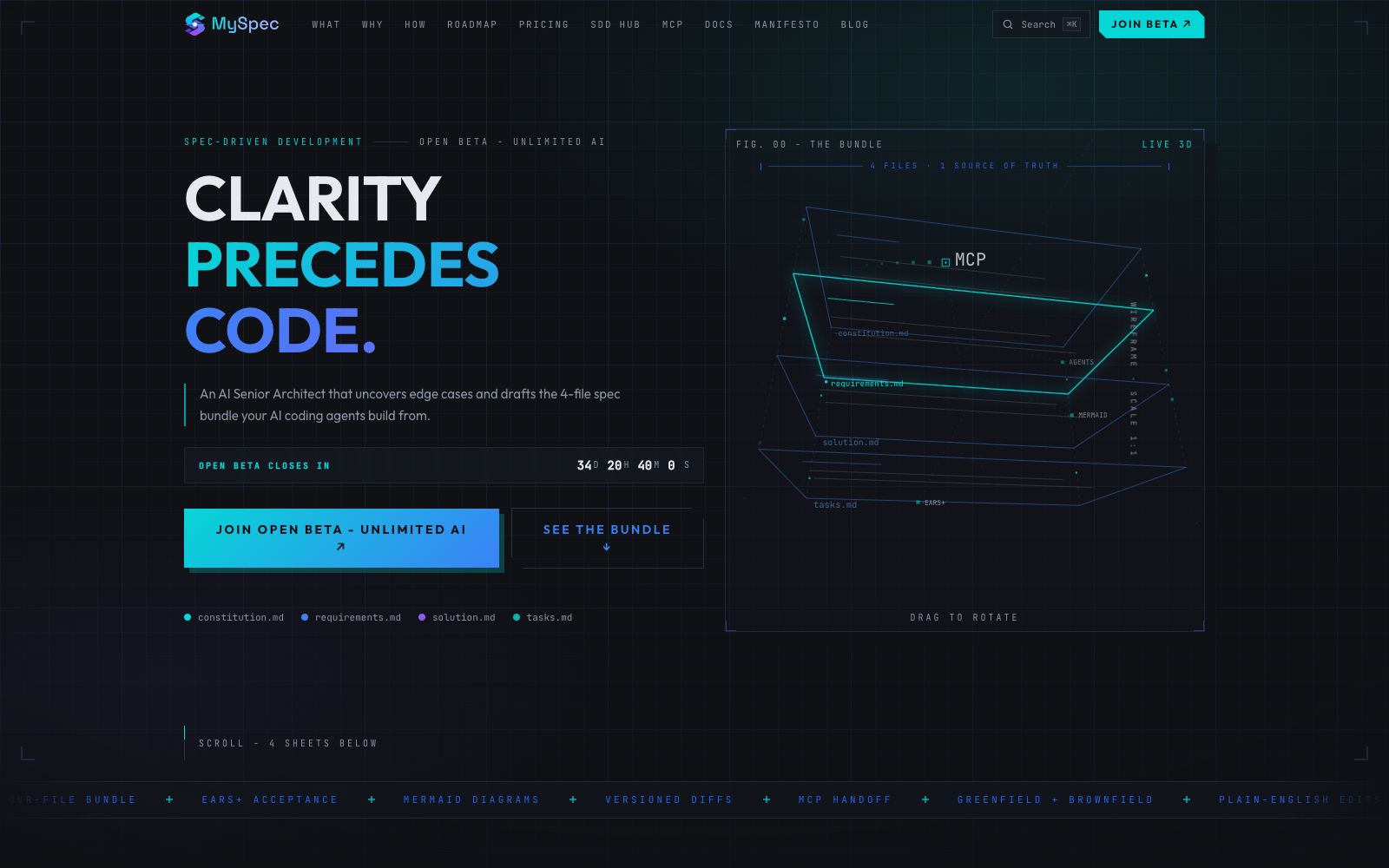
MySpec is a specification generation tool for coding agents: it first clarifies the scope, user flows and boundary conditions through structured interviews, then produces four specification documents for coding agents to follow, and supports export and interface integration.
Updated: 2026-10-27
What is MySpec?
MySpec's official website positions it as a specification-driven development tool, designed to add a layer of executable architectural description before writing code. It addresses common pain points in prompt-driven development: requirements are scattered across dozens of rounds of conversations, agents gradually lose sight of non-goals, invent interfaces out of thin air, or override existing architectures. The solution proposed on the official website is to first have an agent ask questions like a senior architect, then condense the conclusions into a fixed document, so that both humans and coding agents work around the same set of specifications.
Who is it for?
- Independent developers who frequently use AI agents to write code but often have to redo work due to ambiguous requirements.
- Engineering teams that need to solidify requirements, acceptance criteria, and architectural constraints before starting work on new features.
- Technical leaders who entrust product ideas to multiple coding agents and want consistent context.
- Small R&D organizations that need to establish a unified specification format and review process for their teams.
Key features
6Four-file Specification Package
The official website states that the deliverable consists of four files, corresponding to the reason for existence, what is to be built, how it operates, and the execution plan, which serve as a single source of truth.
Structured Interview
The official website states that users can paste a description, chat record, or voice recording, and the system will refine the question structure, then use 5 to 15 questions to clarify the scope, users, processes, and edge cases.
Acceptance and Visualization
The official website states that the specifications include acceptance criteria, edge cases, and diagrams, and emphasizes that each criterion is testable, facilitating subsequent review and traceability.
Handover for Agents
The official website states that the specification package can be downloaded and placed in the project directory for reading by commonly used coding agents; a server-based method is also provided for two-way access by hosted agents.
Incremental Modification Support
The official website states that the current open beta phase supports the stock project workflow, can generate proposals and requirement differences, and is compatible with the file formats of another set of specification workflows.
Collaboration & Quotas
The official website states that the free tier includes 20 projects and 100 specification files, while the team tier supports shared projects, roles, and centralized billing; these pricing rules will take effect in the official version.
How to use MySpec
- 1Start with a small and complete feature, compare the differences between specification-driven development and direct prompt engineering, and then migrate to core modules.
- 2In the interview phase, carefully answer non-goals and boundary conditions, as the value of the specification files mainly comes from these clearly defined constraints in advance.
- 3Add the specification package to version control and have the commit message reference the corresponding requirement ID to facilitate tracing back the source of the requirements.
- 4After the agent generates the code, it still needs to be verified against the acceptance criteria. The specification only reduces ambiguity and does not mean exemption from testing.
- 5The official website states that it is currently in the open beta phase, and the quotas and integration capabilities are subject to the real-time instructions within the product.
Traffic & popularity
Data month Sep 2026
MySpec receives about 15.7K visits per month and ranks #1,181,177 worldwide.
Monthly visits
12 monthsTraffic sources
- Direct30.4%
- Search28.4%
- Referrals12.7%
- Display ads8.3%
- Social6.8%
- Other13.4%
Top countries
- United States100.0%
Estimated from third-party traffic data.
In these collections
Similar tools
 KiroAmazon has launched an AI integrated development environment, with specification-driven as the main line: writing prompts into executable specifications, verifying the correctness of code, using parallel agents to work in large code bases, and its official positioning is to move from assisting in writing code to agent engineering.
 T3 CodeT3 Code is an open-source control plane for coding agents that schedules multiple mainstream coding agents in a single interface. According to its official website, it comes with built-in subscriptions, enabling one-click commit, push and PR creation, and is available on both desktop and mobile platforms.
 TidenAn intent verification platform for coding agents, officially said to capture requirements into versionable specifications and require each change to be proven by tests to prevent requirement deviations caused by agents' self-verification.
 aiXcoderThe enterprise-level AI R&D platform launched by Silicon Core Technology builds a product matrix with code agents, testing agents, code documentation and demand agents, supports private deployment and collaboration between large and small models, and is oriented to enterprise R&D scenarios such as finance and aerospace.
 ZencoderZencoder is an AI programming agent platform for developers. It aggregates multiple cutting-edge large models through a subscription, selects models for each task to perform planning, development and review, and supports parallel execution and quality gates.
 puppyonepuppyone is a folder for AI agents: Over 40 agents such as Claude Code, Codex, and Cursor can read from and write to the same folder simultaneously. All changes are committed to Git, allowing you to view diffs and roll back. It is free by default locally and can also be hosted in the cloud for permanent use.