


CuspAI
A UK research company that uses AI to accelerate the discovery of new materials, registered in Cambridge, focuses on semiconductors, energy and climate. It partners with laboratories and industrial counterparts for collaboration through application.
Updated: 2026-10-26
What is CuspAI?
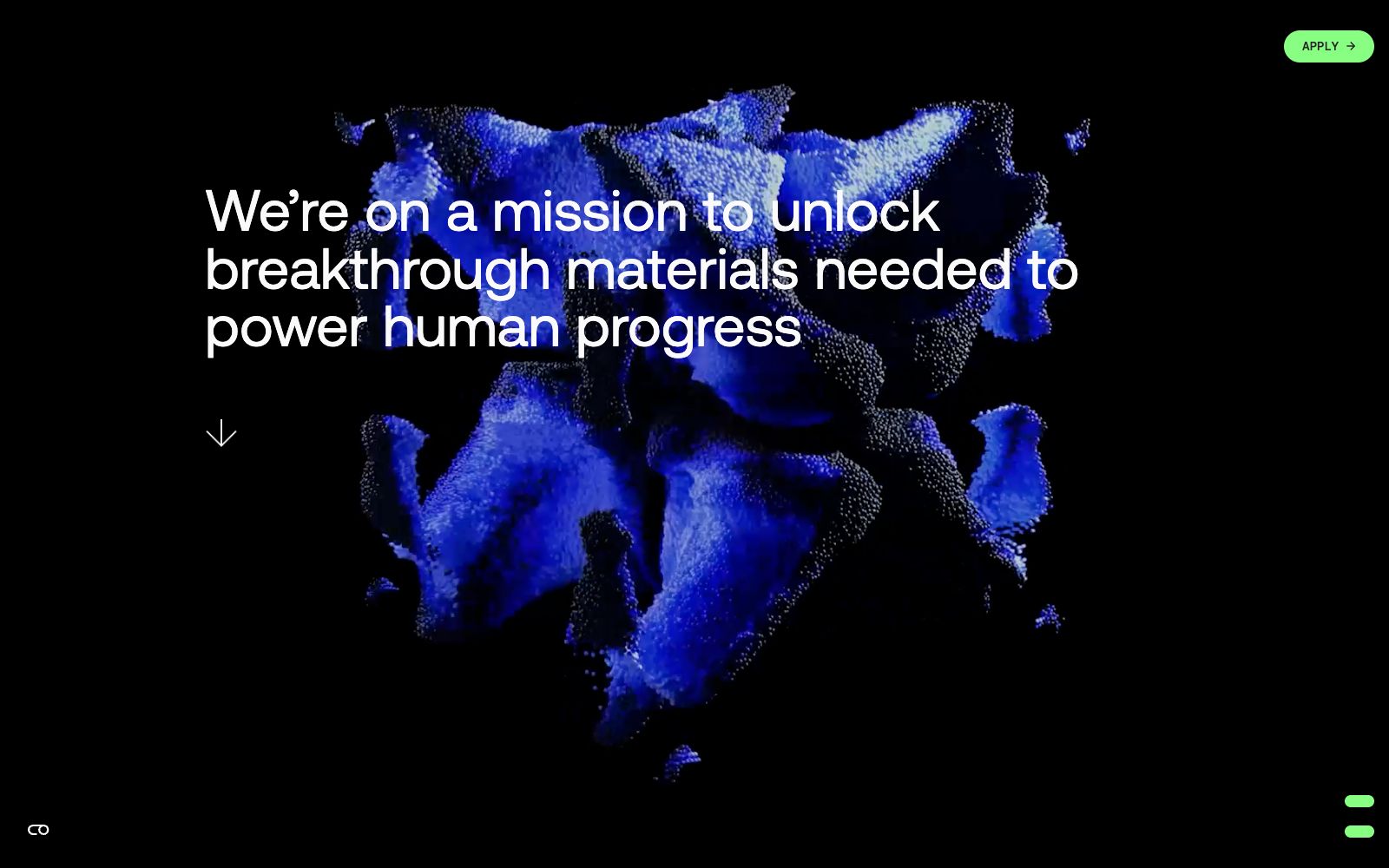
CuspAI is a research company that applies AI to material discovery, registered in Cambridge, UK. Its official mission is to unlock the key materials required for human progress, focusing on three areas: semiconductors, energy, and climate. It is not an online tool for individual users but takes AI Materials Foundry as its core, forming a network by uniting industrial partners, laboratories, and data collaborators, which is accessible through application and cooperation. It is more like a research collaboration portal rather than software that can be directly registered and used.
Who is it for?
- Researchers in materials, chemistry and device directions who need to conduct candidate screening in a large space.
- Enterprise R&D teams in fields such as semiconductors, batteries, and carbon capture seek external AI capabilities to supplement the screening process.
- Laboratories that possess experimental data and are seeking model-side collaboration partners.
- Investors and strategic researchers following the progress of AI for Science.
- R&D teams working on electrolytes and solid-state materials who need to narrow down the scope within the formulation space.
Key features
6Material Discovery
Use models to screen materials in a vast number of candidate structures that may meet the target properties, replace part of the trial-and-error experiments based on intuition, and first narrow the search scope to a verifiable scale.
AI Materials Foundry
Officially described as a global network composed of industry, laboratory and data partners, it connects computing power, data and experimental verification, rather than just providing a single calculation result.
Focus on Scenarios
The company explicitly targets semiconductors, energy and climate, which are typical high-value, long-cycle material challenges, and it is also more suitable for sharing costs through cooperation.
Cooperation Access
The platform has an application portal for coordination sessions with the Foundry. You need to submit requirements and schedule communication, and usually clarify the issues first before discussing cooperation.
Research and Updates
The official team discloses research progress and team information through blog posts, news, and career pages, allowing you to assess whether its methodologies are applicable to your research projects.
Data Compliance
A separate privacy statement is published on the official website, specifying what data is collected, how it is shared and retained, which enterprises can use as a reference for their internal requirements during evaluation.
How to use CuspAI
- First clarify the properties and constraints to be optimized.
- Ambiguous goals are the biggest pitfall in material discovery collaborations.
- even the most powerful models cannot screen out what you need.
- First clarify whether the success criteria are synthesizability, stability or cost controllability.
- the candidates screened out vary greatly for different goals, and these three factors often restrict each other.
- Prepare a verifiable data statement: what characterization data you have, the throughput, and the acceptable validation cycle length.
- After you submit the application through the official website's portal, a meeting will generally be arranged.
- Prepare your list of questions and confidentiality requirements in advance, and do not expect to finalize a cooperation plan during the first meeting.
- Confirm data and ownership of results with the legal team in advance.
- this is the most likely point of future disputes in collaborative research.
- As a research and collaboration-focused platform, its evaluation cycle usually takes quarters, making it unsuitable for individual users who expect to start using it immediately upon registration.
Traffic & popularity
Data month Sep 2026
CuspAI receives about 7.3K visits per month and ranks #4,222,899 worldwide.
Monthly visits
12 monthsTraffic sources
- Search50.0%
- Direct32.3%
- Referrals14.7%
- AI assistants1.7%
- Social1.3%
Top countries
- United States40.3%
- United Kingdom28.4%
- Germany12.8%
- Netherlands8.8%
- United Arab Emirates3.4%
Estimated from third-party traffic data.
Similar tools
 NovixAn AI collaborative scientist for researchers, officially said to support from formulating research hypotheses all the way to experimental verification, covering literature sorting, experimental design, data analysis and visualization.
 WisPaperAI academic search tool, officially said to help researchers find relevant literature faster through deep retrieval, track trends by research direction and subscribe to personalized paper Feeds, reducing repeated trial and error in keywords.
 TroolyAn AI-led in-depth interview research platform that uses multimodal voice agents to complete recruitment, interviews and quality control. The official claims it is about 12 times faster than traditional institutions and costs 60% less, with respondents covering 25 countries.
 OpenScienceAn open-source AI scientific research workbench, which the official says can read papers, write code and run experiments. It has built-in free models and also supports connecting to models from any manufacturer, and links to more than 40 scientific databases such as UniProt and PDB.
 MiroMindPositioned as a general-purpose AI research platform, the open-source MiroThinker series focuses on long-chain reasoning. The official claims that it has achieved an average score of 60.2% on the GAIA benchmark, outperforming open-source models.
 OpenLens AIAn fully automatic multimodal scientific research agent for health informatics research. Upon inputting a research question, it can automatically complete literature review, data analysis, experimental design and code execution, and generate LaTeX-format PDF papers through multi-agent collaboration.