


WisPaper
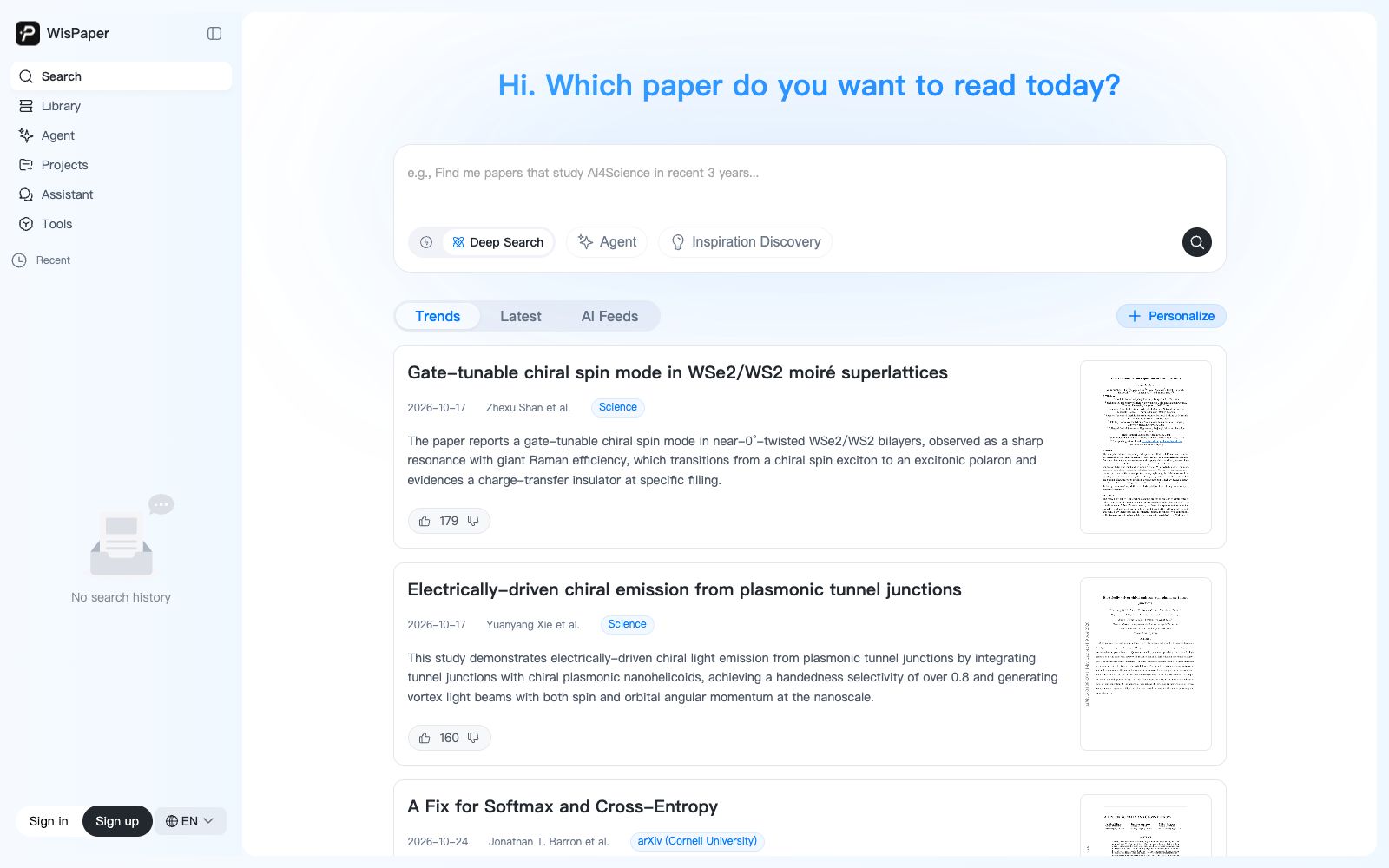
AI academic search tool, officially said to help researchers find relevant literature faster through deep retrieval, track trends by research direction and subscribe to personalized paper Feeds, reducing repeated trial and error in keywords.
Updated: 2026-10-26
What is WisPaper?
WisPaper is an AI academic search tool. The official focus is on three things: finding relevant literature faster, tracking research trends, and subscribing to personalized paper Feeds. It does not attempt to do your research for you; instead, it shortens the most time-consuming path from keywords to a batch of truly relevant papers. It is more suitable as the first stop in the research process rather than the end point.
Who is it for?
- Graduate students and doctoral candidates: They need to get a clear grasp of a research direction within a week when proposing a thesis topic or writing a literature review.
- University teachers and research groups: Keep an eye on field progress and review students' research topic selections.
- Corporate R&D and intelligence roles: Track public research on a certain technical direction.
- Interdisciplinary newcomers: Unfamiliar with the terminology system of new fields and in need of natural language retrieval.
- Researchers who need to regularly update their literature libraries: Rely on Feeds instead of relying on memory to browse.
- People writing grant applications and proposal reports: They need to clearly state in one page "where others have reached in this research direction".
Key features
6AI Academic Search
Describe research questions in natural language instead of keyword matching. The official states that this method can locate relevant literature and reduce the loss of important work caused by inconsistent terminology.
Deep Search
The official offers a Deep Search mode that conducts multiple rounds of retrieval and expansion for a single query, delivering a collection of theme-focused literature rather than individual matches.
Thematic Results
The official description states that it organizes results around research questions and groups papers on the same direction together, making it easy to assess how far this line of research has progressed.
Literature Discovery
Provides a discovery portal beyond retrieval, allowing users to browse research in the field by direction. It is suitable for the stage where you haven't formed a clear research question and just want to get an overview of what's being done in this area.
Trend Tracking
The official version states that it can track research trends, help users see where a certain field is heading in the near future, and is useful for writing review articles or determining research topics.
Personalized Feed
New papers are pushed based on your areas of interest, officially described as personalized AI Feeds, turning "regularly checking databases proactively" into passive reception.
How to use WisPaper
- First, describe your research question in one sentence.
- this makes it easier to get grouped results compared to listing lots of keywords.
- After getting the results, use precise terminology to supplement your search.
- You must read and verify the abstracts of the search results yourself.
- the tool is responsible for narrowing down the scope, but not for judging the quality.
- Create a fixed tracking list: Subscribe to one Feed for each core direction, which saves more time than aimless browsing.
- Treat the Feed as a radar rather than a reading list: For the pushed papers, first check the titles and abstracts, and only move the worthwhile ones into your reference management tool.
- Create a folder for the same topic and write down why you chose it, so you won't end up with just a pile of PDFs in three months.
- Before citing, return to the original text to verify the data and conclusions.
- the abstracts provided by AI may omit qualifying conditions.
- When downloading full texts, pay attention to the access authorization of publishers and do not use non-formal channels.
Traffic & popularity
Data month Sep 2026
WisPaper receives about 337.8K visits per month and ranks #118,747 worldwide.
Monthly visits
12 monthsTraffic sources
- Search47.6%
- Direct38.8%
- Referrals6.9%
- Social4.4%
- AI assistants1.8%
- Other0.5%
Top countries
- China60.1%
- United States8.3%
- Philippines3.9%
- Taiwan, China3.2%
- Australia2.3%
Estimated from third-party traffic data.
Similar tools
 OpenLens AIAn fully automatic multimodal scientific research agent for health informatics research. Upon inputting a research question, it can automatically complete literature review, data analysis, experimental design and code execution, and generate LaTeX-format PDF papers through multi-agent collaboration.
 NovixAn AI collaborative scientist for researchers, officially said to support from formulating research hypotheses all the way to experimental verification, covering literature sorting, experimental design, data analysis and visualization.
 CuspAIA UK research company that uses AI to accelerate the discovery of new materials, registered in Cambridge, focuses on semiconductors, energy and climate. It partners with laboratories and industrial counterparts for collaboration through application.
 Outset.aiAn AI interview platform for corporate research teams, with AI hosts conducting real-time follow-up questions based on responses. The official states that it can process thousands of interviews in parallel and summarize them instantly, covering market strategies, user profiles, and concept testing.
 MiroMindPositioned as a general-purpose AI research platform, the open-source MiroThinker series focuses on long-chain reasoning. The official claims that it has achieved an average score of 60.2% on the GAIA benchmark, outperforming open-source models.
 OpenScienceAn open-source AI scientific research workbench, which the official says can read papers, write code and run experiments. It has built-in free models and also supports connecting to models from any manufacturer, and links to more than 40 scientific databases such as UniProt and PDB.