

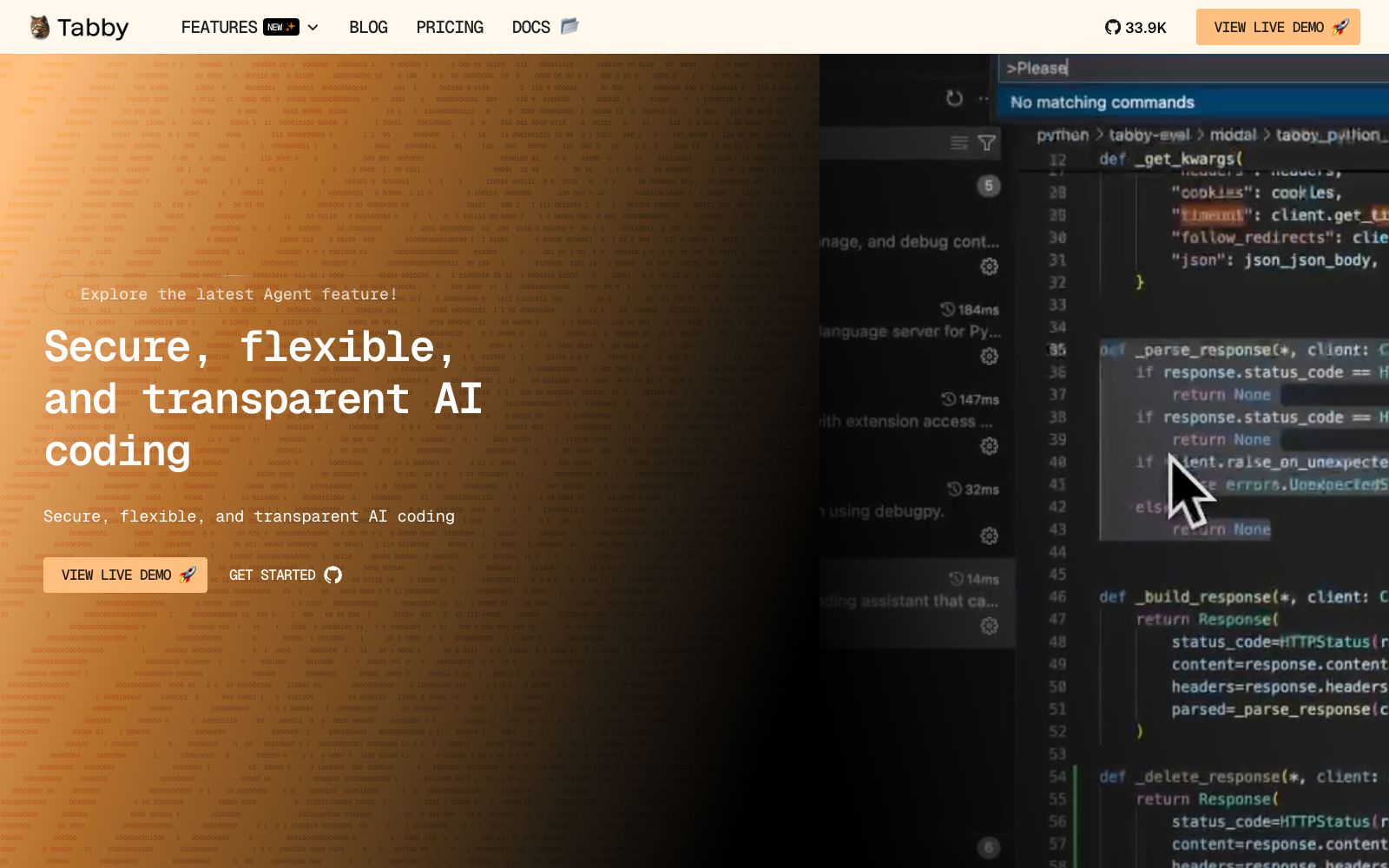

Tabby
Open-source self-hosted AI coding assistant offering code completion, a question-answering engine, and in-line chat. The official states it supports deployment on consumer-grade GPUs, requires no external databases or cloud services, and keeps data within your own environment.
Updated: 2026-10-26
What is Tabby?
Tabby is an open-source, self-hosted AI coding assistant developed by the TabbyML team. The official website title is "Open-source, self-hosted AI coding assistant", and it is positioned as a transparent, configurable, and self-controllable alternative to closed-source solutions. It takes code completion, question-and-answer engine, in-line chat and data connectors as its four core functions. The official states that it can be integrated with existing infrastructure, supports consumer-grade graphics cards, and does not require external databases or cloud services.
Who is it for?
- R&D teams whose companies prohibit sending code to external services and need to run the code completion service on an intranet.
- Small teams and individual developers who only have consumer-grade GPUs and want to run a self-contained code completion solution locally.
- Technical leaders who do not want to maintain an additional database and cloud dependencies in operations and hope for a lightweight deployment.
- People who want to study the implementation of coding assistants and need an open-source baseline that can be read and modified.
- Distributed teams that use cloud IDEs or remote development environments and want the code completion service to follow their environment.
Key features
6Code completion
Predicts the code you are about to write based on context, with the official emphasis on efficiency and intuitiveness.
Answer engine
Get answers to coding questions directly within the IDE without switching to other tabs.
Inline chat
Chat with AI in real time next to your code to modify it, which the official says can improve efficiency and reduce collaboration friction.
Data connectors
Connect to various data sources, giving auxiliary answers more basis within the project.
Flexible deployment
Can be deployed on cloud IDEs or locally; the official states that consumer-grade GPUs are supported.
Transparency & Security
The open-source nature ensures software supply chain security, and you have full control over the configuration and operation methods.
How to use Tabby
- First, start a minimal instance with Docker according to the official documentation, verify the completion latency and first-token latency using a consumer-grade GPU, and then decide whether to scale up.
- Before making a selection, confirm that the editor you are using is on the official support list to avoid finding that the plugin is incompatible after installation.
- When connecting internal documents or repositories for question answering, first limit the index scope, and do not feed libraries that should not be indexed together, especially those containing keys and user data.
- For team deployments, it is recommended to implement access control and audit logs.
- self-hosting is covered by an open-source license, and commercial terms are subject to the official website, which may be subject to change, so double-check before going live.
Traffic & popularity
Data month Sep 2026
Tabby receives about 134.9K visits per month and ranks #244,314 worldwide.
Monthly visits
12 monthsTraffic sources
- Search38.1%
- Direct36.8%
- Referrals11.5%
- Social7.0%
- Display ads1.9%
- Other4.6%
Top countries
- India14.7%
- United States13.7%
- Russia7.4%
- Indonesia4.7%
- Brazil4.5%
Estimated from third-party traffic data.
Similar tools
 Refact.aiOpen-source self-hostable AI coding agent that covers end-to-end task execution, in-IDE dialogue and real-time completion. Officially claims to support more than 25 programming languages and local deployment.
 KodusOpen-source self-hostable AI code review tool, officially claiming that you can use your own model keys with no markup, unlimited PRs, the ability to identify issues across files and enforce team-specific custom rules.
 Hermes AgentNous Research's open-source and self-hostable AI agent, officially available for free under the MIT license, supports persistent memory, automatic skill generation, multi-platform access, and isolated sandboxes. It can be downloaded for desktop or terminal installation.
 CrushA terminal AI coding tool by Charm, which connects your tools, code and workflows to the large model of your choice, and is officially available on macOS, Linux, Windows and BSD.
 AppFlowyFocused on a self-hosted open-source AI workspace, it integrates projects, Wikis, documents, and AI Q&A in one place. It supports local, cloud, and fully isolated environment deployments, allows the use of self-hosted large models, and the official states that the storage region can be specified by the user.
 MikoMiko is a self-hosted, open-source coding agent that connects to Slack, Linear, GitHub, and other channels to pick up assigned tasks. Every task runs in its own isolated Git worktree, keeping your code on your own machine.