


Vanna.ai
Open-source SQL agent framework that enables users without SQL knowledge to query various corporate business systems in natural language. It includes built-in user-level permission and quota management, ready-to-use UI components, and supports multiple databases and multi-turn conversations.
Updated: 2026-10-26
What is Vanna.ai?
Vanna has evolved from "building SQL generation with a RAG framework" to a complete SQL agent in version 2.0. Its official positioning is "Build Agents Your Users Can Actually Use", and it claims to be "The fastest SQL Agent". Its goal is simple: to enable users in an organization, regardless of their SQL proficiency, to query the company's various systems of record using natural language and shift their time from writing SQL to analyzing insights. The product manager is quoted as saying: "Talking to databases with AI is to empower all users in the organization to interact with databases through natural language, regardless of their SQL proficiency, and make data accessible to everyone."
Who is it for?
- Data teams that want business staff to access data independently; developers who need to build Text-to-SQL products for internal users or customers; and organizations that must choose between cloud services and self-hosting in compliance with requirements. For data teams, it turns the repetitive work of "receiving requirements, writing SQL, and delivering data" into simply maintaining good metadata and verification sets; for product teams, out-of-the-box UI components can significantly shorten the distance from prototyping to launch.
Key features
5Natural Language Database Querying
Users can interact with databases without writing SQL, covering the company's various business systems (systems of record) and lowering the threshold for data retrieval. At the framework level, users can freely choose LLM Providers and databases (Choose Your Stack).
User-scoped permission execution
The official emphasizes User-scoped execution, performing queries within the scope of individual users. This is a prerequisite for enabling open data access within an enterprise and prevents unauthorized data retrieval.
Multi-database and Multi-turn Dialogue
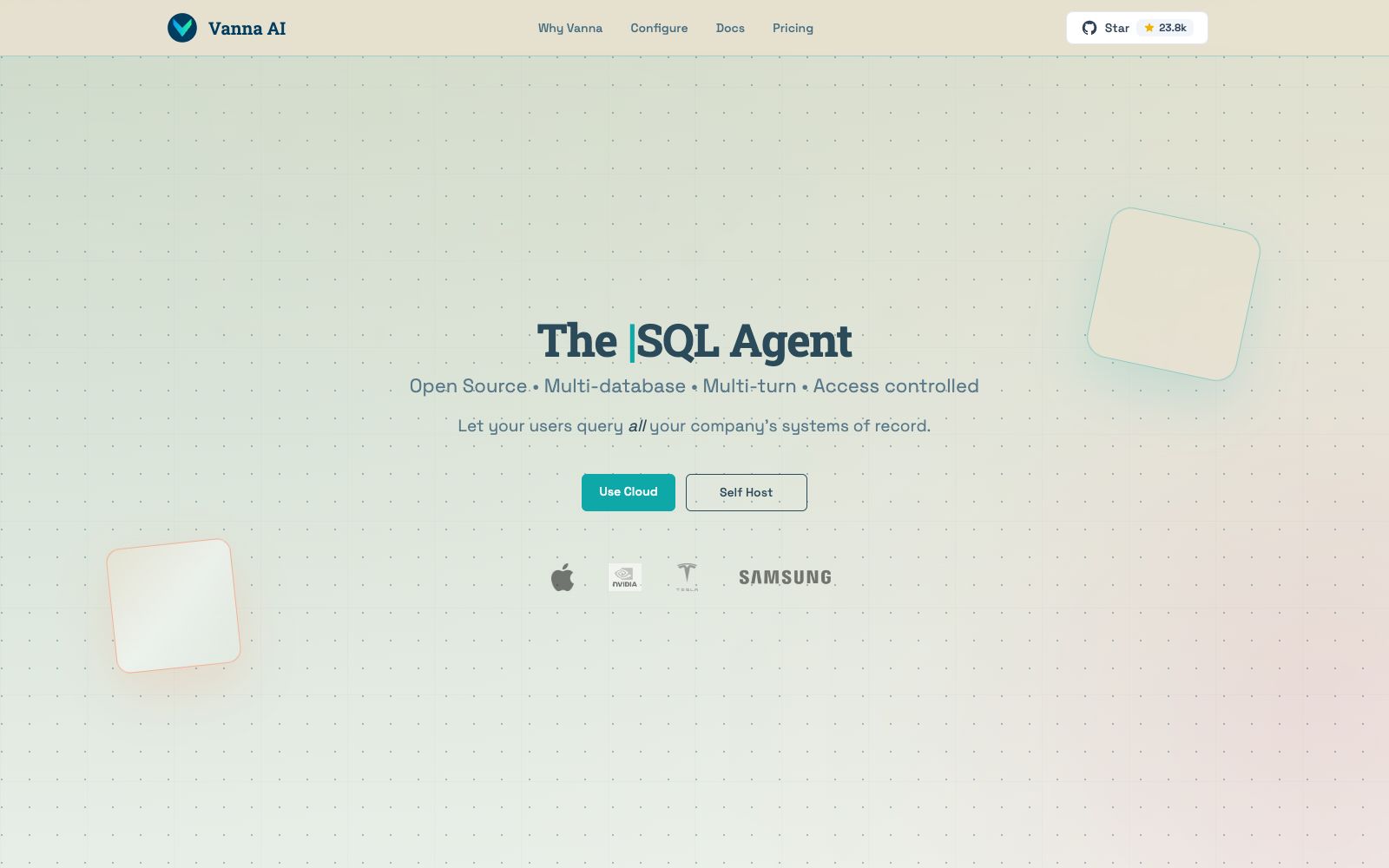
The official clearly lists four major features: Open Source, Multi-database, Multi-turn, and Access controlled. It supports multiple databases and follow-up-style multi-round interaction; before implementation, first confirm that the target database type is on the official support list.
Built-in UI Components and Quota Management
Provides ready-to-use interface components (rich UI components), eliminating the need to build the front end from scratch; built-in usage quota management to prevent a small number of users from exhausting resources and facilitate usage accounting by department.
Cloud and Self-Hosted
It offers two forms: Cloud and Self-Host. It is open source and supports self-deployment, allowing you to freely choose the tech stack between LLM Providers and databases.
How to use Vanna.ai
- The official value judgment is practical — the significance of using AI to query databases lies in shifting time from writing SQL to analyzing insights.
- During implementation, first define the core business database tables and high-frequency questions, establish a validation set to evaluate accuracy, then gradually open it to business parties.
- meanwhile, ensure permissions and quotas are in place before the function goes online.
- Within the team, first train a small group of "super users", consolidate high-frequency questions into a validation set, and then gradually expand to all employees.
Things to know
Traffic & popularity
Data month Sep 2026
Vanna.ai receives about 7.0K visits per month and ranks #3,315,240 worldwide.
Monthly visits
12 monthsTraffic sources
- Direct40.0%
- Search34.7%
- Referrals10.3%
- Social6.4%
- Mail2.8%
- Other5.8%
Top countries
- United States22.4%
- Brazil12.3%
- Turkey10.0%
- India8.3%
- Vietnam7.6%
Estimated from third-party traffic data.
Similar tools
 AI2sqlAn AI SQL assistant based on your real database table structure that generates, explains, fixes, and optimizes queries in natural language, and supports direct database connection for clients such as Claude, Cursor, and ChatGPT via MCP.
 Hermes AgentNous Research's open-source and self-hostable AI agent, officially available for free under the MIT license, supports persistent memory, automatic skill generation, multi-platform access, and isolated sandboxes. It can be downloaded for desktop or terminal installation.
 DifyDify is an open-source LLM application development platform for production-grade Agentic workflows. It enables the building of Agents, knowledge pipelines (RAG) and workflows on a unified canvas, and supports cloud, VPC or self-hosted deployment.
 ClineOpen-source AI programming agent, officially said to adopt the Plan-then-Act mode to modify code across files and execute bash commands in editors and terminals, supporting MCP extensions and multi-Agent collaboration.
 Chat2DBAn open-source database client that integrates natural language-to-SQL conversion, conversational data analysis and visual management into a single desktop tool. Queries are processed locally, and it supports both relational and non-relational databases.
 Wren AIOpen-source core generative BI agent that converts natural language to SQL using a semantic layer (MDL). The commercial and open-source versions run on the same context engine, supporting cloud, VPC and air-gapped deployment.