


Dograh
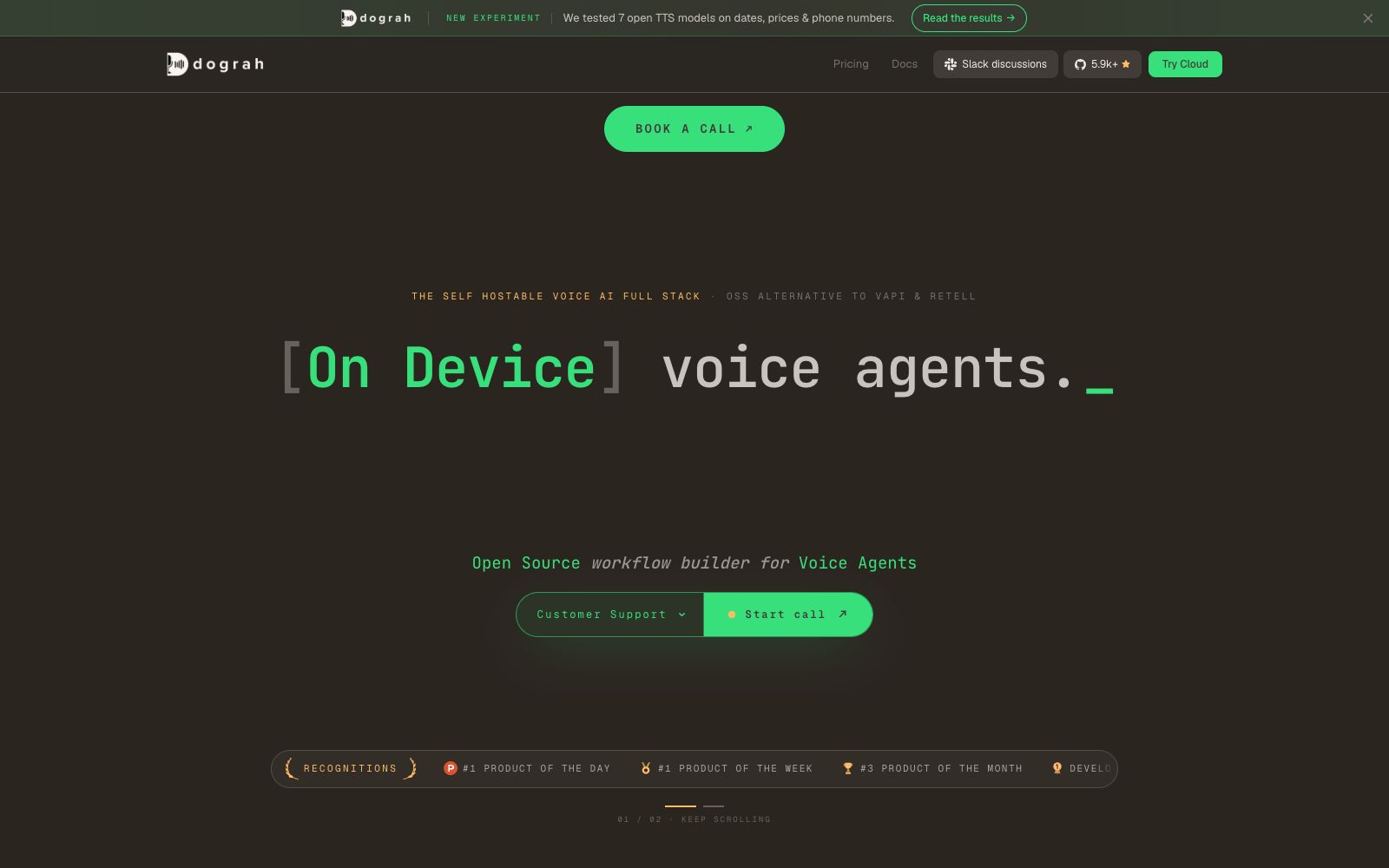
Dograh is a self-hostable open-source voice agent platform. According to its official website, it can carry its own models, be driven by MCP, deployed on your own servers or in the cloud, supports two link types: voice-to-voice and cascading, and covers voice automation scenarios for customer service, outbound notifications and regulated industries.
Updated: 2026-10-26
What is Dograh?
Dograh's official website refers to itself as "the open source Vapi alternative" and takes the form of a forkable voice agent workflow builder. Its difference from hosted voice platforms lies in data boundaries: the website places "your data never leaves" at the top, supporting deployment to local or private cloud VPCs, and models can also serve within the boundaries or even be completely isolated. Therefore, calls, recordings, transcriptions, prompts, and customer personal information are not leaked externally, eliminating the need to subject vendors to compliance audits.
Who is it for?
- Voice automation for regulated industries such as finance, healthcare, insurance, and government affairs
- Teams that have data residency requirements and originally cannot use hosted voice platform providers
- Developers for customer service and outbound calling scenarios (the official example is an EMI repayment reminder)
- Engineering teams looking to replace Vapi or Retell and break free from lock-in
- Cross-border businesses requiring regional language support and on-premises deployment
Key features
6Each component is replaceable
The inbound channel, STT, LLM, TTS, and telephone network are independent modules. The optional suppliers listed on the official website include Deepgram, AssemblyAI, ElevenLabs, Cartesia, Rime, Twilio, Telnyx, etc. You can also switch to voice-to-voice overall to skip the cascade.
Voice-to-Voice
Audio in, audio out, no transcription cascades or text round-trips. The official website states that this enables real turn handoffs, true interruption handling, and ultra-low latency, and it supports GPT Realtime 2 or Gemini 3.1 Flash Live.
MCP Driver Development
Built-in MCP server allows Claude Code, Cursor, Codex, etc. to directly create, modify and deploy complete voice agents in the IDE. Official website examples also include inserting CRM pull nodes before calls.
Pre-recorded Voice Mixing
Mix real pre-recorded human voices with TTS of the same cloned voice tone. The model prioritizes pre-recorded sentences and falls back to TTS only when unsuitable. The official website claims this doubles conversion rates and reduces costs by up to three times.
Self-hosted weights
You can run models such as Whisper, Voxtral, Canary Qwen, Kokoro, and Chatterbox in your own VPC. The official website states that STT and TTS are ready for production, while LLM replacement is still in beta.
Three deployment modes
Self-hosting (BSD 2-Clause license, just run `docker compose up`), official managed cloud, or official deployment and operation on your own VPC.
How to use Dograh
- 1Self-hosting is under the BSD 2-Clause license; you can get it up and running by cloning the repository and running `docker compose up`. The official cloud version offers a free trial on its website.
- 2First, get the pipeline up and running before switching models. The official website clearly states that LLM replacement is still in beta, so don't replace the "brain" with self-hosted models right away.
- 3Telephone networks and outbound calling involve recording and notification obligations. Confirm the local one-party or two-party consent rules and retention periods before launch.
- 4When generating agents via MCP in an IDE, separately audit the data scope, webhook authentication, and failure retries for nodes such as CRM data retrieval.
- 5Voice cloning and pre-recorded audio must be authorized by the individual; while data within your boundaries address the residency issue, the source of the materials still needs to be verified.
Traffic & popularity
Data month Sep 2026
Dograh receives about 15.4K visits per month and ranks #1,990,837 worldwide.
Monthly visits
12 monthsTraffic sources
- Direct48.8%
- Search25.9%
- Social11.7%
- Referrals11.2%
- Mail1.2%
- Other1.2%
Top countries
- India32.3%
- United States20.1%
- Pakistan4.1%
- Nigeria3.2%
- Brazil2.9%
Estimated from third-party traffic data.
In these collections
Similar tools
 DeepgramAn enterprise-oriented voice AI interface platform that provides speech-to-text, text-to-speech, and voice agent interfaces. According to its official website, it supports real-time or batch operation, as well as cloud-based or private deployment.
 AppFlowyFocused on a self-hosted open-source AI workspace, it integrates projects, Wikis, documents, and AI Q&A in one place. It supports local, cloud, and fully isolated environment deployments, allows the use of self-hosted large models, and the official states that the storage region can be specified by the user.
 ElevenLabsAI voice platform, offering ultra-realistic speech synthesis, voice cloning, cross-language dubbing for 5000+ voices and 70+ languages, as well as deployable voice agents, equipped with secure APIs and SDKs, targeting creators and developers.
 Hermes AgentNous Research's open-source and self-hostable AI agent, officially available for free under the MIT license, supports persistent memory, automatic skill generation, multi-platform access, and isolated sandboxes. It can be downloaded for desktop or terminal installation.
 InworldA real-time voice platform for consumer-grade applications that provides text-to-speech, speech recognition, and voice-to-voice models, and hosts open-source large models. The official claims that the audio delay for the first word can be as low as 50 milliseconds, making it suitable for voice companion, oral practice, and real-time dialogue products.
 KodusOpen-source self-hostable AI code review tool, officially claiming that you can use your own model keys with no markup, unlimited PRs, the ability to identify issues across files and enforce team-specific custom rules.