


MemoryRouter
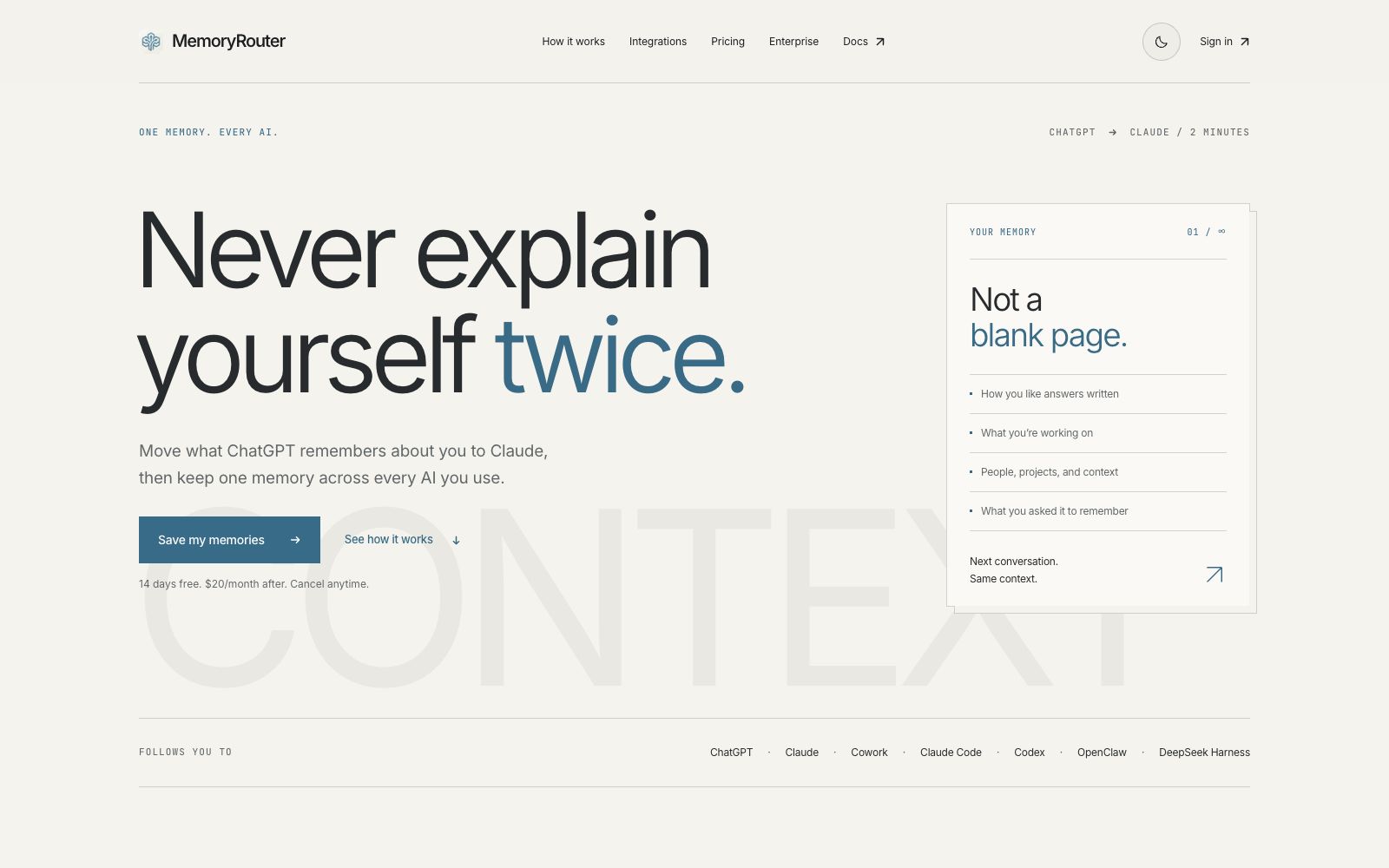
A persistent AI memory layer across ChatGPT, Claude, Codex and other tools, officially said to migrate ChatGPT memories, connect various AI tools via MCP, and make backgrounds and project contexts follow users at all times.
Updated: 2026-10-27
What is MemoryRouter?
The problem MemoryRouter solves is "having to start from scratch every time you switch AIs". It brings the preferences, projects, and background you've accumulated in ChatGPT to Claude, and further allows ChatGPT, Claude, Claude Code, Codex, OpenClaw, DeepSeek Harness, and any MCP client to share the same set of memories. The official statement is that memories belong to the user, not to a single vendor.
Who is it for?
- Professional users who use multiple AI assistants or coding tools simultaneously and do not want to repeatedly introduce their background.
- Users who are switching from ChatGPT to Claude or other models and want to retain their historical context.
- Enterprises that need to share company knowledge and control access permissions.
- Developers who want to add a persistent memory layer to their own applications or agents.
- **Hierarchical Import**: First complete a basic migration that takes about two minutes, then import the officially exported files as needed to recover key details from years of conversations.
Key features
6ChatGPT Memory Migration
Copy a prompt to ChatGPT, ask it to export your memory profile, review each item one by one and then save it; it also supports importing officially exported chat history to restore details.
Unified MCP Connector
Access multiple tools through a single address, trace project context in Claude Code, continue technical decisions in Codex, and maintain memory across compressions and restarts in OpenClaw.
CLI Management
Search, store and manage memories in the terminal and integrate them into your workflow.
Context Companion
Your writing preferences, current tasks, relevant people, and project status migrate with each conversation, eliminating the need to repeatedly paste background information.
Team Shared Memory
Provides corporate context and access control for enterprises, ensuring new members' AIs understand the company background from day one.
Developer Interface
Provides API, MCP server, CLI and framework guides for building persistent memory into your own products.
How to use MemoryRouter
- 1After the migration or import is complete, check each generated memory entry one by one, delete outdated or irrelevant content, and keep the context accurate for each tool.
- 2First, perform the basic migration: copy the official prompts to ChatGPT, review the generated memory profiles, and only keep the entries you wish to retain.
- 3For long-term projects, use official export and import to restore key details from old conversations, then confirm each item one by one.
- 4Add the MCP address to the settings of common tools and verify that each tool can read the same set of memories.
- 5Use the CLI to establish your own memory naming conventions for easier subsequent retrieval and cleanup.
Traffic & popularity
Data month Sep 2026
MemoryRouter receives about 278 visits per month and ranks #46,841,248 worldwide.
Monthly visits
4 monthsTraffic sources
- Direct37.9%
- Search31.2%
- Referrals12.1%
- Social7.1%
- Display ads3.8%
- Other7.9%
Top countries
- Germany52.4%
- Indonesia47.6%
Estimated from third-party traffic data.
Similar tools
 ClariLayerA context memory layer for AI development tools, according to the official website, can store key decisions from past conversations as reusable memories, carry them across sessions such as Cursor, Codex, Claude Code, and also support viewing, modifying or forgetting a specific memory by scope.
 PiecesPieces is an AI memory layer for modern work, capturing your research, chats, emails and meetings in the background to form searchable memory, and bringing real context into various AI tools through MCP.
 StreamientStreamient is an open-source team-shared AI memory layer that organizes notes, URLs, email archives, and Git decisions into self-hostable memory, accessible for reading and writing by mainstream AI clients via MCP and API.
 UnabyssUnabyss is a shared context layer for AI tools. According to its official website, after connecting more than 20 sources such as email, Slack and Notion, it structures them into a real-time context, which is then provided to Claude, ChatGPT and other applications via MCP, covering scenarios such as weekly report writing, multi-agent collaboration and multi-client isolation.
 MemUA layer of personal memory shared by multiple AI agents: Codex, Claude Code, Cursor, etc. share the same readable Markdown memory file, supporting source tracing, memory retrieval, and automatic skill extraction.
 TabbitThe AI-native browser launched by Beijing Kuxun Interactive Technology states on its official website that it can one-click reference web pages, screenshots and files as context, the Agent can automatically perform repetitive tasks and intelligently group tabs, and supports switching multiple domestic large models.