

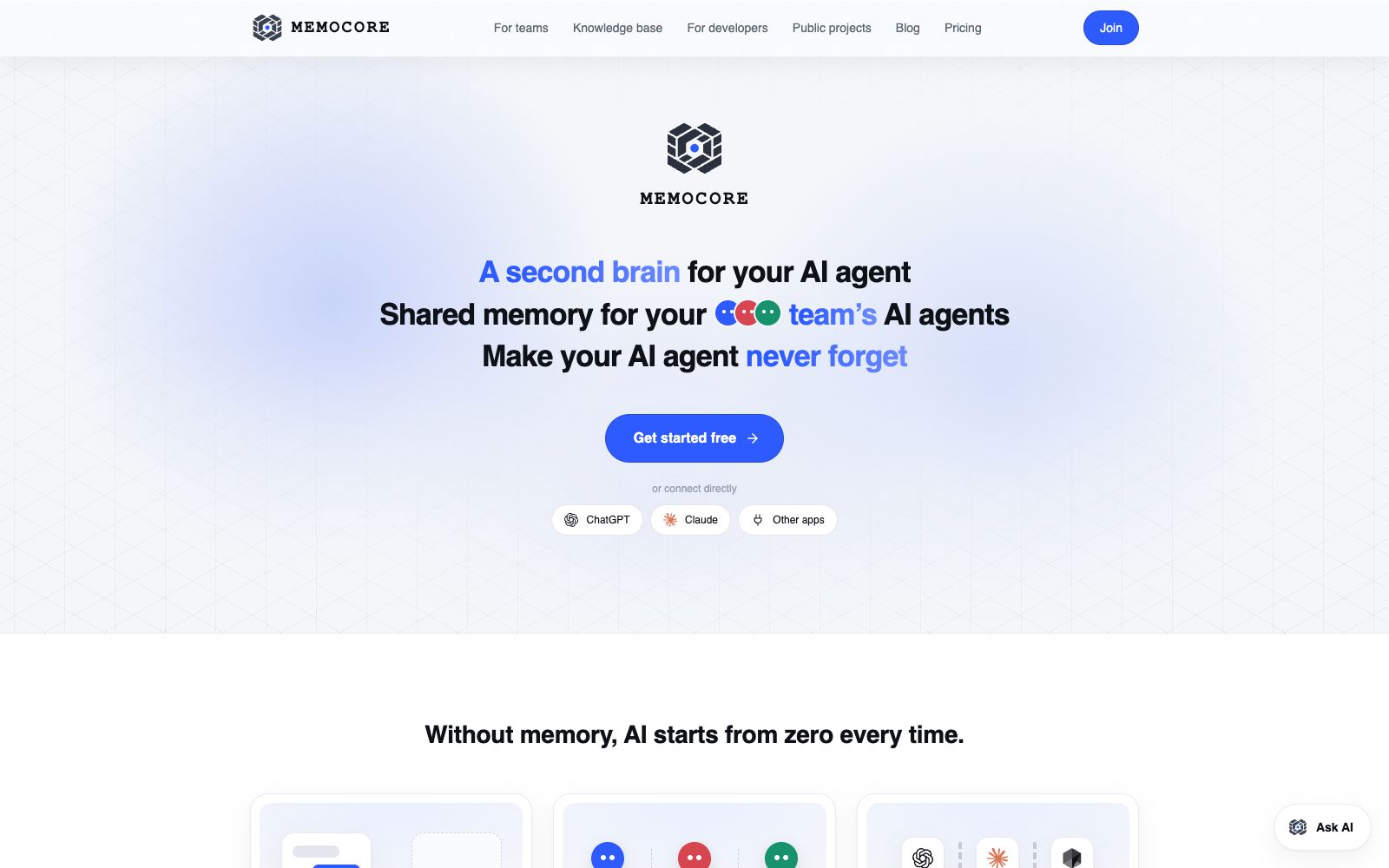

Memocore
Memocore is a cloud-based memory layer for AI agents and teams: it saves facts, decisions and project materials as memos for cross-session reading by different AI applications. Its official website states that it supports MCP, project permissions and APIs.
Updated: 2026-10-27
What is Memocore?
Memocore's official website positions itself as a "cloud memory for AI agents and teams", addressing three specific pain points: starting from scratch in new conversations, AI agents of colleagues being unaware of each other, and having to re-explain everything when switching to another AI tool. The main workflow provided on the official website is concise: connect, remember, recall. Instead of locking data within a specific chat tool, it stores memories in Memocore for access by different applications.
Who is it for?
- Individual users who frequently switch between tools like ChatGPT, Claude, and Cursor and don't want to repeat their preferences and project backgrounds every time.
- R&D or product teams that need to continuously feed decision-making, specification, and process documents to multiple AI agents.
- Teams that want to connect the same knowledge base to customer service bots or internal products.
- Small teams that need separate management of public projects, personal family projects, and company projects.
Key features
5Cross-application memory
The official website states that it supports ChatGPT, Claude, Cursor, VS Code, Claude Code, and any MCP-enabled applications; when switching tools, the new application can view the content that the old application already knows.
Project-based sharing
The official website states that personal memos are only visible to the user, while project memories are shared exclusively with invited team members, with permissions differentiated as editors or readers.
Structured Data
The official blog introduces table projects, where rows and columns have types, and AI agents can fill in, filter, and count data; memos also support titles, tables, lists, and images.
Multi-Entry Accumulation
The official website provides entry points such as the Chrome extension, Notion import, and Telegram dump, which are used to turn web pages, old documents, and temporary messages into retrievable memory for the team.
Application-side Integration
The official website states that the Team plan provides API keys, with each key only having access to specified projects; self-developed applications or chatbots can search these memories and write memos as well.
How to use Memocore
- Start with the free tier to verify the quality of writing and recall, then check if the quota of 100 memos and 3 projects is sufficient.
- Split content that is repeatedly explained into separate projects: create dedicated projects for corporate messaging, customer profiles, writing preferences, and family documents to make permission management more centralized.
- First define column names and types for table projects, then let AI agents fill them in to avoid free text that is difficult to filter later on.
- Before launching the team, design the project invitation scope first.
- The official website emphasizes that personal memos are private and project memories are shared by invitation, and the boundaries should be clearly defined by the users themselves.
- Only authorize necessary projects for API keys, and regularly check which external applications still require read and write permissions.
Traffic & popularity
Data month Sep 2026
Memocore receives about 1.5K visits per month and ranks #8,743,197 worldwide.
Monthly visits
3 monthsTraffic sources
- Direct30.2%
- Search28.3%
- Referrals12.6%
- Display ads8.6%
- Social6.8%
- Other13.4%
Top countries
- United States60.2%
- United Kingdom39.8%
Estimated from third-party traffic data.
Similar tools
 MemUA layer of personal memory shared by multiple AI agents: Codex, Claude Code, Cursor, etc. share the same readable Markdown memory file, supporting source tracing, memory retrieval, and automatic skill extraction.
 AppFlowyFocused on a self-hosted open-source AI workspace, it integrates projects, Wikis, documents, and AI Q&A in one place. It supports local, cloud, and fully isolated environment deployments, allows the use of self-hosted large models, and the official states that the storage region can be specified by the user.
 Construct ComputerConstruct Computer is an AI agent platform for startup and small teams. According to its official website, agents can handle research, outreach, operations and reporting. Users can turn processes into workflows, generate internal tools, schedule repetitive tasks, and check agent memory and execution history.
 MemoryRouterA persistent AI memory layer across ChatGPT, Claude, Codex and other tools, officially said to migrate ChatGPT memories, connect various AI tools via MCP, and make backgrounds and project contexts follow users at all times.
 MonolithosMonolithos is the personal agent operating system as referred to on the official website: built on your Markdown and YAML memories, it connects knowledge, writing, tasks, and multi-device work, with key actions awaiting authorization.
 OsaurusOsaurus is an open-source client for running AI agents natively. It works with local models like Raptor, is private by default and can run offline, offering a stable Mac version and a public beta version for Windows; the agent can read documents and notes in local folders, retain cross-session memory, and ask for confirmation before modifying files.