


LangChain
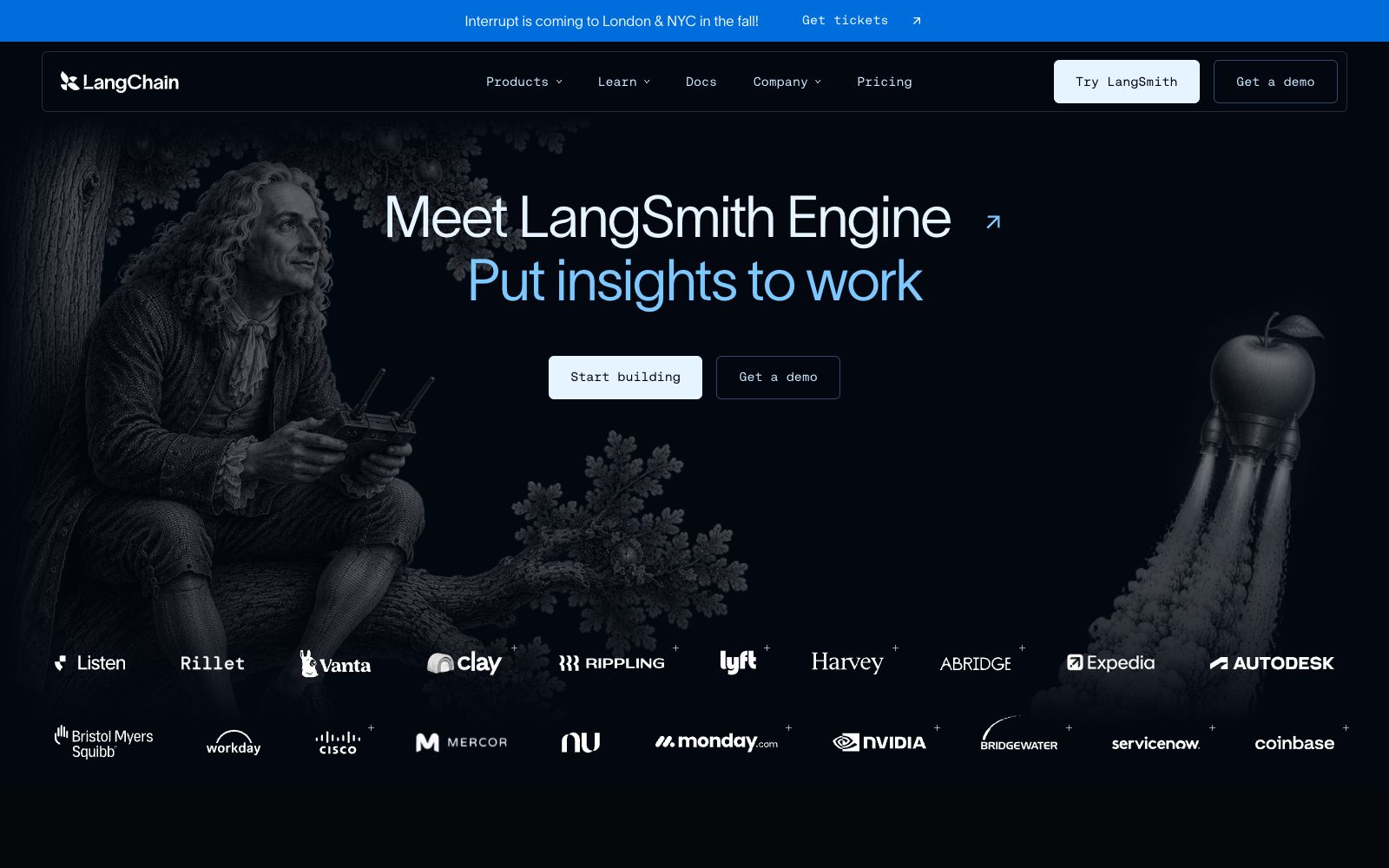
An open-source agent engineering platform for building LLM applications. With LangSmith Engine, it covers development, testing, deployment, and monitoring across the full lifecycle while keeping model, context, and execution-framework choices open.
Updated: 2026-10-26
What is LangChain?
LangChain's current self-positioning is "an open Agent platform that empowers your own intelligence". Its proposition is to let every company take control of its own intelligence: use an open Agent engineering platform to control, govern and accumulate intelligent assets, and the official claims that it is used by more than 7,000 organizations. The platform covers the entire development cycle of Build, Test, Deploy, Monitor, Iterate, and Govern, and is corely composed of an open-source framework combined with the LangSmith Engine. It combines the "open-source framework + managed platform", enabling teams to gain the breadth of the community ecosystem without having to maintain observation infrastructure on their own.
Who is it for?
- Developers building LLM applications from scratch who need flexible control over orchestration details; teams with extensive LangChain integrations in their codebases; enterprise teams looking to add governance, testing, and monitoring capabilities to production-grade Agents; and teams moving from prototypes to production who need to fill gaps in testing and governance.
Key features
7Open-source framework
A foundational library for model abstraction, chaining orchestration, tool invocation, and memory management. It is one of the broadest LLM frameworks in the ecosystem with a large community.
Agent Development
The official provides proven Agent patterns as a starting point, which can be deeply customized when needed, balancing ease of getting started with flexibility.
LangSmith Engine
A supporting observation and evaluation platform that covers the entire process from testing to monitoring. The official claims that "it becomes smarter after each launch".
Independent Control
Retain the choice of models, context, memory, and execution frameworks (harness) without being locked into a single vendor.
Fleet and Deep Agents
Enables driving multi-agent teams with natural language and performing deep agent tasks over longer cycles.
Builder Community
The official claims to have the largest builder community in the AI field, with the number of integrations and the ecosystem consistently leading the way.
No-Code Building
The official supports building agents quickly with or without code, and non-technical roles can also participate in the development.
How to use LangChain
- Confirm the complexity of requirements first before deciding to introduce: when orchestration capability is truly needed, start with the officially validated Agent pattern, then connect LangSmith's tracing to ensure every change is data-driven.
- For small projects, directly connect to the SDK first to avoid using a framework just for the sake of it.
- Pay close attention to official blogs and release notes—new capabilities such as Fleet and Deep Agents are maturing rapidly, and include these in your planning when selecting tools.
Things to know
Traffic & popularity
Data month Sep 2026
LangChain receives about 5.8M visits per month and ranks #7,835 worldwide.
Monthly visits
12 monthsTraffic sources
- Search39.6%
- Direct38.2%
- Referrals12.5%
- Social5.6%
- AI assistants2.4%
- Other1.7%
Top countries
- United States22.4%
- China18.4%
- India18.3%
- Germany4.2%
- United Kingdom2.4%
Estimated from third-party traffic data.
In these collections
Similar tools
 HaystackAn open-source AI orchestration framework maintained by deepset, which builds production-ready agents, retrieval-augmented and semantic search systems with modular components, where every step can be inspected, debugged and replaced.
 DifyDify is an open-source LLM application development platform for production-grade Agentic workflows. It enables the building of Agents, knowledge pipelines (RAG) and workflows on a unified canvas, and supports cloud, VPC or self-hosted deployment.
 MLflowMLflow is the largest open-source AI engineering platform, covering Agents, LLMs and traditional models: it integrates link monitoring, system evaluation, prompt optimization, AI gateways and model deployment into one solution, making AI iteration ten times faster.CCodeFuseThe open-source code large model toolchain of Ant Group covers a multi-task fine-tuning framework, static code analysis, test agents, semantic caching and evaluation benchmarks. It faces the entire R&D lifecycle and is available for independent deployment and use by enterprises and developers.
 Coze StudioCoze Studio's open-source entry, where the official team releases a development platform, a compass for operation and maintenance optimization, and a Go-based open-source agent framework. It is suitable for technical teams that want to build their own agent platforms or perform secondary development.
 MastraAn AI agent framework in the TypeScript ecosystem that bundles workflows, memory, tools, and observability into a single set of APIs. Its coding style is very friendly to front-end engineers. It is suitable for those who need to run agents in a production environment for a long time.