


LMQL
A query programming language for large language model interaction that describes outputs with types, templates and constraints, is equipped with an optimized runtime, makes prompts more robust and reusable, and works across local and cloud backends.
Updated: 2026-10-26
What is LMQL?
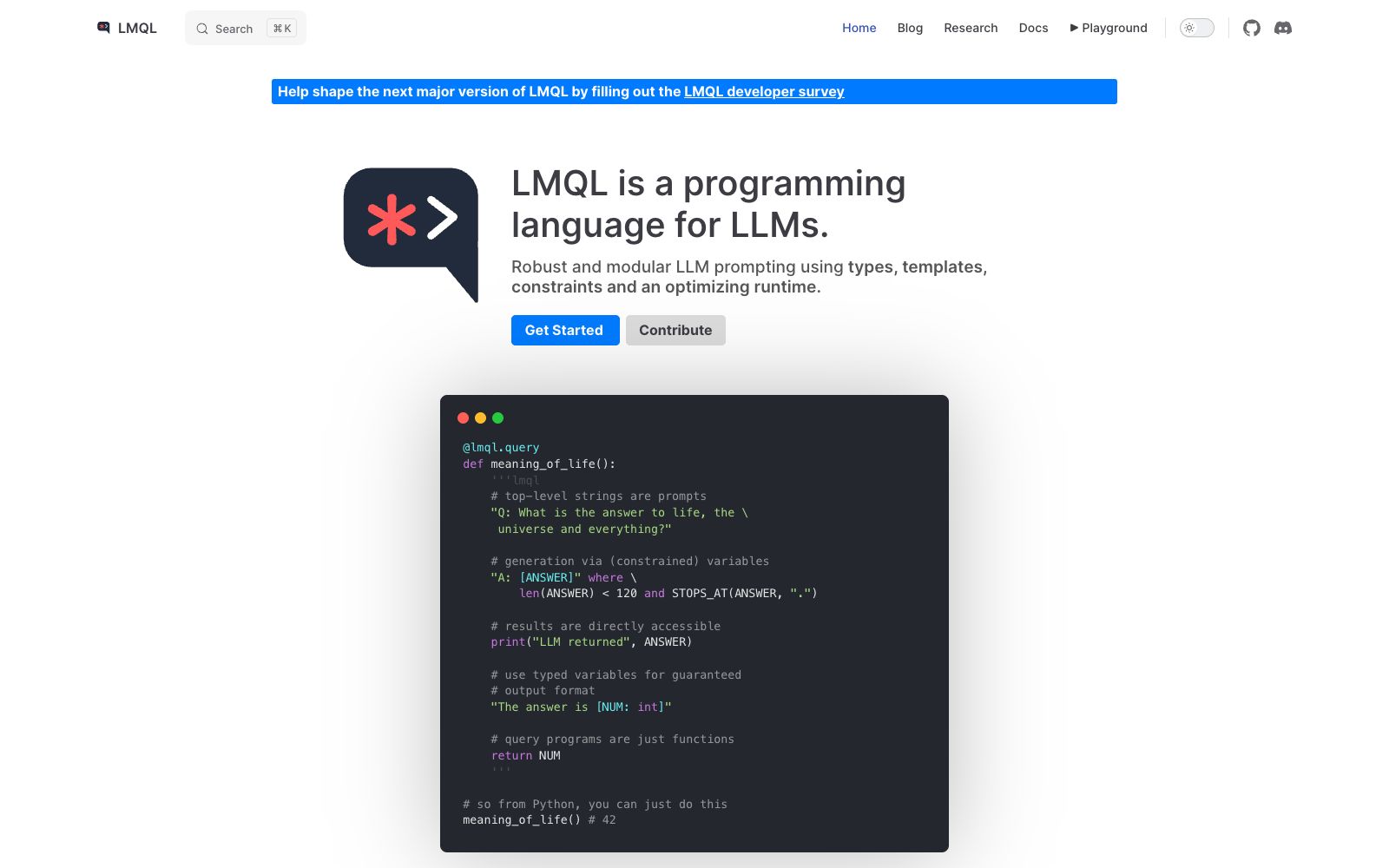
LMQL (Language Model Query Language) is a programming language for interacting with large language models. Its official website defines it as "Robust and modular LLM prompting using types, templates, constraints and an optimizing runtime" — writing prompts with types, templates, constraints and an optimization-capable runtime. It elevates prompt engineering from "string concatenation" to "programming": first clearly describe the desired output, then hand it over to the runtime for execution, making model outputs more controllable, robust, and reusable. Its coding style resembles Python decorators — use `@lmql.query` on a function to declare a constrained query, where constraints can be length limits, enumerations, or any Python expression, and then call it directly. Prompts and logic are naturally organized together, facilitating reuse and version control. The optimizing runtime prunes the search space during generation according to constraints, rather than validating after generation, which is the key difference in mechanism from ordinary template prompts and the source of stable outputs.
Who is it for?
- This is suitable for engineers who need to stably call large models in production systems, especially for teams that need to strictly control the output structure and do not want to rely on regular expressions as a fallback. It is also suitable for individuals engaged in prompt engineering research, teaching, or experimentation. The project is open source, with complete Docs, Blog, Research, and Playground resources. The official team also drives the direction of the next version through developer surveys, resulting in high community engagement.
Key features
5Constrained Generation
Apply type and format constraints (such as length, enumeration, regular expressions, etc.) to the generated results, reduce parsing failures and random answers at the source, and eliminate the need to rely on regular expressions and retries as a fallback.
Templates and Modular Prompting
Prompts can be split into typed modules, making large-scale prompt logic maintainable and reusable. Team collaboration is no longer reliant on copy-pasting and version chaos.
Nested Queries
Officially described as "bringing procedural programming to prompt engineering", it allows nesting one query within another to combine more complex multi-step behaviors.
Cross-backend Support
It supports backends such as llama.cpp, OpenAI, and Transformers at the same time. Local models and cloud APIs are described using the same set of language, resulting in low migration costs.
Execution Trace
Records the actual execution process of prompts, facilitating debugging of "why the model outputs as it does", and transforming prompt optimization from a mysterious practice into an observable process.
How to use LMQL
- First, use the official Playground to draft a constrained query and experience the difference between it and pure string prompts.
- start with the small scenario of "constraining the output format", and after getting it right, gradually introduce templates and nested queries.
- When encountering boundary behaviors, check the official documentation before writing code, which can save a lot of trial and error.
- The project is still collecting community feedback to advance the next major version.
- Following the official blog and surveys will help you understand the direction of interface evolution in advance.
Things to know
Traffic & popularity
Data month Sep 2026
LMQL receives about 14.1K visits per month and ranks #1,368,372 worldwide.
Monthly visits
12 monthsTraffic sources
- Direct39.0%
- Search34.1%
- Referrals10.0%
- Social6.2%
- Mail3.4%
- Other7.4%
Top countries
- United States65.9%
- India29.8%
- Switzerland4.3%
Estimated from third-party traffic data.
Similar tools
 DifyDify is an open-source LLM application development platform for production-grade Agentic workflows. It enables the building of Agents, knowledge pipelines (RAG) and workflows on a unified canvas, and supports cloud, VPC or self-hosted deployment.
 LangGPTThe structured prompt framework proposed by Yunzhong Jiangshu is officially said to split prompts into modules such as Role, Profile, Goal, Skills, Rules, and Workflow. It is reusable and scalable, and has been open-sourced on GitHub.
 Mem0A memory layer for AI agents and applications that preserves cross-session context in a cycle of addition, retrieval, and compression. It can be integrated into agent frameworks for long-term memory, and the official version offers graph memory, auditing, and enterprise private deployment options.
 LangChainAn open-source agent engineering platform for building LLM applications. With LangSmith Engine, it covers development, testing, deployment, and monitoring across the full lifecycle while keeping model, context, and execution-framework choices open.
 SEAL LLM LeaderboardThe expert-driven evaluation list produced by the labs under Scale AI covers more than 20 benchmarks and over 100 models including agent programming, cutting-edge reasoning and safety alignment. It can be browsed by capability tiers and is continuously updated.
 OllamaOpen-source large model local runtime: one-click to launch the model, and prompts never leave the local machine, yet can also connect to the cloud. Suitable for developers who run models locally and are concerned about data leakage, it supports installation on all three desktop platforms.