


Dify
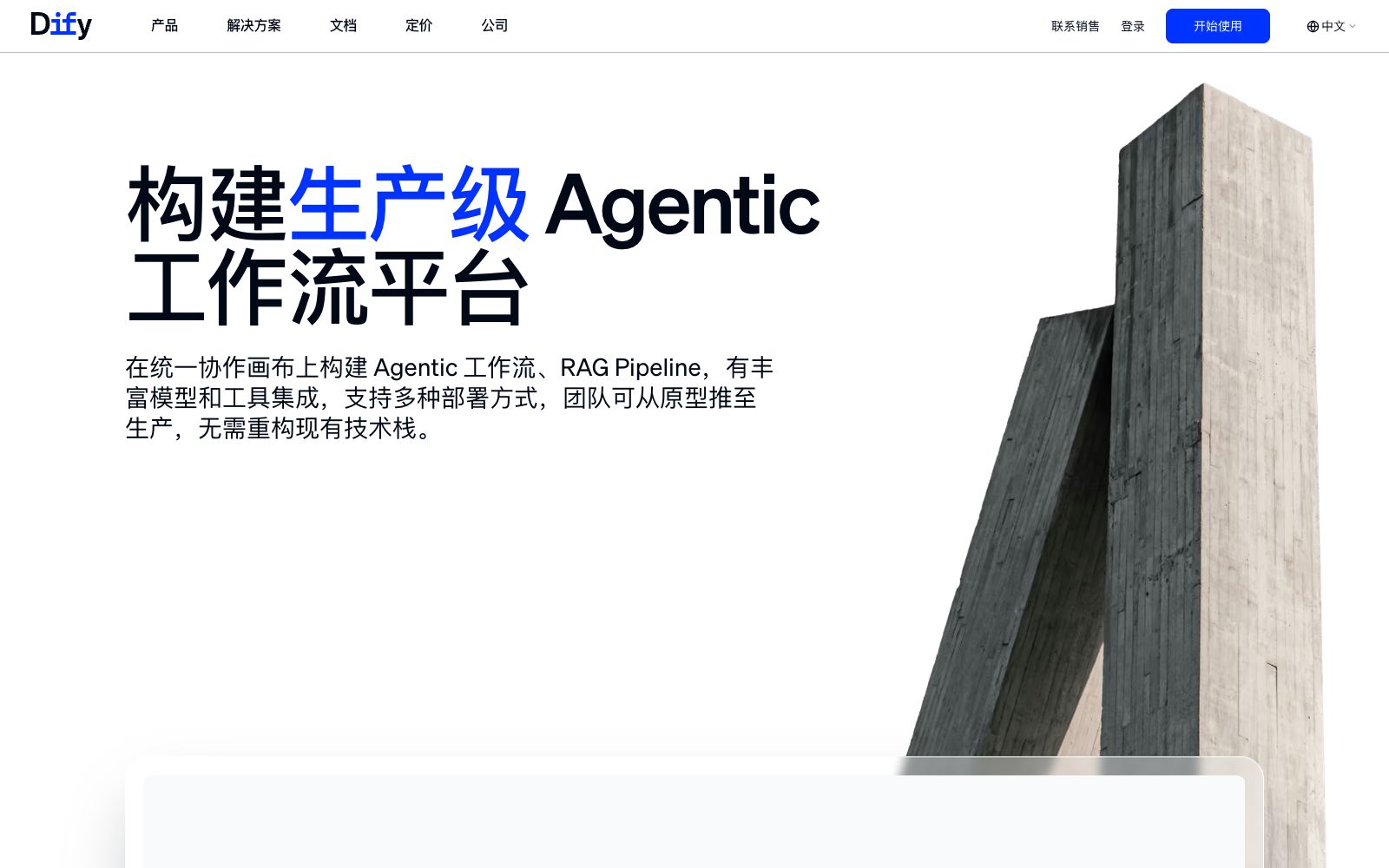
Dify is an open-source LLM application development platform for production-grade Agentic workflows. It enables the building of Agents, knowledge pipelines (RAG) and workflows on a unified canvas, and supports cloud, VPC or self-hosted deployment.
Updated: 2026-10-26
What is Dify?
Dify's official positioning is "a platform for production-grade Agentic workflows". It places Agents, knowledge pipelines (RAG), models, and tools on the same collaborative canvas for construction, and supports deployment on the cloud, your own VPC, or full self-hosting. The official emphasis is that teams can move from prototype to production without rewriting their tech stack. For developers, it transforms prompt logic into visual execution paths, serving as the bridge between an LLM application's idea and its product. The official also highlights that it makes AI Agent development accessible to everyone-combining the no-code platform's features with an intuitive interface, even beginners can get started quickly. Developers and enterprises worldwide are using it. It is particularly suitable for team-based projects that require long-term maintenance and multi-person collaboration. It upgrades "prompt engineering" to "process engineering", turning the units for debugging and reuse from sentences into nodes, making applications more controllable and transferable.
Who is it for?
- For development and product teams that truly want to implement LLM applications into production, especially enterprises with requirements that data must not leave the intranet and prefer self-hosting, as well as individual developers who want to quickly build RAG question-answering or Agent applications. Whether teams are conducting prototype verification, enterprises are carrying out private deployment, or individual developers are quickly building RAG applications, they can all find corresponding solutions among the three deployment paths.
Key features
8Workflow Orchestration
Transforms prompt logic into visual execution paths, facilitating debugging, optimization, and team handovers.
Agent Construction
Configure skills, tools and knowledge for the Agent to build an intelligent agent that can perform real tasks. The three elements can be freely combined according to scenarios and become more and more aligned with the business with continuous use.
Knowledge Pipeline (RAG)
Prepares the context required for retrieval in AI applications and supports question answering based on private data and documents.
Plugin Ecosystem
Integrate different models and tools into a unified workspace to flexibly compose your own AI tech stack.
Unified Publishing
The same set of logic can be released as an application, API, or tool, built once and called multiple times.
Release and Monitoring
Supports runtime monitoring after application release, enabling continuous observation of effects and iterations, which aligns with the usage habits of production environments.
No-Code Friendly
The platform emphasizes its positioning of making AI Agent development accessible to everyone. Its intuitive interface and rapid deployment make it suitable for beginners, and it is also adopted by developers and enterprises worldwide.
Multiple Deployment Options
Three paths including Dify Cloud, Enterprise Edition, and Community Edition (self-hosted) can be selected according to team needs.
How to use Dify
- First, use your own data to build a prototype of a knowledge Q&A or Agent, and confirm the effect and cost before deciding on the deployment form.
- Newcomers can start with official examples and templates, familiarize themselves with the nodes on the canvas, and then process their own business data.
- During team collaboration, unify the workflow and plug-in usage specifications as early as possible to avoid building independently and making it difficult to maintain, which would instead turn the tool into new technical debt.
- Before going online, prepare monitoring and rollback plans.
- When changing the model, first verify the effect on the canvas before switching to reduce the impact on online applications.
Things to know
Traffic & popularity
Data month Sep 2026
Dify receives about 1.9M visits per month and ranks #23,444 worldwide.
Monthly visits
12 monthsTraffic sources
- Direct57.9%
- Search30.1%
- Referrals7.8%
- AI assistants1.8%
- Social1.6%
- Other0.7%
Top countries
- China49.0%
- Japan12.1%
- United States7.5%
- Singapore2.9%
- India2.8%
Estimated from third-party traffic data.
In these collections
Similar tools
 LangChainAn open-source agent engineering platform for building LLM applications. With LangSmith Engine, it covers development, testing, deployment, and monitoring across the full lifecycle while keeping model, context, and execution-framework choices open.
 Hermes AgentNous Research's open-source and self-hostable AI agent, officially available for free under the MIT license, supports persistent memory, automatic skill generation, multi-platform access, and isolated sandboxes. It can be downloaded for desktop or terminal installation.
 Lobe ChatOpen-source multi-model AI workspace, positioned by the platform as the Chief Agent Operations Officer, supports centralized scheduling and management of multiple Agents, provides a skill marketplace and MCP servers, and can be used in common chat tools via an IM gateway.
 Vanna.aiOpen-source SQL agent framework that enables users without SQL knowledge to query various corporate business systems in natural language. It includes built-in user-level permission and quota management, ready-to-use UI components, and supports multiple databases and multi-turn conversations.
 n8nAn open-source workflow automation platform that integrates AI capabilities with business processes. It features a visual canvas for building while retaining code editing space, with full traceability of Agent reasoning on the canvas. It supports over 500 integrations and can be self-hosted for deployment.
 LatitudeLatitude is an open-source AI Agent observability and monitoring platform that tracks production traces, clusters failure patterns and dispatches repair tasks to coding Agents. The official version states that it is compatible with OTEL and supports custom signals.