


Komo
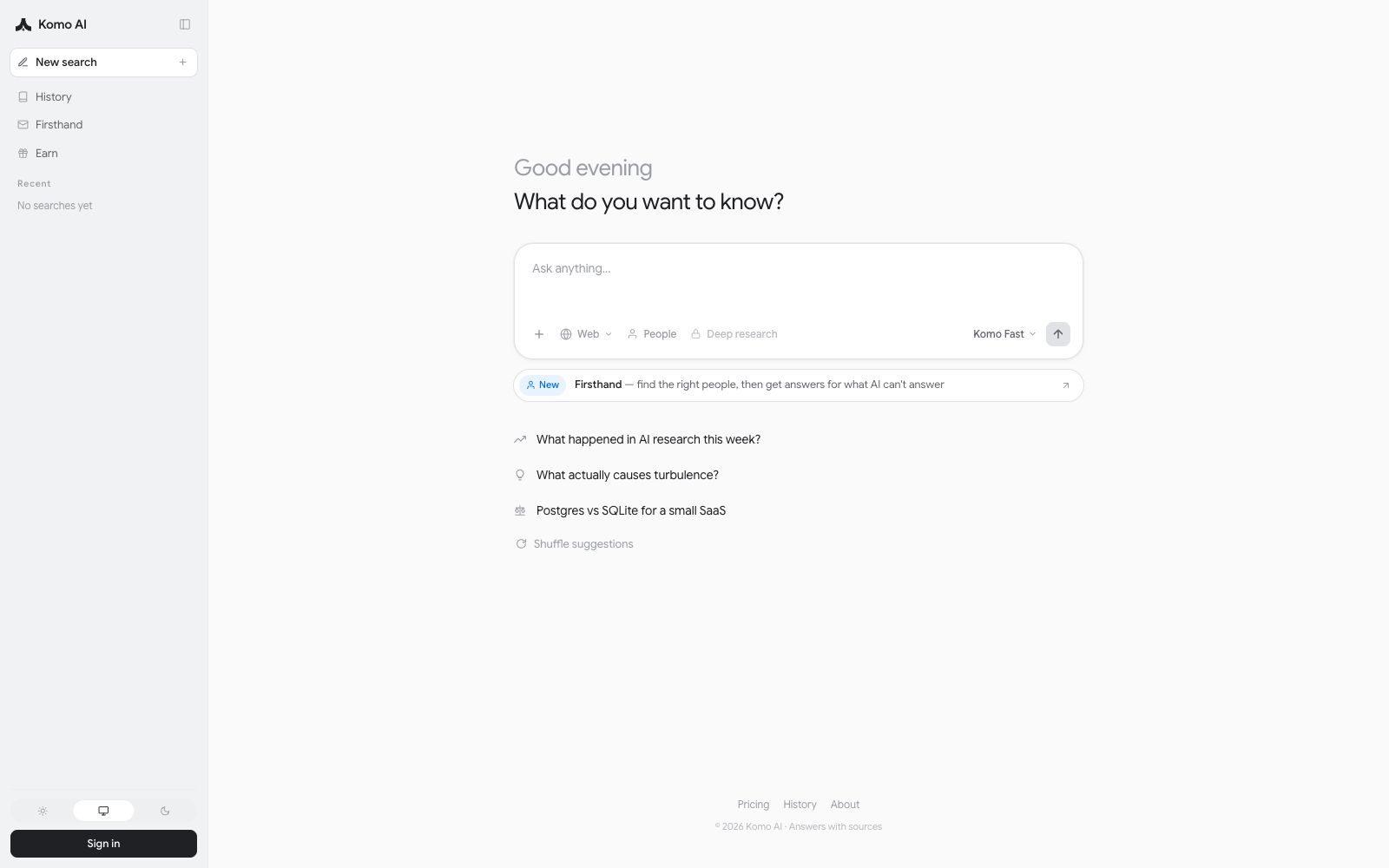
AI search engine that retrieves web pages after a query and provides answers with sources. It offers three modes: Web Search, Find People, and In-depth Research. Among them, Firsthand is specifically designed to find real people who can answer questions that AI cannot, and search results can trace back to history.
Updated: 2026-10-26
What is Komo?
Komo is an AI search engine with the official slogan "Ask anything. Komo searches the web and answers with sources." — ask a question, and it retrieves web pages to provide answers with sources. In addition to regular web searches, it offers People search and in-depth research mode. Among them, Firsthand is its flagship new feature: first find the right people, then obtain the answers that AI cannot answer. All search results are marked with sources, making it easy for users to trace and verify. There are also search history and faster search modes, balancing depth and efficiency. Between the result lists of traditional search engines and the black-box answers of general AI assistants, Komo attempts to offer a middle ground: it has the summarization capability of AI while retaining the tradition of traceable sources, making it more acceptable to user groups with a strong awareness of information verification. The interface is deliberately kept lightweight, with only a question box on the homepage, hiding the complexity behind the scenes.
Who is it for?
- Users who want to quickly get answers with sources; research scenarios where you need to find industry insiders rather than just relying on public materials; users who are dissatisfied with traditional search result lists and prefer direct answer-style outputs; and those who conduct competitor intelligence and information tracking. Professionals in "professions that must be accountable for information" such as education, research, media, and consulting practitioners often need source-included answer-style searches more than ordinary users, and Komo's design is precisely aligned with such needs.
Key features
6Answer-style Search
Crawls web pages and outputs conclusions along with source links, aligning with the intuitive usage of "ask a question, get an answer".
Multiple search modes
Three entry points including Web, People, and Deep research to cater to different needs.
Firsthand
Officially described as a feature to find real people who can answer questions that AI cannot, supplementing information beyond publicly available data.
Deep Research
Designed for scenarios that require systematic data collation, and the official indicates that this feature requires a paid plan.
Search History
Saves your search history, making it convenient to review previous questions and results, which is highly practical for comparative research.
Komo Fast
A faster search tier, suitable for quick casual browsing.
How to use Komo
- Treat it as a "quoted quick intelligence entry": first ask for the candidate answers and their sources, then verify the key conclusions against the original text.
- For research-based questions, prioritize deep research files.
- for quick checks, Komo Fast is more time-efficient.
- The history feature is worth using regularly to compare how answers change at different time points.
- When conducting research, treat the people you find through Firsthand as interview candidates rather than sources for conclusions, and cross-verify the information you obtain afterward.
- In daily use, pay attention to its coverage of Chinese content.
- If the quality of Chinese answers is mediocre, you can switch to asking questions in English or cross-referencing English source pages for verification.
- Overall, use it as the first stop in your search process, not the only one.
Things to know
Traffic & popularity
Data month Sep 2026
Komo receives about 142.0K visits per month and ranks #250,829 worldwide.
Monthly visits
12 monthsTraffic sources
- Search56.9%
- Direct33.8%
- Referrals6.8%
- AI assistants2.5%
- Social0.1%
Top countries
- United States18.1%
- India8.3%
- Italy4.4%
- Spain4.3%
- Mexico4.0%
Estimated from third-party traffic data.
Similar tools
 PerplexityAI answer search engine: You can get conclusions with cited sources by asking questions in natural language. It supports follow-up questions, multiple retrieval modes and document upload-based Q&A, making it suitable for retrieval scenarios that require checking while searching.
 MetasoAd-free Chinese AI search engine that directly outputs answers with sources, supports switching between the entire internet, academic and library scopes, and provides in-depth research, file upload Q&A and voice input.
 ExaA search API for AI agents that provides real-time web data, deep research, and structured content through a single endpoint, with highlighted, token-efficient results for Q&A, research, and coding agents.
 FlowFlow is an AI knowledge assistant that can answer questions in real time with internet access, summarize long articles and web pages, and assist in writing documents. It covers a wide range of knowledge needs from life encyclopedias to professional academics, helping you quickly enter a state of flow.
 Le ChatThe original dialogue assistant has been renamed Vibe. The same account retains the original package and historical conversations. It is divided into three modes: work, programming, and chat. It supports online retrieval, multi-application connectors and scheduled tasks, and is suitable for users who want to switch from pure chatting to getting work done.
 MemFreeMemFree is a hybrid AI search tool that draws from knowledge bases and the internet. It first indexes web pages, local files, and browser bookmarks before conducting a unified search. It also supports asking questions based on images and generating web pages.