


AMiner
An AI-driven technology intelligence and academic search platform, which, according to the official, provides scholar portraits, paper retrieval and AI research assistants. It can assist in designing experiments, building review frameworks and writing paper introductions, and uses intelligent agents to track and summarize the latest papers every day.
Updated: 2026-10-30
What is AMiner?
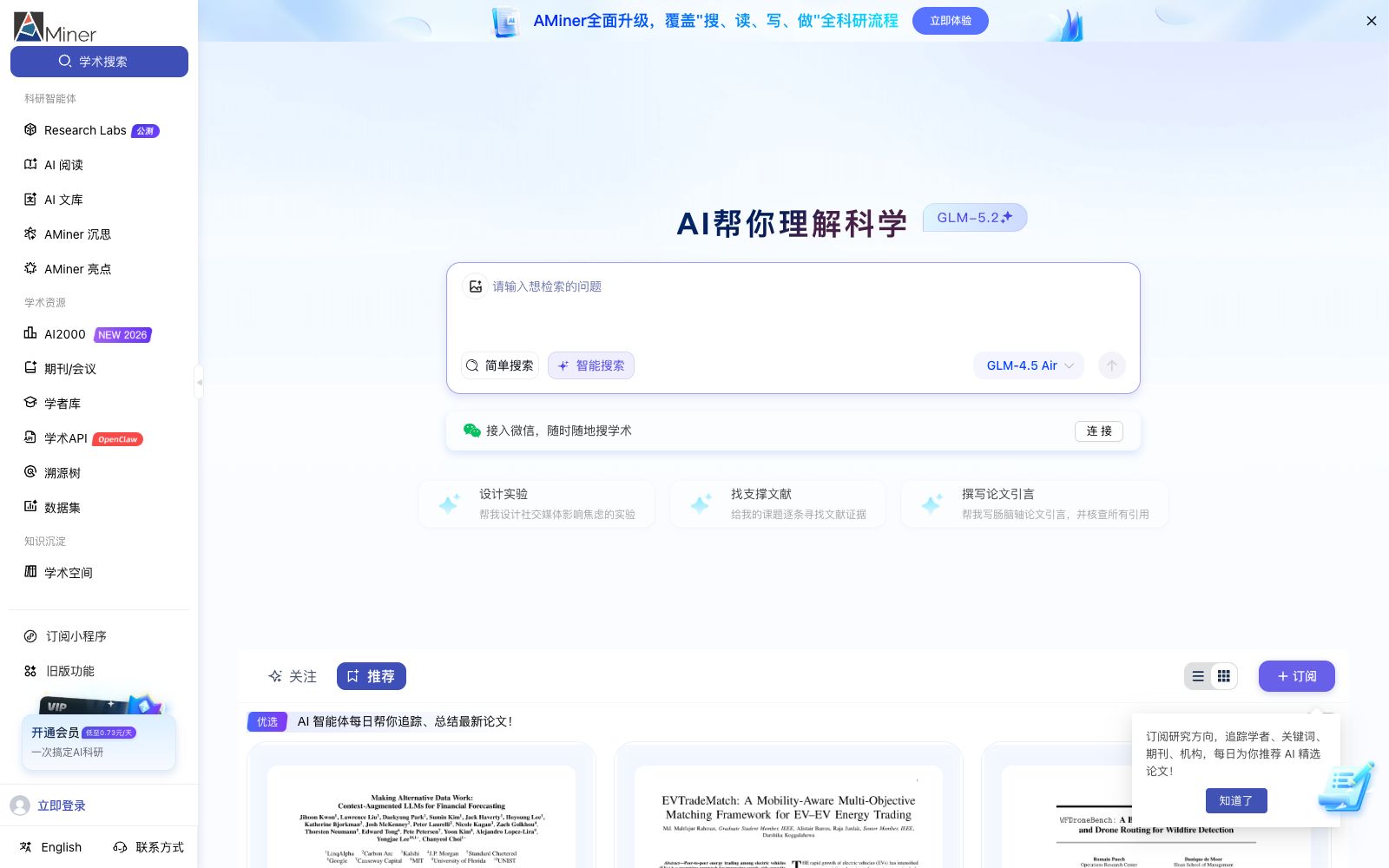
AMiner is an AI-driven technology intelligence mining and academic search platform. The official homepage features an AI research assistant as the main entry point: users can ask it to design experimental schemes, build review frameworks, and write paper introductions, with the official explicitly noting that it verifies citations when writing introductions. Another core focus of the platform is scholar and paper data. The official displays a large number of scholar homepages and reading records from well-known institutions, and uses intelligent agents to track and summarize the latest papers on a daily basis.
Who is it for?
- Postgraduate students: Use the search and tracking functions to quickly get a clear understanding of the main papers and representative scholars in a research direction.
- Project leaders: Use experimental design and review framework capabilities to improve the preparation efficiency of the proposal stage.
- Enterprise R&D intelligence personnel: Track the latest achievements and institutional trends in specific technical directions.
- Academic editors and reviewers: Gain an understanding of the distribution of authors and institutions in a specific field. The official states that the platform displays a large number of scholar homepages and reading records from well-known institutions.
- Scientific research managers: Use intelligence data to serve as a reference for analyzing talents and cooperative institutions. The official states that AI agents will track and summarize the latest papers daily to help researchers keep up with the cutting-edge developments.
Key features
6Intelligent Academic Search
The official states that it provides scholar portraits and paper retrieval capabilities, supporting the discovery of relevant scholars and achievements by research direction.
AI Research Assistant
It is claimed by the official that it can assist in designing experiments, building review frameworks and writing paper introductions, and verify the sources of citations during writing.
Paper Tracking Agent
It is claimed by the official that the AI agent tracks and summarizes the latest papers every day to help researchers keep up with the cutting-edge progress.
Academic Space
It is claimed that the platform provides an aggregated academic space for managing research interests and reading content. It is also stated that users can ask the assistant to design experimental plans, build review frameworks, and write paper introductions.
WeChat Integration
The official states that it can be integrated with WeChat to search for academic content anytime and anywhere, placing the search entry in daily usage scenarios.
Scientific and Technological Intelligence Mining
The official states that it organizes scientific research information through data mining methods to analyze the research output of institutions and talents. The official homepage features the AI Research Assistant as the main entry point.
How to use AMiner
- 1The introductions and review frameworks generated by AI must be manually verified against the original citations. Although the platform marks that citations are checked, you still need to conduct your own review.
- 2Pay attention to the difference between preprints and officially published papers when viewing paper search results, and confirm the version and publication status before citing.
- 3When judging influence using scholar profiles, take multiple metrics into account; a single number is prone to misjudgment.
- 4When using AI to assist in writing, clearly ask it to distinguish between facts and speculations, and avoid generating content that seems plausible but cannot be traced back to a source.
- 5Academic scenarios have strict requirements for citation norms, and any part involving AI participation must be disclosed in accordance with the regulations of the journal to which the paper is submitted.
Traffic & popularity
Data month Sep 2026
AMiner receives about 758.5K visits per month and ranks #51,639 worldwide.
Monthly visits
12 monthsTraffic sources
- Direct67.0%
- Search24.6%
- Referrals6.9%
- Social1.2%
- Display ads0.3%
Top countries
- China61.1%
- Hong Kong, China9.2%
- United States5.1%
- Taiwan, China2.1%
- Germany1.4%
Estimated from third-party traffic data.
Similar tools
 Qiewen AcademicAn AI academic search and literature discovery tool for researchers, supporting deep retrieval, citation network expansion, knowledge base Q&A, and paper reproduction. Its official website states that it can track research trends and provide personalized recommendations.
 UndermindUndermind is an AI co-researcher for researchers, focusing on the literature domain. It can read full texts and charts, retrieve along citation chains and cite point by point, and help users build a dynamic literature library from broad to in-depth.
 ConsensusAn AI academic search engine for peer-reviewed literature. You can retrieve evidence from 250 million papers by asking questions in natural language, visually present the consensus and divergence of research conclusions, and support Deep Search automated reviews and medical modes.
 alphaXivAn open platform providing discussion forums for arXiv papers, where each paper can be commented on, questioned about, and annotated. Meanwhile, it aggregates popular papers by theme to help users quickly keep up with the cutting-edge developments in the AI field.
 Bohr AIBohr is an AI for Science space station for global scientists, offering literature search and structured Q&A, knowledge base dialogue, first draft generation of review articles, manuscript review and scientific figure drawing, along with supporting scientific computing power and experimental resources.
 FlowFlow is an AI knowledge assistant that can answer questions in real time with internet access, summarize long articles and web pages, and assist in writing documents. It covers a wide range of knowledge needs from life encyclopedias to professional academics, helping you quickly enter a state of flow.