


Undermind
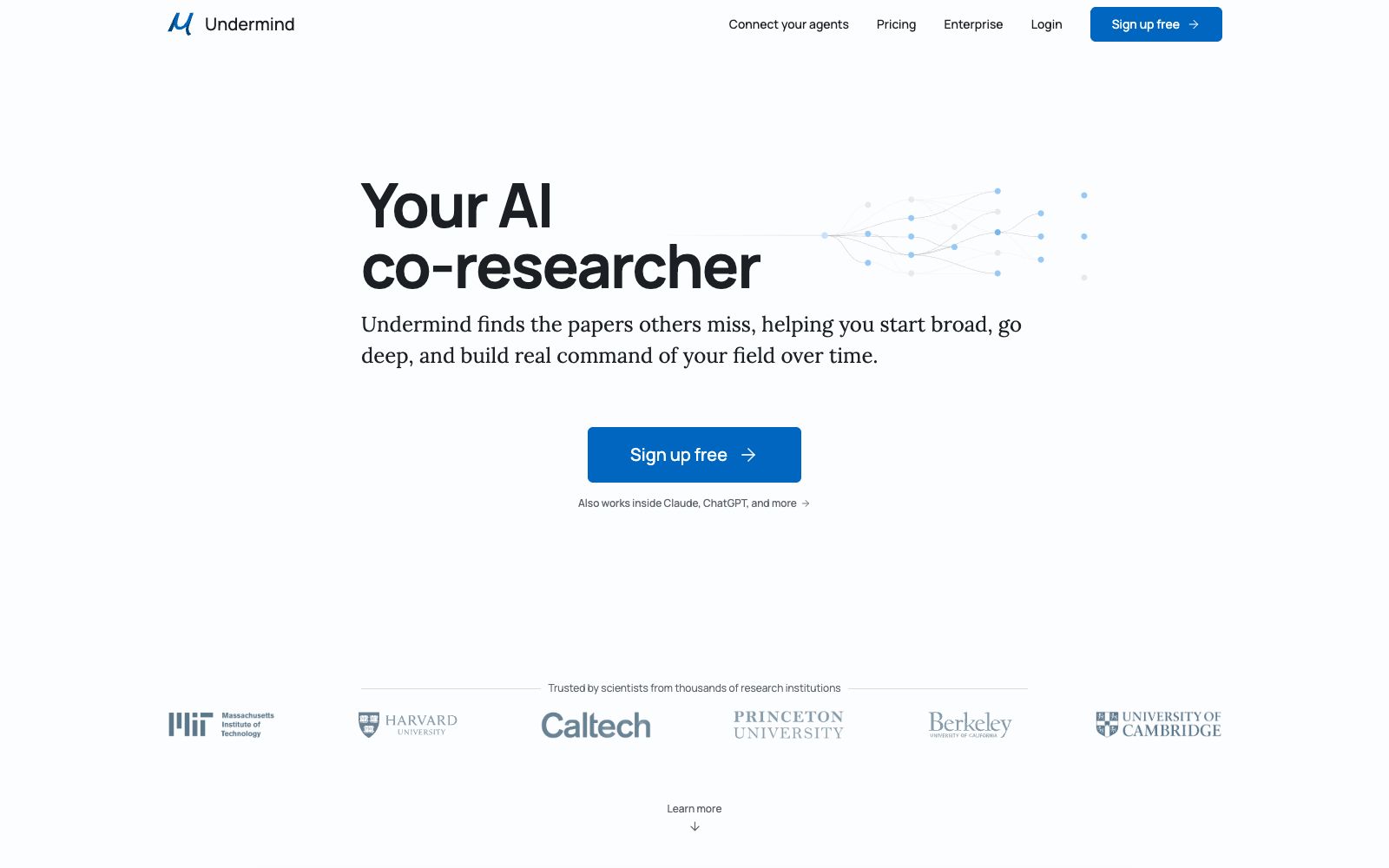
Undermind is an AI co-researcher for researchers, focusing on the literature domain. It can read full texts and charts, retrieve along citation chains and cite point by point, and help users build a dynamic literature library from broad to in-depth.
Updated: 2026-10-26
What is Undermind?
Undermind is positioned as an AI collaborator for researchers, focusing on the literature domain. It can find papers that others have missed, read full texts and charts, and cite them one by one, helping researchers start broadly and delve deeper step by step, and build their own dynamic literature database during the process. Its official website states that it already has users from thousands of research institutions, and more than a thousand GSK scientists are using it. It emphasizes letting AI handle the tedious work of retrieval, reading and summarization, allowing people to focus on judgment and creation. It is not just a search engine, but more like a research partner who has read a large number of literatures and is on call at any time.
Who is it for?
- Researchers: Those who conduct systematic reviews and track cutting-edge research, using AI to accelerate exploration from broad to in-depth.
- Pharmaceutical and Life Sciences: Teams that rely on massive volumes of literature to support discoveries, such as large pharmaceutical company R&D teams, to shorten research and investigation cycles.
- Graduate students and scholars: Students and teachers who wish to quickly build a comprehensive overview of the field, and who can offload the reading burden to AI agents.
- Corporate R&D: R&D teams looking for research gaps in innovative directions to identify areas where they can make an impact.
- Medicine and Clinical Practice: Practitioners who need evidence-based and up-to-date literature verification to keep track of the latest evidence updates.
Key features
5Description as Research
Users state their research questions, and Undermind clarifies their needs through follow-up questions before conducting searches, understanding intent better than keyword searches.
In-depth Literature Retrieval: Read and evaluate hundreds of papers, trace citation chains until all relevant literature is found, and avoid missing key research.
Co-create understanding
Iterate on reports, drill down into full texts, extract details, gradually deepen mastery of the field, rather than providing one-time answers.
Traceable sources
Any conclusion can be traced back to the original paper through in-line citations, facilitating verification and citation, and reducing the risk of hallucinations.
Continuous Tracking
Stay focused on topics of interest and be notified when relevant new papers are published, keeping your literature library fresh and up-to-date.
How to use Undermind
- 1First, describe your research question in one or two sentences and answer its follow-up questions to make the retrieval more accurate and avoid detours.
- 2Start with a broad retrieval and then dive deeper along the citation chain, avoiding narrowing down the scope too early and missing important branches.
- 3Make good use of in-line citations to verify key conclusions and retain the sources in your own literature library for easy citation in subsequent writing.
- 4Enable real-time updates to let the system notify you proactively when relevant papers are published, eliminating the need for repeated manual searches.
- 5It can also be integrated into environments such as Claude and ChatGPT, embedded into existing research workflows, and serve as an external brain.
Traffic & popularity
Data month Sep 2026
Undermind receives about 189.3K visits per month and ranks #238,421 worldwide.
Monthly visits
12 monthsTraffic sources
- Direct48.7%
- Search26.7%
- AI assistants14.3%
- Referrals5.7%
- Mail2.7%
- Other1.9%
Top countries
- United States32.7%
- China11.5%
- India6.5%
- Brazil4.8%
- Germany4.7%
Estimated from third-party traffic data.
Similar tools
 Qiewen AcademicAn AI academic search and literature discovery tool for researchers, supporting deep retrieval, citation network expansion, knowledge base Q&A, and paper reproduction. Its official website states that it can track research trends and provide personalized recommendations.
 AnaraAnara is an AI research workbench for scientific research scenarios. It can search literature databases and full-network papers, conduct comprehensive analysis and table extraction across more than a thousand documents, and automatically provide clickable and verifiable citation sources during writing.
 ResearchPalResearchPal is an AI research platform integrating research, writing, analysis and citation. It provides research agents to help you find literature, write reviews and manage citations, and the official claims that citations are not fabricated.
 ConsensusAn AI academic search engine for peer-reviewed literature. You can retrieve evidence from 250 million papers by asking questions in natural language, visually present the consensus and divergence of research conclusions, and support Deep Search automated reviews and medical modes.
 TXYZAn AI academic workbench for scientific research scenarios integrates paper retrieval, in-depth reading and writing assistance into a seamless workflow. It supports uploading and analyzing full documents, and offers annual subscription tiers ranging from free to high-end.
 R DiscoveryA literature reading and retrieval application for researchers, officially claiming to include hundreds of millions of papers and preprints. It offers AI abstracts, paper Q&A, literature review generation and translation, and supports web and mobile access.