

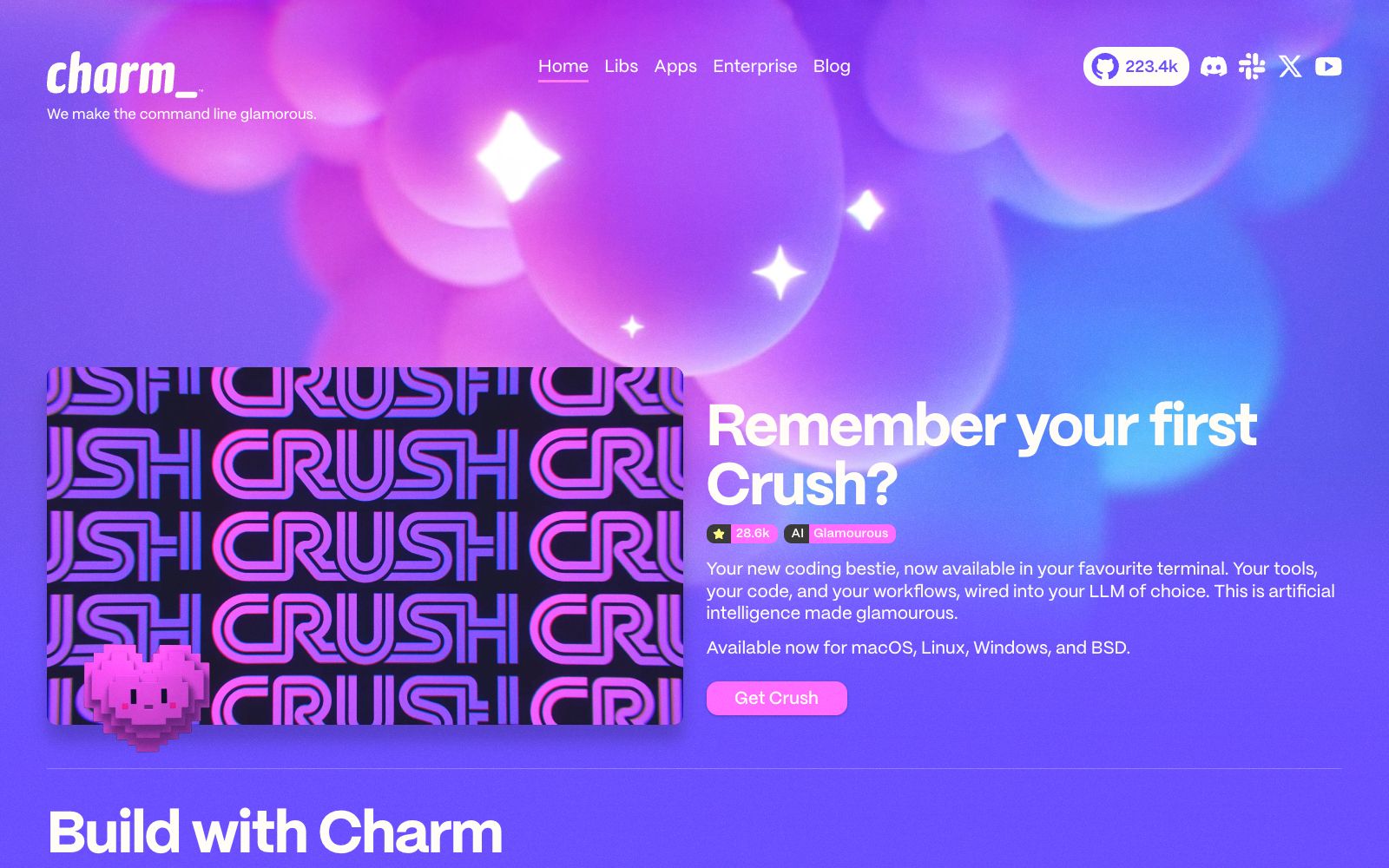

Crush
A terminal AI coding tool by Charm, which connects your tools, code and workflows to the large model of your choice, and is officially available on macOS, Linux, Windows and BSD.
Updated: 2026-10-26
What is Crush?
Crush is a terminal AI coding tool launched by the Charm team, whose slogan is "Make the command line charming". The official website describes Crush as "your new coding buddy", with the selling point of integrating your existing tools, code and workflows into your preferred large language model (LLM) instead of opening another web-based chat window. The official states that it offers versions for macOS, Linux, Windows and BSD. All of Charm's underlying libraries are open source, and its terminal interface components are themselves open-source libraries relied upon by numerous projects.
Who is it for?
- Backend and DevOps engineers who spend most of their workday in the terminal and over SSH sessions and don't want to switch away to an AI window.
- Developers who already write command-line tools in Go and want to directly reuse existing component libraries.
- Automation enthusiasts who need to integrate model calls into scripts and pipelines for batch processing.
- Teams that focus on supply chain security and prefer to build from open source rather than closed-source services.
- Platform engineering teams that need to build a good-looking and user-friendly command-line tool for internal colleagues.
Key features
6LLM of choice
Integrate your existing tools, code, and workflows with the large language model (LLM) of your choice, with no binding to a single vendor.
Available on macOS, Linux, Windows, and BSD
The four officially listed platforms that can be installed directly.
Bubble Tea
An open-source library for building terminal UIs with Go, which the official website describes as "building today's terminal user interfaces from the future."
Lip Gloss
A terminal styling and layout toolkit that handles colors, borders, and typography.
Mods
Officially described as a command-line interface to large language models, allowing direct model invocation within pipelines.
Glow
A Markdown reader for the command line, offering both CLI and TUI interfaces, which is ideal for directly reading documents and instructions in the terminal.
How to use Crush
- First get it working in an irrelevant repository to confirm how many files it reads and whether it will touch the workspace, before deploying it to official projects.
- When dealing with company code, first confirm whether the terms of the selected model allow code to be sent out, and switch to a self-hosted model if necessary.
- The official states that Charm's technology has been used in more than 25,000 applications, but the specific capabilities and versions shall be subject to the official website documentation.
- do not follow old tutorials.
- Terminal tools hand over command execution authority to agents.
- It is recommended to first enable change previews and confirmations to avoid accidentally modifying files that should not be changed in one go, especially operations such as deletion, overwriting, and batch renaming.
Traffic & popularity
Data month Sep 2026
Crush receives about 30.8K visits per month and ranks #1,114,579 worldwide.
Monthly visits
12 monthsTraffic sources
- Direct68.9%
- Search15.8%
- Referrals9.6%
- Social3.7%
- AI assistants1.1%
- Other1.0%
Top countries
- China35.2%
- United States13.8%
- Vietnam9.1%
- Indonesia6.8%
- Philippines6.8%
Estimated from third-party traffic data.
Similar tools
 CodebuffAn AI coding assistant that runs in the terminal, modifies codebases and executes commands in natural language. The official claims it completes full library indexing in two seconds, delivers higher output quality and is over 100 seconds faster than similar products, and supports global npm installation.
 Refact.aiOpen-source self-hostable AI coding agent that covers end-to-end task execution, in-IDE dialogue and real-time completion. Officially claims to support more than 25 programming languages and local deployment.
 LLMAn open-source command-line tool and Python library for calling OpenAI, Claude, Gemini, Qwen, DeepSeek, and other models from the terminal. It stores prompts, responses, and embeddings locally in SQLite.
 TabbyOpen-source self-hosted AI coding assistant offering code completion, a question-answering engine, and in-line chat. The official states it supports deployment on consumer-grade GPUs, requires no external databases or cloud services, and keeps data within your own environment.
 OpenCodeOpenCode is an open-source AI programming agent that can write code in terminals, IDEs and desktop clients. It supports LSP, multi-session parallelism and 75+ models, and prioritizes privacy without storing code.
 ClineOpen-source AI programming agent, officially said to adopt the Plan-then-Act mode to modify code across files and execute bash commands in editors and terminals, supporting MCP extensions and multi-Agent collaboration.