


Ultralytics
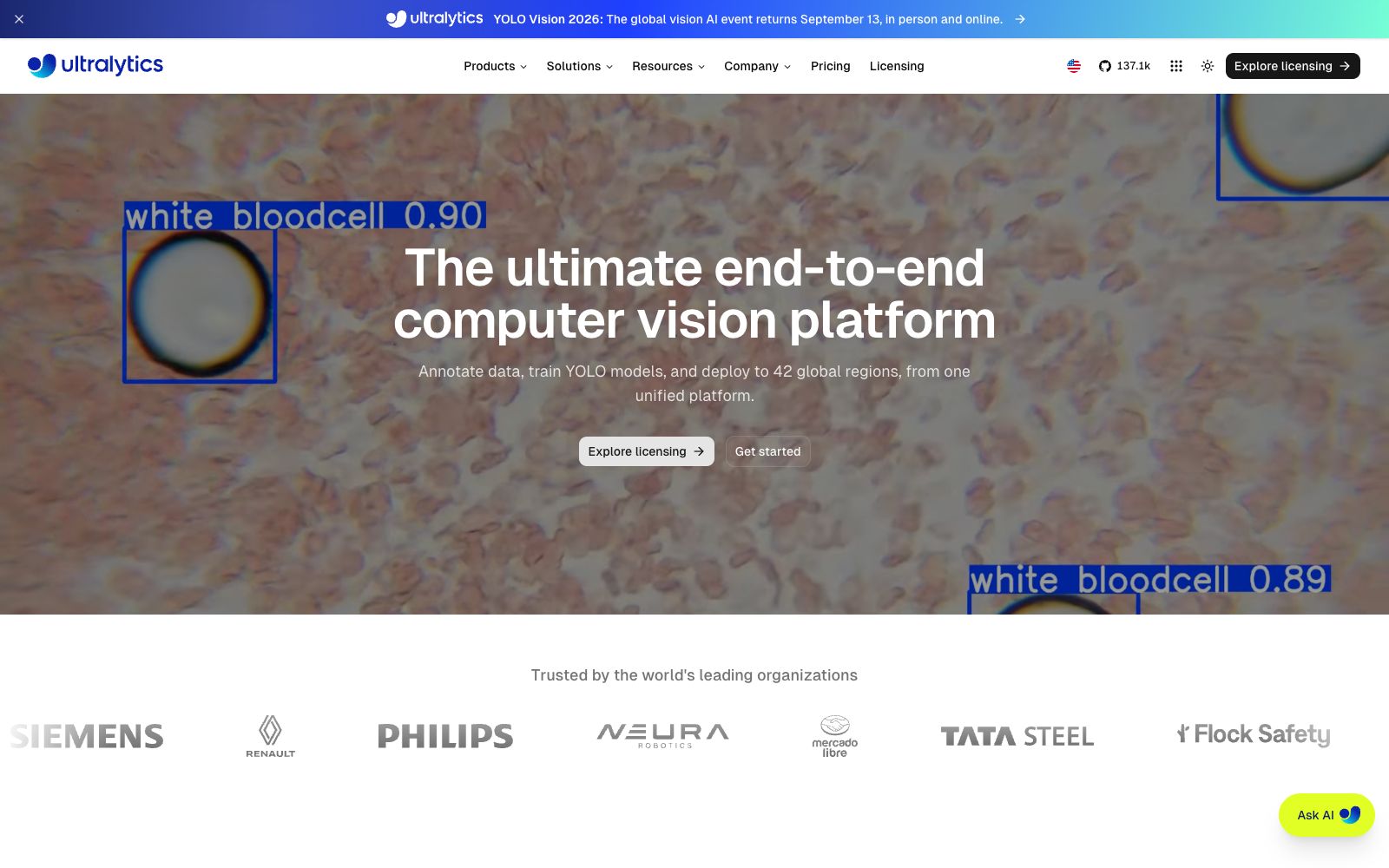
Ultralytics is the open-source team behind the YOLO series of visual models. Officially, it claims to enable one-stop annotation, training and deployment, supports YOLOv5 to YOLO26, covers detection, segmentation and pose estimation, and a commercial license for enterprise use is required for closed-source commercialization.
Updated: 2026-10-26
What is Ultralytics?
Ultralytics is the maintenance team for the YOLO series of visual models. Its official website positions itself as an "end-to-end computer vision platform", where annotation, training and deployment are completed in one place. Its biggest difference from most online visual services lies in licensing: Ultralytics YOLO is open-source under AGPL-3.0, and the code, models and training processes can be fully run on your own machines and private environments; if used for closed-source commercial products, internal tools, SaaS or embedded devices, you need to purchase an Enterprise License. The official website also provides two paths: a cloud platform and an open-source library. Small teams can first get the process running locally before deciding whether to move to the cloud.
Who is it for?
- Algorithm engineers engaged in object detection and industrial vision who need a locally trainable and commercially controllable model stack
- For universities and research institutions, the AGPL-3.0 license can be directly adopted for academic or fully open-source scenarios
- Manufacturing and quality inspection teams that need to implement production line defect detection and safety compliance monitoring
- For robotics, drones, and autonomous driving, which require edge or embedded deployment
- Business parties in retail, logistics, agriculture and other sectors that require inventory checking, sorting, and growth monitoring
- For beginners who want to learn computer vision from scratch, they can run the examples locally
Key features
6Smart Annotation
The official website states that it supports 6 types of annotation tasks including bounding boxes, polygons, semantic masks, key points and rotated boxes. After integrating SAM, it can generate precise masks with one click, supports formats such as YOLO and COCO, and provides team review and version management.
Cloud Training
The official claims 26 cloud GPU configurations are available, ranging from RTX 2000 Ada to NVIDIA B300. It natively supports YOLOv5, YOLOv8, YOLO11 and YOLO26. You can view training metrics in real time and conduct experiment comparisons, with both a no-code interface and a Python SDK provided.
Deployment and Export (Deploy)
The official website states that it supports auto-scaling deployment across 42 global regions and offers 20 export formats including ONNX, TensorRT, CoreML, LiteRT, QNN, Hailo, and Ascend, covering edge, mobile, and embedded hardware.
Multi-task Model Family
The official website lists seven types of tasks including object detection, instance segmentation, semantic segmentation, depth estimation, image classification, pose estimation, and rotated box detection.
Open Source and Enterprise License
AGPL-3.0 applies to academic research, coursework, personal projects and fully open-source projects; the official lists scenarios requiring an enterprise license, including internal tools, commercial products, SaaS, hardware embedding and unopened-source R&D,
Industry Solutions
The official website provides scenarios based on aerial imagery, security, robotics, logistics, retail, healthcare, manufacturing and agriculture. The manufacturing sector lists quality control and defect detection, while the security sector lists perimeter monitoring and license plate recognition.
How to use Ultralytics
- First, run the inference of the official pre-trained model locally using open-source libraries to confirm the task type (detection, segmentation, pose estimation, or rotated bounding box), and then prepare the data.
- For annotation, it is recommended to use SAM's one-click masking for initial labeling and then manual edge correction, which saves time compared to drawing bounding boxes from scratch.
- For training, first run a small number of epochs on a small-scale dataset to verify the workflow, then switch to cloud GPUs for scaling up.
- Cloud services are billed by usage, so estimate the cost before formal training.
- The most important thing to note is the license: as long as you use Ultralytics' code, architecture, or training outputs, enterprise licensing is required for closed-source commercial use, and the same applies to self-developed models for internal use only.
- This should be confirmed at the project initiation stage.
- When exporting to edge devices, first test on the actual device using the target format.
- prices and terms may be adjusted, so recheck the official website before commercial use.
Traffic & popularity
Data month Sep 2026
Ultralytics receives about 1.5M visits per month and ranks #33,173 worldwide.
Monthly visits
12 monthsTraffic sources
- Search50.2%
- Direct28.0%
- Referrals12.4%
- AI assistants4.4%
- Social3.9%
- Other1.0%
Top countries
- China22.7%
- India10.8%
- United States10.3%
- Russia6.0%
- Japan3.8%
Estimated from third-party traffic data.
Similar tools
 RoboflowA computer vision platform for developers and enterprises, covering data management, annotation, training to cloud and edge deployment. The official claims that over 1 million engineers are using it, and it is equipped with open-source libraries such as Inference and supervision.
 Lightning AIAn AI cloud platform built by the original team of PyTorch Lightning. The official website provides on-demand GPUs, clusters and coding agents, covering the entire process from dataset construction to training and inference, targeting teams that develop dedicated models independently.
 PaperspaceThe cloud GPU platform under DigitalOcean offers GPU computing power and hosts such as H100, covering the entire process from model development, training to deployment, and also provides cloud desktops and rendering workflows.
 Hive ModerationHive is an AI platform that provides content understanding APIs. Its official website lists models such as visual, text and audio moderation, AI-generated image and video recognition, OCR, as well as trademark and celebrity recognition, and it charges based on call volume.
 Vertex AIAn AI development platform under Google Cloud, now named Gemini Platform on its official website, provides model invocation, training fine-tuning and agent deployment capabilities, targeting technical teams that need to integrate AI into production systems.
 OpenDataLabThe open data platform launched by the Shanghai Artificial Intelligence Laboratory is officially said to provide high-quality open-source datasets for domestic large models, support dataset retrieval and download, and be equipped with data annotation and governance tools as well as open-source community capabilities.