


Roboflow
A computer vision platform for developers and enterprises, covering data management, annotation, training to cloud and edge deployment. The official claims that over 1 million engineers are using it, and it is equipped with open-source libraries such as Inference and supervision.
Updated: 2026-10-26
What is Roboflow?
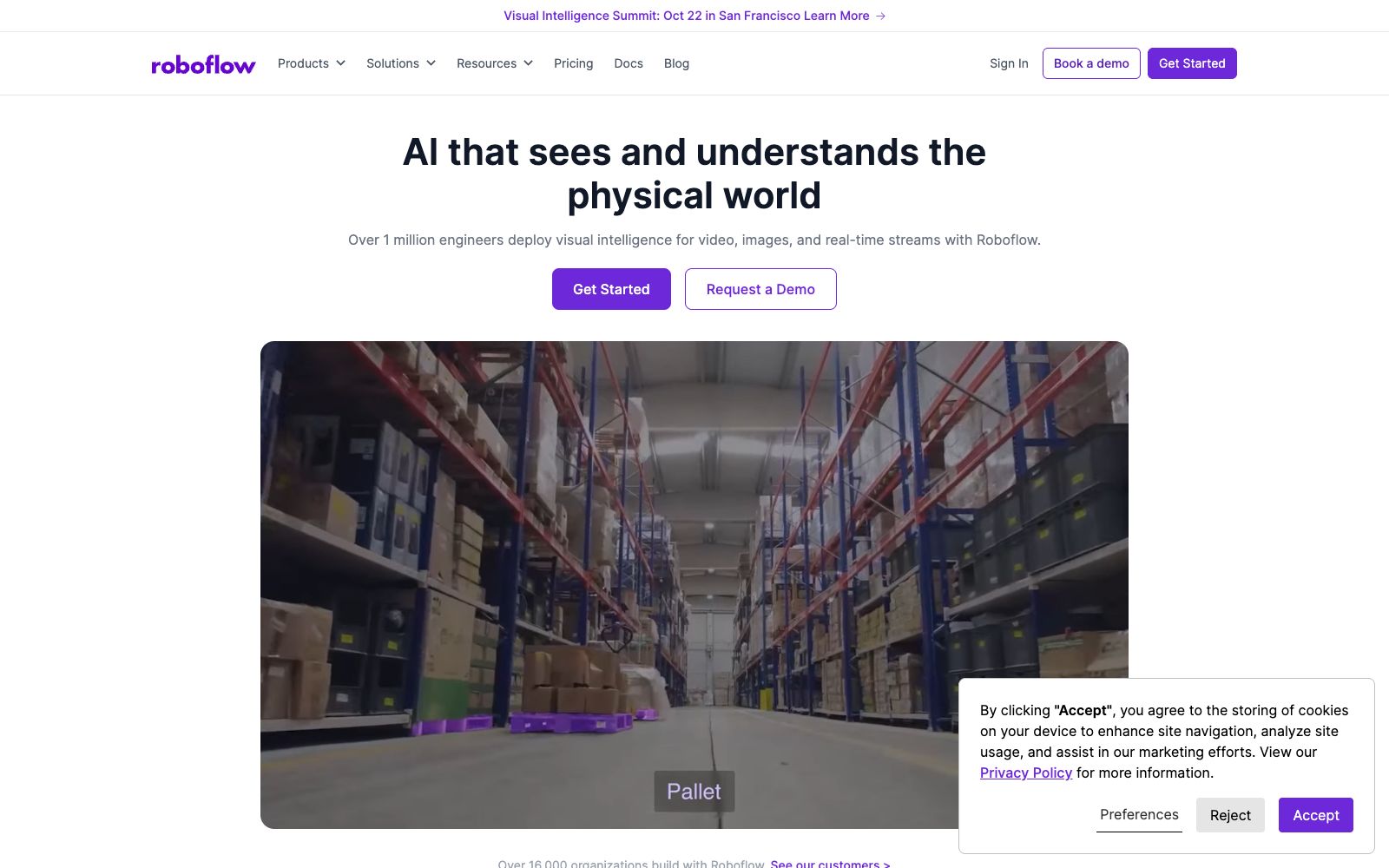
Roboflow is a computer vision platform for developers and enterprises. Its official website positions it as "AI that can see and understand the physical world", integrating the entire pipeline from data to deployment into one platform. The official website summarizes its workflow as follows: select models (use the latest foundation models or fine-tune them for specific needs), turn predictions into actions (chain multiple models, add custom logic, and integrate with existing pipelines), and deploy instantly (run on scalable cloud infrastructure or a fleet of edge devices).
Unlike simple annotation tools or training frameworks, it has a robust open-source ecosystem. The official website lists open-source projects such as supervision, notebooks, trackers, autodistill, and inference, and emphasizes its integration with mainstream frameworks like PyTorch, Ultralytics, and TensorFlow.
The official website states that it is used by over 1 million engineers and 16,000 organizations, and claims that more than half of the Fortune 100 companies build on its platform. Its integrations cover AWS S3, Google Cloud, Azure, CVAT, Labelbox, NVIDIA, Raspberry Pi, and more.
Who is it for?
- Algorithm engineers and machine learning teams that truly want to deploy visual models into production environments
- Automation teams in manufacturing and logistics enterprises performing quality inspection, inventory checking, and inspection tasks
- Developers of robots and edge devices who need to run inference on hardware with limited computing power
- Computer vision teams that need to centrally manage datasets and annotation workflows
- Small and medium-sized enterprises that want to complete annotation, training and deployment on a single platform
Key features
6Model Acquisition and Fine-Tuning
The official website states that users can access the latest foundation models, and also fine-tune the performance for specific scenarios, making trade-offs between general capabilities and specialized precision as needed.
Workflow Orchestration
Chain multiple models together, add custom logic, and integrate with existing business pipelines to convert prediction results directly into executable actions.
Roboflow Inference
An open-source high-performance inference and deployment solution. The official website demonstrates that you can start a local service after installing it via pip, get the model running within two minutes, and provides examples of HTTP client calls.
Edge and Cloud Deployment
The official website states that inference can be performed on scalable cloud infrastructure and can also be deployed to a batch of edge devices; the integration list includes NVIDIA, Luxonis, Raspberry Pi, Kubernetes, etc.
Open-source supporting libraries
supervision provides tools from annotation to object tracking; trackers are multi-object tracking algorithms under Apache 2.0; notebooks offer training examples; autodistill uses large models to automatically label small models.
Data and Third-Party Integrations
The official website lists integrations with storage services such as AWS S3, Google Cloud, and Azure, annotation tools like CVAT and Labelbox, as well as systems such as ROS and SAP.
How to use Roboflow
- The fastest way to get started is to first run the open-source Inference from the official website: after installing and launching the local service, verify it with the official sample model before connecting your own data, which saves time compared to building a training pipeline from the start.
- When working on a project, first clarify the deployment location—cloud API or edge device, which determines the model size and subsequent optimization directions.
- for edge scenarios, prioritize small models with fine-tuning, and consider base models on the cloud.
- Labeled data can be imported from existing tools such as CVAT and Labelbox, and the official website also provides APIs, SDKs, and documentation, so there is no need to reinvent the wheel during the access phase.
- Before training, confirm data authorization and privacy compliance, especially when dealing with facial, medical, or industrial site images.
- prices and free quotas are subject to the official website's Pricing page.
Traffic & popularity
Data month Sep 2026
Roboflow receives about 2.8M visits per month and ranks #8,293 worldwide.
Monthly visits
12 monthsTraffic sources
- Direct42.5%
- Search38.7%
- Social7.8%
- Referrals4.3%
- AI assistants4.1%
- Other2.6%
Top countries
- India16.0%
- Philippines13.3%
- United States12.4%
- Pakistan4.8%
- China3.7%
Estimated from third-party traffic data.
Similar tools
 OpenDataLabThe open data platform launched by the Shanghai Artificial Intelligence Laboratory is officially said to provide high-quality open-source datasets for domestic large models, support dataset retrieval and download, and be equipped with data annotation and governance tools as well as open-source community capabilities.
 UltralyticsUltralytics is the open-source team behind the YOLO series of visual models. Officially, it claims to enable one-stop annotation, training and deployment, supports YOLOv5 to YOLO26, covers detection, segmentation and pose estimation, and a commercial license for enterprise use is required for closed-source commercialization.
 Vertex AIAn AI development platform under Google Cloud, now named Gemini Platform on its official website, provides model invocation, training fine-tuning and agent deployment capabilities, targeting technical teams that need to integrate AI into production systems.
 PaperspaceThe cloud GPU platform under DigitalOcean offers GPU computing power and hosts such as H100, covering the entire process from model development, training to deployment, and also provides cloud desktops and rendering workflows.
 Lightning AIAn AI cloud platform built by the original team of PyTorch Lightning. The official website provides on-demand GPUs, clusters and coding agents, covering the entire process from dataset construction to training and inference, targeting teams that develop dedicated models independently.
 MercorA human resource data platform for the AI field, its official website states that it has built a network of professionals such as doctors, lawyers, and engineers, providing data annotation, model evaluation datasets, human evaluation and agent training services for cutting-edge laboratories and enterprises.