


Tempus
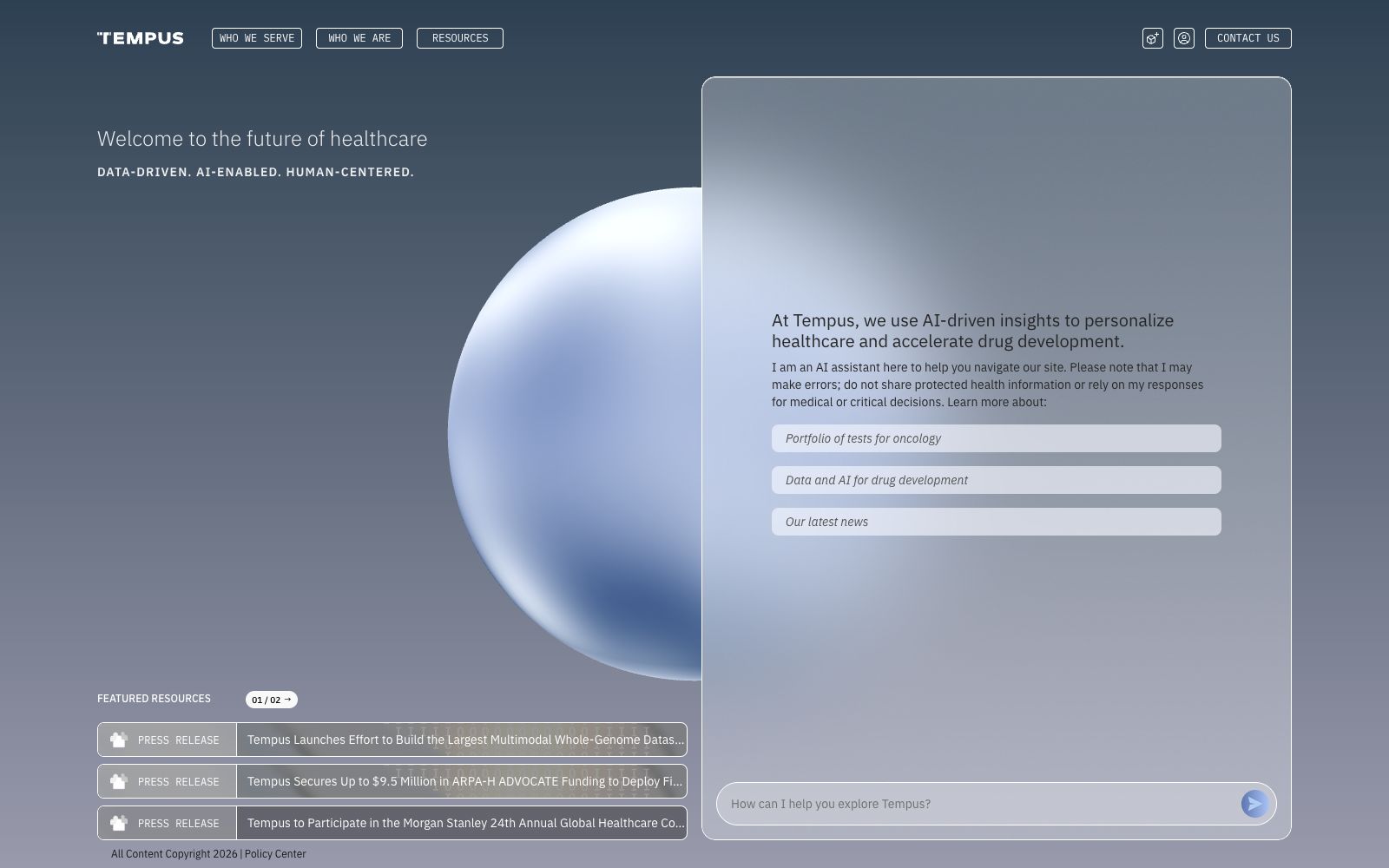
Tempus is an AI precision medicine company founded by Eric Lefkofsky. It provides gene sequencing, the Tempus One assistant and the Lens platform, and uses multimodal data to assist oncologists in decision-making.
Updated: 2026-10-26
What is Tempus?
Tempus is an AI-driven precision healthcare technology company founded in Chicago in 2015 by Eric Lefkofsky and listed on Nasdaq in 2024 (ticker symbol: TEM). Unlike laboratories that only conduct genetic testing, Tempus integrates multi-modal data such as genomics, clinical records, pathology, and imaging. It then uses AI and software layers to transform this data into actionable decision-making insights for doctors, positioning itself as an infrastructure that "enables every patient to benefit from the treatment experience of others."
Who is it for?
- Oncologists who need interpretation of molecular test results and decision-making for targeted or immunotherapy.
- Hospitals and cancer centers looking to establish or expand precision medicine programs.
- Pharmaceutical companies and biotech firms that use real-world data for target discovery and trial design.
- Patients who wish to participate in clinical trial matching and obtain next-generation sequencing (NGS) (must be prescribed by a doctor).
- Research and public health institutions focused on multimodal data governance and AI modeling.
Key features
6Tempus One
A generative AI clinical assistant for oncologists, which allows voice-activated access to patient insights, streamlines the prescription and interpretation of genetic tests, and transforms unstructured medical records into queryable information.
Tempus Hub
A unified workstation for physicians, integrating test ordering, result viewing and complete clinical context, and embedded into existing EHRs and workflows.
Tempus Lens
An agent-based AI platform for pharmaceutical companies and research institutions, which can explore patterns on massive de-identified clinical and molecular data, discover drug targets, and design clinical trials.
Tempus Next
An intelligent AI care pathway platform that real-time compares patient data with clinical guidelines, flags patients who have deviated from standard care, and suggests subsequent interventions.
Tumor Diagnostic Panel
Provides tests such as xT CDx (FDA-approved 648-gene solid tumor panel), xR, xF, xE, hereditary risk (CancerNext, including Ambry Genetics) and MRD (xM).
Real-world data
Officially states that it connects more than 4,500 medical institutions, accumulates over 45 million de-identified medical records, and partners with more than 50% of academic medical centers across the United States.
How to use Tempus
- 1Patient side: Testing must be ordered by a doctor, and results must be interpreted by a clinician. AI insights are for reference only, and medication and treatment plans must follow medical advice.
- 2For institutions: First, use Tempus Hub to complete the closed loop of ordering, viewing and interpreting, then add Lens and Next to carry out scientific research and pathway management.
- 3Pay attention to the boundaries of data compliance and de-identification, and confirm access permissions and retention strategies before cross-institutional collaboration.
- 4Evaluate costs: Tempus offers financial assistance for U.S. patients, while most international patients pay out of pocket. Be sure to clarify the out-of-pocket maximum before placing an order.
- 5Official regulations, indications and medical insurance policies are subject to change; prior to formal procurement or clinical application, the official website and contract shall prevail.
Traffic & popularity
Data month Sep 2026
Tempus receives about 71.3K visits per month and ranks #491,525 worldwide.
Monthly visits
12 monthsTraffic sources
- Search46.4%
- Referrals29.3%
- Direct19.1%
- Social2.7%
- Mail1.6%
- Other0.8%
Top countries
- United States77.2%
- India1.8%
- United Kingdom1.8%
- Canada1.5%
- Brazil1.4%
Estimated from third-party traffic data.
Similar tools
 AbridgeAbridge is a generative AI clinical documentation tool for doctors. It real-time generates structured medical records, coding and summaries during doctor-patient conversations. It is built by clinicians for clinicians, and the notes need to be reviewed by doctors.
 Insilico MedicineInsilico Medicine is a clinical-stage biotech company using generative AI for drug discovery. Its platform includes PandaOmics for target identification, with public pipelines covering fibrosis and tumors. The drugs under research have not been marketed yet and should be taken under medical advice.
 Tencent MiyingTencent's first product that applies AI to medicine focuses on AI medical imaging and AI-assisted medical diagnosis. It provides products such as an open experimental platform and imaging cloud, serving hospitals, physical examination institutions and scientific research teams.
 Docus AIDocus is an AI platform for medical testing institutions, providing test report interpretation, follow-up suggestions, compliance verification, and digital order forms, helping laboratories increase retest rates and operational efficiency.
 Senyi IntelligenceA medical big data and artificial intelligence enterprise, it is officially stated that it uses four product lines: AI clinics, clinical auxiliary decision-making and quality control, hospital operation management, and clinical research to help hospitals conduct medical record quality control, build specialized disease databases, and carry out multi-center scientific research collaboration.
 AidocAidoc is a clinical AI platform for healthcare, equipped with FDA-certified radiology and cardiovascular algorithms. It converts clinical signals into actionable decision support and faster care, covering departments such as radiology, cardiology, and neurology.