


Heidi
An AI medical assistant for clinic consultations can sort doctor-patient conversations into medical records, retrieve guidelines and literature and mark sources during diagnosis and treatment, while emphasizing compliance. It is suitable for outpatient doctors and residents.
Updated: 2026-10-26
What is Heidi?
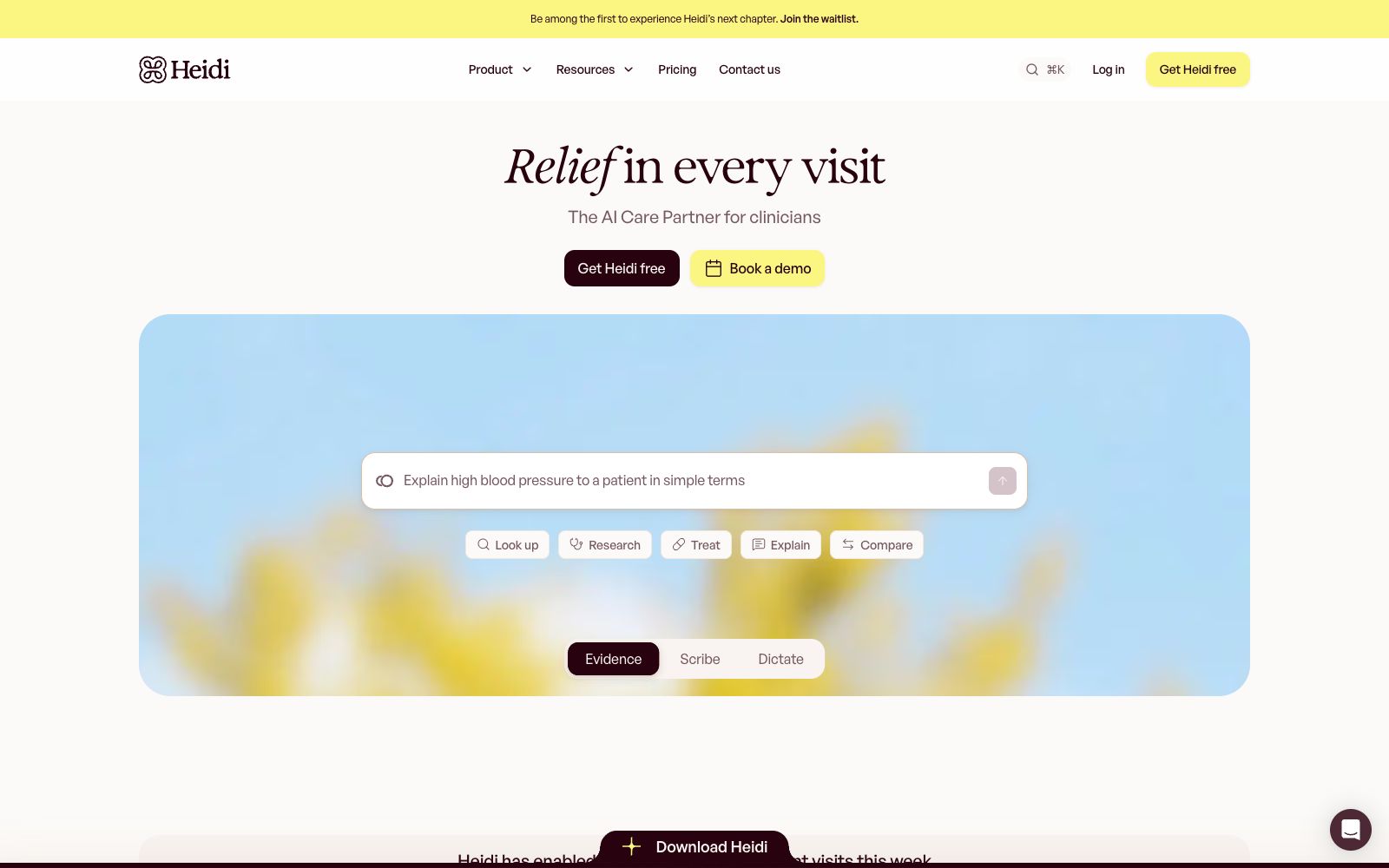
Heidi is an AI medical assistant for clinical scenarios, officially positioned as an "AI care partner". It mainly does two things: sort out doctor-patient conversations during diagnosis and treatment into medical records, and retrieve credible guidelines and research literatures on the spot during diagnosis and treatment. Unlike recording tools that only do speech-to-text, it integrates "writing medical records" and "finding evidence" into the same workflow, and lists HIPAA, GDPR and safety instructions in a single column in the footer of the official website. The official website provides a free start button.
Who is it for?
- Outpatient doctors: They see a large number of patients in a day and hope to generate medical records while conducting consultations, eliminating the need to catch up on writing them after work.
- Resident physicians and medical trainees: They need to write a large number of progress notes after ward rounds and quickly verify guidelines and medication basis.
- Specialist doctors with high evidence-based medicine requirements: They need to look up the original texts and sources of guidelines on the spot in the consultation room instead of going back to their offices to search through literature.
- IT leaders at clinics or hospitals: They need to evaluate whether the tool complies with requirements such as HIPAA and GDPR before deciding to adopt it.
Key features
5AI Support for Medical Records
The official states that it can assist in drafting medical records based on conversations during diagnosis and treatment, reducing the time spent on writing medical records afterward.
AI Evidence Retrieval
The official description states that it can retrieve credible clinical guidelines and research literature at any time, while viewing relevant medical information and their sources to facilitate on-site citation during outpatient consultations.
Unified Screen for Documentation and Verification
The two functions are integrated into a single interface, eliminating the need to switch to a separate literature system while writing medical records.
Compliance and Safety Statement
The official website lists HIPAA, GDPR, and safety clauses separately in the footer, enabling institutions to evaluate data processing methods.
Japanese Localization
The official website features a Japanese interface, accompanied by localized product descriptions and support portals, allowing clinics in non-English speaking regions to use it directly as a reference.
How to use Heidi
- First, use the free entry on the official website to run a section of de-identified real consultation audio to check if the transcription quality and medical record structure conform to the writing habits of your department.
- Treat evidence retrieval as an aid rather than a conclusion: The official emphasizes that sources will be provided, and the final judgment still requires doctors to verify the original text themselves.
- Before formally accessing patient data, have the institution's legal team confirm the deployment method, data retention, and cross-border terms before deciding to use it for real outpatient consultations.
- The official website is currently mainly in Japanese.
- Before use, Chinese medical departments should confirm the support for target languages to avoid inconsistent terminology.
- It is recommended to retain a manual review process after generating records, especially for the diagnostic conclusions and medication sections, and do not sign and file them directly.
Traffic & popularity
Data month Sep 2026
Heidi receives about 1.3M visits per month and ranks #35,152 worldwide.
Monthly visits
12 monthsTraffic sources
- Direct69.9%
- Search16.3%
- Referrals6.0%
- Mail2.6%
- Display ads2.6%
- Other2.6%
Top countries
- Canada39.3%
- Australia25.1%
- United States11.3%
- United Kingdom8.8%
- South Africa5.7%
Estimated from third-party traffic data.
Similar tools
 FreedAI medical record assistant for independent clinics organizes consultation dialogues into notes that can be synchronized with electronic medical records, provides coding suggestions and cited clinical Q&As, helping doctors spend less time writing medical records.
 Lyrebird HealthA clinic recording assistant for clinicians, which real-time converts consultation dialogues into structured medical records, synchronizes bidirectionally with EMR, and automatically generates referral letters and care plans, suitable for general practice and specialized departments.
 DoctronicDoctronic connects AI consultations with real doctors. The official statement says you can describe your symptoms anonymously for free and get a treatment plan. A 39-dollar video consultation is available, suitable for pre-visit inquiries and prescription refills.
 Docus AIDocus is an AI platform for medical testing institutions, providing test report interpretation, follow-up suggestions, compliance verification, and digital order forms, helping laboratories increase retest rates and operational efficiency.
 SnapEat AIAI calorie logging and diet tracking app that can recognize food and calculate nutritional information with just a photo, providing personalized meal suggestions, goal progress tracking, and fitness device data synchronization, targeting people who need weight loss and diet management.
 PearlPearl is an imaging AI for dental clinics. Officially, it can detect 37% more lesions, color-code findings in images and convert them into patient-friendly reports. It covers 2D and 3D imaging and is suitable for clinics and chain organizations.