


Aidoc
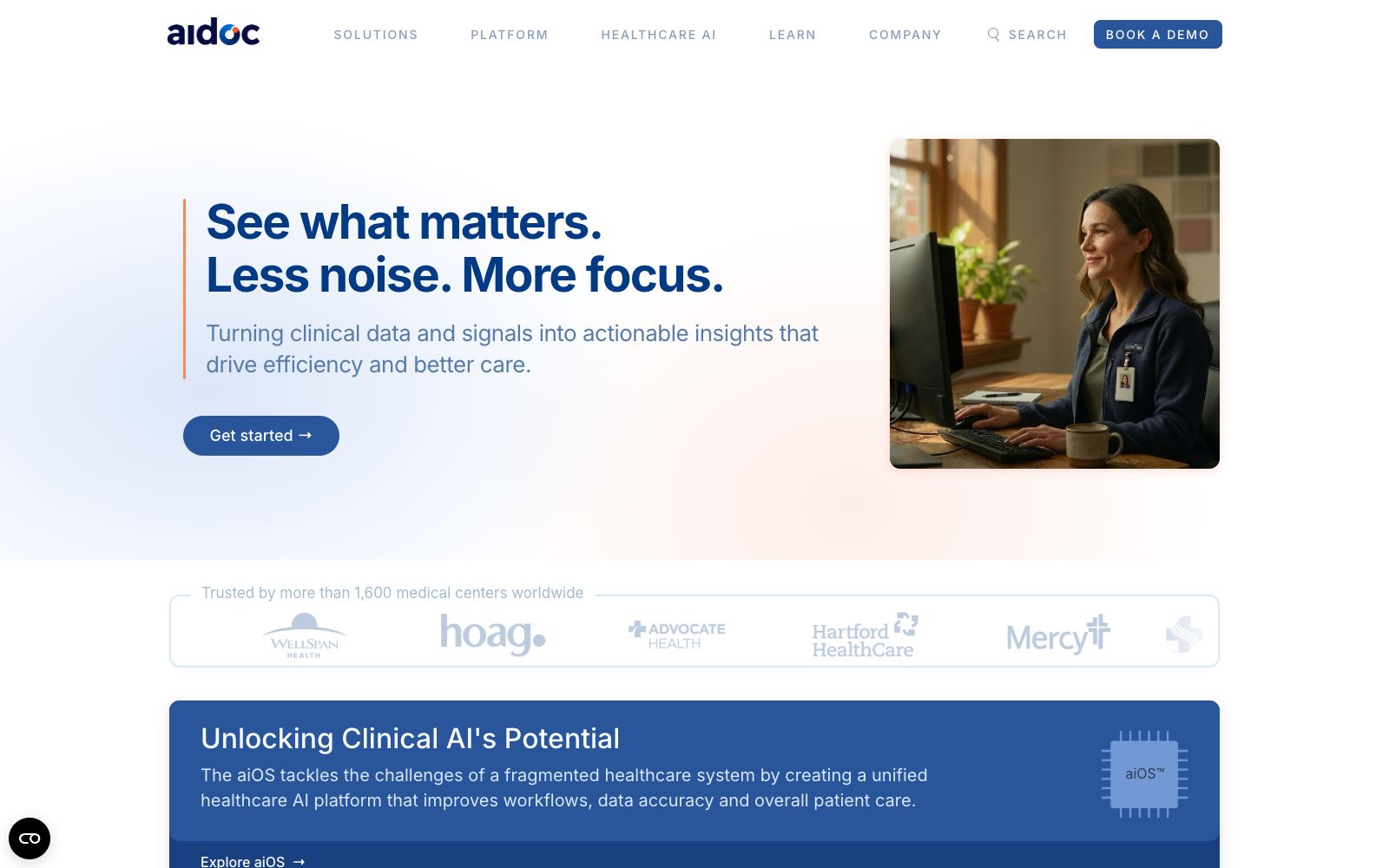
Aidoc is a clinical AI platform for healthcare, equipped with FDA-certified radiology and cardiovascular algorithms. It converts clinical signals into actionable decision support and faster care, covering departments such as radiology, cardiology, and neurology.
Updated: 2026-10-26
What is Aidoc?
Aidoc is a clinical AI platform for healthcare providers, positioned to empower clinicians with faster and more accurate decision support. It features a self-developed aiOS enterprise platform and multiple FDA-cleared radiology and cardiovascular algorithms. The platform focuses on converting clinical data and signals into actionable insights to enhance efficiency and care quality, while emphasizing end-to-end integration with hospitals' existing IT infrastructure for scalable deployment. For clinicians and hospital administrators, it consolidates scattered specialty algorithms into a single platform, enabling AI to truly integrate into existing clinical workflows rather than operating in isolation. Its value does not lie in replacing physicians, but in ensuring that critical findings reach the right people at an earlier stage.
Who is it for?
- Hospitals and imaging centers: Need to implement AI at scale and integrate it into existing workflows.
- Clinical teams such as radiology departments, cardiology departments, and neurology departments: who wish to prioritize critical findings.
- Healthcare IT professionals and managers: Focus on deployment costs, ROI, and interoperability.
- Evidence-driven clinical institutions: Value research, case studies, and measurable outcomes.
- Multi-department collaborative medical institutions: Require a unified platform to manage different specialized algorithms.
Key features
5Radiology Support
Run a large number of FDA-cleared algorithms on a single platform, prioritize findings, activate care teams, and integrate into existing workflows.
Cardiology
Consistently measure diseases and capture incidental findings, covering coronary artery disease, echocardiography, etc., to support quantitative assessment.
Neurovascular
Set neurological care standards with real-time notifications, cover acute scenarios such as stroke, and seize the treatment time window.
Spine & Vascular
Streamline workflows and centrally manage patients, cover protocols such as VTE and aorta, and unify treatment pathways.
aiOS Platform
Provides end-to-end integration with existing IT infrastructure, including care coordination, patient management, system integration, and third-party algorithm partners.
How to use Aidoc
- 1Start with the most mature algorithms such as those in radiology, then expand to cardiology, neurology, spine, and vascular care, gradually building trust.
- 2Leverage aiOS for integration with existing IT systems to minimize additional implementation burdens and shorten launch time.
- 3Use AI findings as a tool for "prioritization and activation" rather than replacing clinical judgment, ensuring clear accountability for clinical care.
- 4Follow the BRIDGE guidelines and AI strategic framework to establish scalable implementation paths and evaluation mechanisms.
- 5When conducting evaluations, base your assessment on real-world research and customer success stories to verify improvements in efficiency and outcomes, rather than relying solely on demonstrations.
Traffic & popularity
Data month Sep 2026
Aidoc receives about 38.0K visits per month and ranks #966,591 worldwide.
Monthly visits
12 monthsTraffic sources
- Search66.2%
- Direct21.9%
- Referrals7.4%
- Social2.4%
- AI assistants2.0%
Top countries
- United States55.1%
- Israel11.3%
- Brazil4.1%
- Australia2.9%
- Germany2.5%
Estimated from third-party traffic data.
Similar tools
 United Imaging IntelligenceAn AI medical company under United Imaging Group, it officially states that it focuses on the Yuanzhi Medical Large Model and hospital-level AI imaging solutions, provides imaging quality control, auxiliary diagnosis and multimodal imaging assessment capabilities, and undertakes multiple national-level intelligent diagnosis and treatment research projects.
 AbridgeAbridge is a generative AI clinical documentation tool for doctors. It real-time generates structured medical records, coding and summaries during doctor-patient conversations. It is built by clinicians for clinicians, and the notes need to be reviewed by doctors.
 Senyi IntelligenceA medical big data and artificial intelligence enterprise, it is officially stated that it uses four product lines: AI clinics, clinical auxiliary decision-making and quality control, hospital operation management, and clinical research to help hospitals conduct medical record quality control, build specialized disease databases, and carry out multi-center scientific research collaboration.IInfervisionAn enterprise focusing on AI medical imaging, officially stated that InferRead covers major diseases such as lung diseases and cardiovascular and cerebrovascular diseases, InferOperate provides intelligent surgical planning and intraoperative navigation, and its products have obtained market access in multiple overseas markets.
 Insilico MedicineInsilico Medicine is a clinical-stage biotech company using generative AI for drug discovery. Its platform includes PandaOmics for target identification, with public pipelines covering fibrosis and tumors. The drugs under research have not been marketed yet and should be taken under medical advice.
 Tencent MiyingTencent's first product that applies AI to medicine focuses on AI medical imaging and AI-assisted medical diagnosis. It provides products such as an open experimental platform and imaging cloud, serving hospitals, physical examination institutions and scientific research teams.