

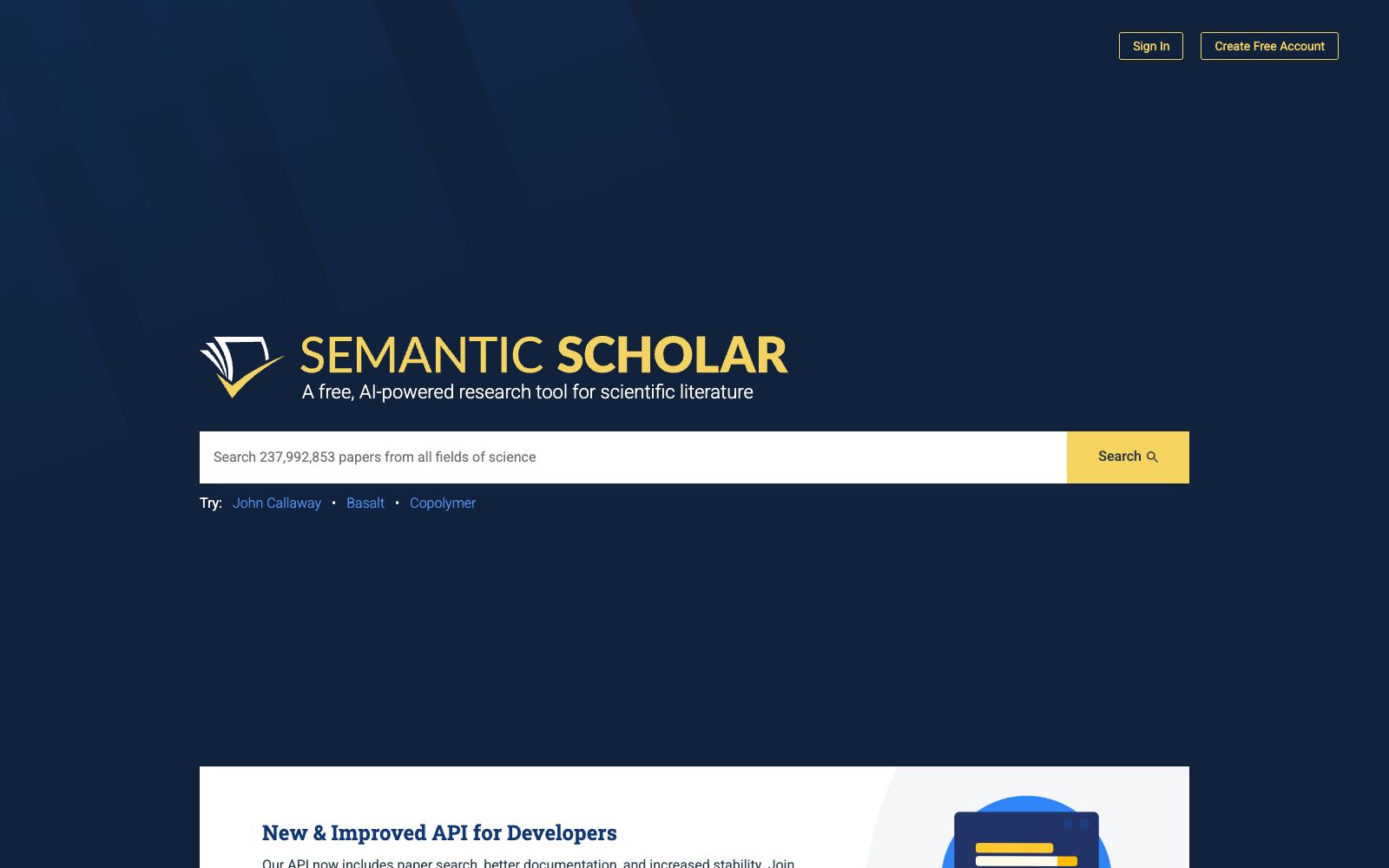

Semantic Scholar
Semantic Scholar is an academic search tool developed by the Allen Institute for Artificial Intelligence (Ai2). According to its official website, it can search more than 200 million papers, provides TLDR summaries, high-impact citations and literature libraries, and also offers paper Q&A and APIs.
Updated: 2026-10-26
What is Semantic Scholar?
Semantic Scholar is an academic search tool launched by the Allen Institute for Artificial Intelligence (Ai2). Its official website defines it as a free tool that uses AI and engineering methods to understand the semantics of scientific literature and help researchers discover relevant research. It is more than just title search: the results page comes with AI-generated TLDR short summaries, the paper page allows viewing high-impact citations and related topics, and you can directly ask questions about a single paper. The official homepage shows that the number of retrievable papers exceeds 200 million, covering all scientific fields. There are also APIs and an API Gallery for developers.
Who is it for?
- Graduate students and researchers who are embarking on a new direction and need to quickly grasp the context of the field
- People doing literature reviews who use high-impact citations and research alerts to narrow their reading scope
- Writers who need to batch export citations in formats such as BibTeX
- Researchers who track the latest citations of a specific author or a particular paper
- Engineers who want to perform secondary development using large-scale literature data
- Researchers looking for interdisciplinary sources who can't think of the right keywords to search with
Key features
6Semantic Search
The official website states that it can search papers across all scientific fields and supports filtering by journals and conferences, authors, publication types, and time ranges.
TLDR Summary
An ultra-short abstract generated by AI that summarizes the main objectives and findings of the paper. According to the official, it covers nearly 60 million papers in the fields of computer science, biology and medicine.
High-Impact Citations
The official states that machine learning models are used to filter out citations that have a significant impact on the citing papers, helping users prioritize important ones among a large number of citations.
Library & Research Alerts
After logging in, you can save papers to an online library, organize them into folders, export citations in bulk, share folders for collaborators to copy with one click, and enable AI-powered research alerts for folders to receive regular recommendations of new papers.
Alerts & Author Pages
You can set up new citation alerts for a specific paper, or follow authors to get alerts about their new papers; after claiming your author page, you can view the latest citation status of your own papers.
Paper Q&A and Topic Pages
The Ask This Paper feature on the paper page allows you to ask questions about the article with supporting sentences from the original text attached; the Topics page compiles AI-generated definitions, highly cited papers, and related topics, and the official states that it is currently only open to the computer science field.
How to use Semantic Scholar
- First, filter out irrelevant content using TLDR and summaries, then read the full text.
- Do not get stuck in full-text perusal during the retrieval stage.
- After identifying several core papers, place them in the same literature library folder and enable research alerts.
- The official recommendation is to include 5 relevant papers and mark 3 irrelevant ones as irrelevant to train the recommendation system, which will significantly speed up the convergence rate.
- For citation lists, prioritize high-impact citations, then trace back along the chain.
- Ask This Paper is officially stated to be currently available only on some papers and has mainly been tested on English papers, so exercise caution when using it across languages.
- Topics and some capabilities are in beta or limited scope, and the coverage may change, subject to the current official website instructions.
- Note that it does not include the full texts of all paid databases.
- access the original text through institutional subscriptions or publisher channels when off-campus.
Traffic & popularity
Data month Sep 2026
Semantic Scholar receives about 4.9M visits per month and ranks #12,810 worldwide.
Monthly visits
12 monthsTraffic sources
- Search67.3%
- Direct22.9%
- Referrals4.8%
- Social2.6%
- AI assistants1.9%
- Other0.6%
Top countries
- United States20.1%
- Indonesia10.0%
- India6.4%
- Germany4.1%
- Philippines3.5%
Estimated from third-party traffic data.
Similar tools
 ResearchRabbitAn AI tool focused on literature review, which generates citation maps from a seed paper and continuously recommends relevant literature, new authors and emerging directions. Its official website shows that it has access to over 310 million papers, and registration is free.
 ScholarcyScholarcy is an AI summarization and literature management tool for academic papers. It can convert papers, articles, textbooks and videos into structured summary cards, and supports citation organization and export to note-taking applications.
 sciteAn AI tool for academic research, which uses intelligent citations to indicate whether papers are supported or refuted, has a search coverage of over 300 million articles, preprints and patents, can be integrated with Claude, ChatGPT and Zotero, and provides verifiable evidence.
 R DiscoveryA literature reading and retrieval application for researchers, officially claiming to include hundreds of millions of papers and preprints. It offers AI abstracts, paper Q&A, literature review generation and translation, and supports web and mobile access.
 Connected PapersConnected Papers is a tool that helps researchers visually explore academic literature. Entering a single paper generates a relational graph of related papers, which is used for topic selection research, filling knowledge gaps, and constructing reference lists.
 ExplainpaperAfter uploading the paper, you can get a popular explanation by selecting words, ask questions about the entire paper and automatically generate key insights. The official says it has been used by more than 400,000 researchers, helping readers understand obscure literature faster.