


ResearchRabbit
An AI tool focused on literature review, which generates citation maps from a seed paper and continuously recommends relevant literature, new authors and emerging directions. Its official website shows that it has access to over 310 million papers, and registration is free.
Updated: 2026-10-26
What is ResearchRabbit?
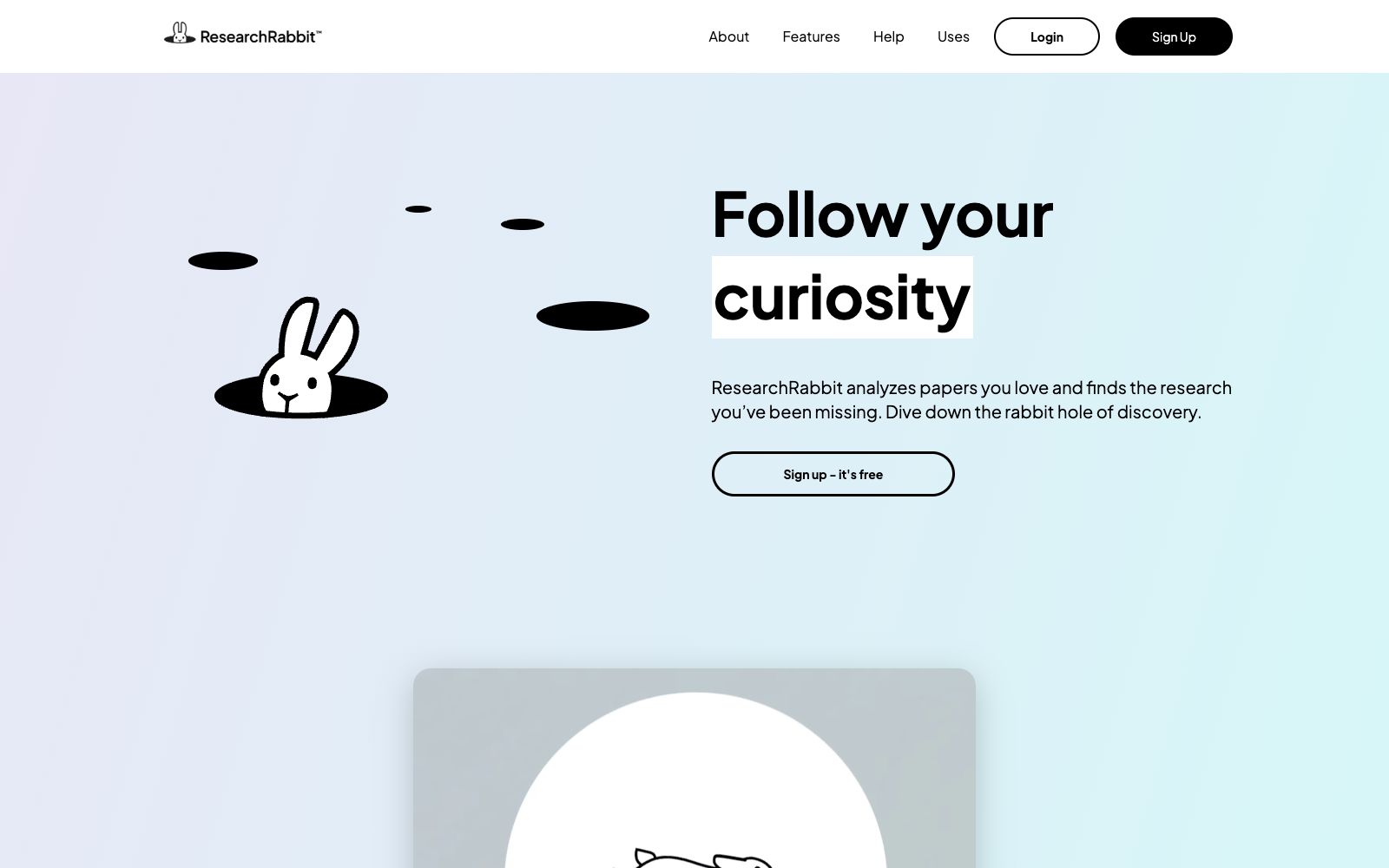
ResearchRabbit is an AI tool for literature reviews. Its official website positions itself as "An AI Tool for Smarter, Faster Literature Reviews", with the core concept of "Follow your curiosity": you feed it a favorite paper as a seed, and it uncovers related research you might have missed. Unlike traditional literature database searches (where you actively piece together keywords), it maps the citation relationships between papers into an explorable graph, and uses a recommendation engine to continuously push relevant literature, new authors and emerging directions as you explore. According to its official website, it has integrated over 310 million academic papers, and registration is free.
Who is it for?
- Graduate and doctoral students working on literature reviews and proposal reports.
- Researchers who need to map the citation network of a specific field and identify key papers.
- People who already manage literature with Zotero and wish to create visual connections.
- Researchers who want to identify gaps in literature reviews and track emerging authors and new research directions.
- Cross-institutional collaboration teams that need to share the same literature map and collection.
Key features
6Seed Paper Discovery
Take a paper you have read as the seed, the system automatically finds relevant papers and expands along the citation chain, turning a single document into a "mind map".
Citation Graph Visualization
Visualizes the citation and cited relationships between papers into an interactive map, allowing you to intuitively see which works are connected to each other and which are key nodes.
Literature Recommendation Engine
The more you explore, the more the engine understands your research direction, and it continuously recommends relevant studies, newly emerging authors, and cutting-edge research topics.
Citation Library Integration
You can connect your existing reference library (such as Zotero) with ResearchRabbit to discover overlooked studies on top of your existing collections.
Research Trend Tracking
Track the research trends of a specific field or topic, helping to grasp the changes in directions and the migration of hotspots.
Collections and Collaboration
Organize papers into collections for easy topic-based management and sharing of literature maps with collaborators.
How to use ResearchRabbit
- The most convenient way is to start with a "seed paper" that you have already understood, ask the system to generate a citation map, and then explore further along the branches, which is much more efficient than thinking of keywords out of thin air.
- Make good use of collections to group relevant papers by theme, and the recommendation engine will become more and more accurate with your organization.
- If you are using Zotero, it is recommended to connect and sync your library first to avoid duplicate entries and inconsistent standards.
- This tool is free to use upon registration.
- if there are more advanced institutional authorizations or paid tiers, please refer to the official website's on-page instructions for details.
- It should be noted that its citations and paper data come from third-party academic databases, and the key conclusions and citation relationships should still be subject to the original texts and databases.
Traffic & popularity
Data month Sep 2026
ResearchRabbit receives about 270.7K visits per month and ranks #167,797 worldwide.
Monthly visits
12 monthsTraffic sources
- Search46.4%
- Direct43.6%
- Referrals4.2%
- AI assistants2.8%
- Social2.0%
- Other1.0%
Top countries
- United States11.7%
- India10.2%
- Indonesia8.3%
- Germany6.6%
- Chile4.4%
Estimated from third-party traffic data.
Similar tools
 Semantic ScholarSemantic Scholar is an academic search tool developed by the Allen Institute for Artificial Intelligence (Ai2). According to its official website, it can search more than 200 million papers, provides TLDR summaries, high-impact citations and literature libraries, and also offers paper Q&A and APIs.
 LitmapsA literature management software for literature reviews connects the process of finding papers and sorting out the context through four steps: discovery, visualization, collaboration and monitoring, and it can also generate BibTeX citations. It is suitable for graduate students and researchers who write literature reviews and prepare research proposals.
 Connected PapersConnected Papers is a tool that helps researchers visually explore academic literature. Entering a single paper generates a relational graph of related papers, which is used for topic selection research, filling knowledge gaps, and constructing reference lists.
 SciSpaceSciSpace is an AI academic research assistant developed by PubGenius. According to the official statement, it can conduct systematic literature reviews across more than 280 million papers and write papers with citations, covering scenarios such as literature retrieval, PDF reading, and review writing.
 Qiewen AcademicAn AI academic search and literature discovery tool for researchers, supporting deep retrieval, citation network expansion, knowledge base Q&A, and paper reproduction. Its official website states that it can track research trends and provide personalized recommendations.
 UndermindUndermind is an AI co-researcher for researchers, focusing on the literature domain. It can read full texts and charts, retrieve along citation chains and cite point by point, and help users build a dynamic literature library from broad to in-depth.