


scite
An AI tool for academic research, which uses intelligent citations to indicate whether papers are supported or refuted, has a search coverage of over 300 million articles, preprints and patents, can be integrated with Claude, ChatGPT and Zotero, and provides verifiable evidence.
Updated: 2026-10-26
What is scite?
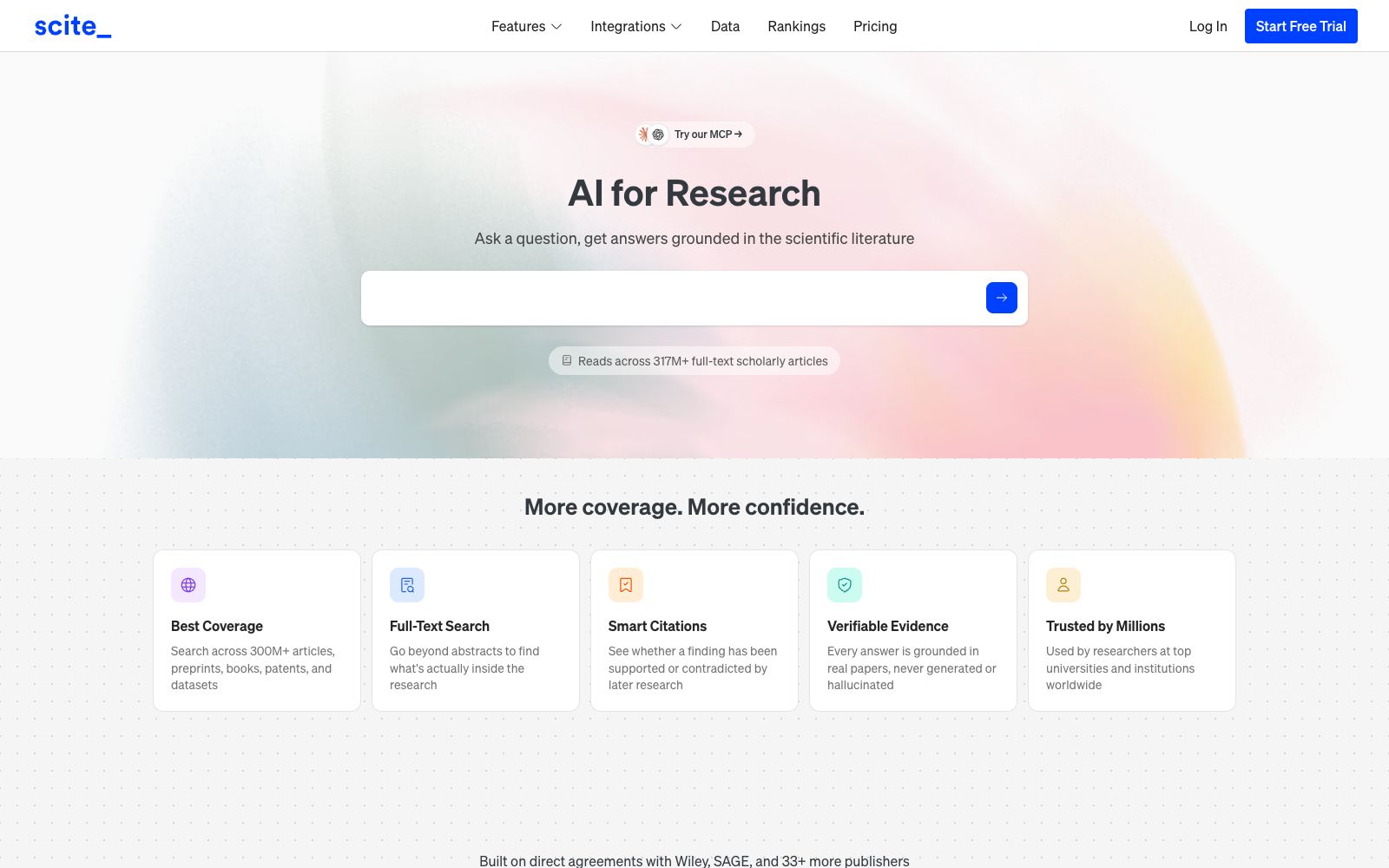
scite is an AI tool for academic research. Its official website states that its goal is to "show you how every claim is supported or disputed". Its most distinctive feature is "Smart Citations": traditional citations only count how many times a paper has been cited, while scite indicates whether subsequent research supports, refutes, or merely discusses the paper, thereby helping to determine whether a finding is valid. According to its official website, its search scope covers more than 300 million academic articles, preprints, books, patents, and datasets, and it builds its database through direct licensing with more than 35 publishers (including Wiley, SAGE, etc.). It can be used independently as well as integrated with Claude, ChatGPT, Zotero, and custom APIs.
Who is it for?
- Researchers conducting systematic reviews, meta-analyses, and needing to evaluate the strength of evidence.
- Reviewers and scholars who want to verify whether a conclusion has been refuted or supported by subsequent research.
- Researchers in medicine and clinical fields who need to track clinical trials and patents.
- People who already use Zotero, Claude, or ChatGPT workflows and want to integrate citation verification into them.
- Institutions or teams that want to integrate scite into their own research systems via APIs.
Key features
6Smart Citations
Labels each paper with whether subsequent research is "supporting / contradicting / discussing", upgrading citation counts to stance-based citation signals.
Full-text Academic Search
It indexes over 300 million articles, preprints, books, patents and datasets, and can dive into full texts rather than just abstracts.
Verifiable Evidence-Based Answers
AI assistants answer based on real papers, with each conclusion accompanied by traceable literature sources rather than being generated out of thin air.
Multi-type Databases
In addition to journal articles, the database extends to patents, clinical trials, research grants, preprints and datasets, making it easy to track the entire process of an idea from conception to implementation.
Publisher-Authorized Library
Built on direct licensing with over 35 publishers and open access corpora, allowing access to full paper content even behind paywalls.
Integration and API
Can be invoked in Claude, ChatGPT, or any MCP-compatible assistant, integrated with Zotero, or embedded into team-built systems via APIs.
How to use scite
- When retrieving a conclusion, prioritize the distribution of "supporting/contradicting" in Smart Citations rather than just looking at citation counts—many citations do not mean the conclusion is reliable.
- Make good use of full-text search to locate evidence paragraphs within the paper instead of just skimming the abstract.
- If you are using the Zotero or MCP assistant, it is recommended to integrate scite into your existing workflow to automate citation checks.
- The official website offers a free trial.
- deep retrieval and API calls are part of the paid tier, so evaluate them on demand.
- It should be emphasized that AI responses are only auxiliary clues.
- Key claims should be based on the original text and databases, and cross-verify once again before formal publication or decision-making.
Traffic & popularity
Data month Sep 2026
scite receives about 1.5M visits per month and ranks #33,445 worldwide.
Monthly visits
12 monthsTraffic sources
- Direct45.5%
- Search32.9%
- AI assistants8.4%
- Referrals7.5%
- Social3.3%
- Other2.5%
Top countries
- Iraq16.1%
- Indonesia11.1%
- United States9.3%
- India8.4%
- Philippines6.8%
Estimated from third-party traffic data.
Similar tools
 Semantic ScholarSemantic Scholar is an academic search tool developed by the Allen Institute for Artificial Intelligence (Ai2). According to its official website, it can search more than 200 million papers, provides TLDR summaries, high-impact citations and literature libraries, and also offers paper Q&A and APIs.
 ConsensusAn AI academic search engine for peer-reviewed literature. You can retrieve evidence from 250 million papers by asking questions in natural language, visually present the consensus and divergence of research conclusions, and support Deep Search automated reviews and medical modes.
 Nightwatch AI TrackingNightwatch AI Tracking helps brands monitor their visibility, position, share of voice, and sentiment across ChatGPT, Claude, Gemini, and Perplexity. It also connects AI citations with Google ranking data, giving teams a clearer view of how their brand performs in AI-powered search.
 ElicitAI research assistant: Enter a research question to search over 125 million papers, automatically generate cited structured research reports, and support data extraction, systematic literature reviews, and library alerts.
 AMinerAn AI-driven technology intelligence and academic search platform, which, according to the official, provides scholar portraits, paper retrieval and AI research assistants. It can assist in designing experiments, building review frameworks and writing paper introductions, and uses intelligent agents to track and summarize the latest papers every day.
 AnaraAnara is an AI research workbench for scientific research scenarios. It can search literature databases and full-network papers, conduct comprehensive analysis and table extraction across more than a thousand documents, and automatically provide clickable and verifiable citation sources during writing.