


Rome
Open-source agent operating system: describe your goals through conversation, and the Agent can build tools by itself, save actions, retain context and have cross-task reusability. It supports self-hosting and can be connected to your existing cutting-edge coding models and subscription plans.
Updated: 2026-10-27
What is Rome?
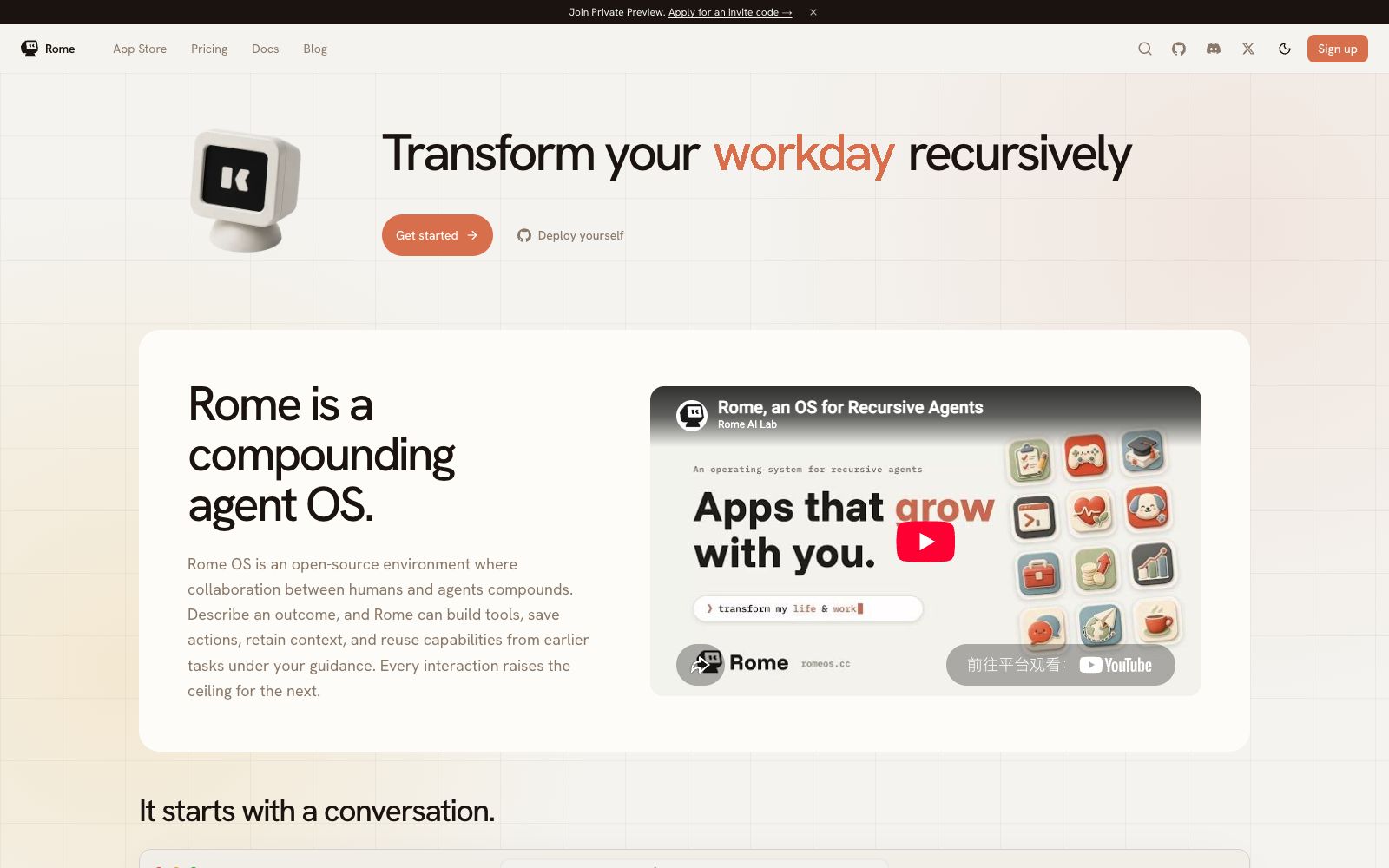
Rome is an open-source "compound interest" intelligent agent operating system, officially described as an environment designed for recursive agents: you describe an outcome, and under your guidance, Rome will build its own tools, save actions, retain context, and reuse the capabilities accumulated from previous tasks in the next one. Unlike one-time question-and-answer assistants, its core concept is "every interaction raises the bar for the next one" — the official metaphor is to give the agent a place to grow, starting from a workflow, letting Rome retain effective parts and achieve continuous compound interest. It supports self-hosting and can also integrate with your existing cutting-edge models and coding agent subscriptions.
Who is it for?
- Developers and independent developers who want to quickly turn ideas into small tools or applications using natural language.
- Engineers who maintain open-source or team projects and want to automate issue triage and code review cycles.
- Founders and product managers who need to continuously conduct user interviews and track information.
- Geek users who value data privacy and wish to self-host and customize their agent environments.
Key features
6Conversational App Building
Describe the outcome from a single idea. The official demo shows you can directly turn an idea into a runnable application and host it under a personal subdomain in the format of your.romeos.cc.
Tool Construction and Reuse
Rome can build tools and save actions for tasks, accumulate effective capabilities, and reuse them in subsequent tasks to avoid reinventing the wheel.
Context Retention
Preserves memory and context across tasks, eliminating the need to re-explain the background from scratch in every conversation.
Coding Workflow Automation
Official examples include running automated code review cycles, i.e., continuously fixing P1 and P2 issue comments until there are no merge blockages, and building an automatic GitHub Issue triage application with a single prompt.
Life and Research Scenarios
It can track the price of a certain game and send an alert when the price drops to a set value, as well as automatically interview multiple customers, probe for details, and summarize areas that need improvement.
Private & Controllable
The official statement says you decide what Rome can access, connect to, and remember. Its open-source code allows you to review it yourself and customize it to your own needs.
How to use Rome
- Currently in Private Preview, an invitation code is required to apply on the official website.
- You can first learn about the mechanism through the GitHub repository, Docs, and Blog before getting started.
- Start with a specific, verifiable workflow (such as issue triage), let Rome accumulate effective actions, and then gradually expand to more tasks.
- Do not cover all scenarios at once.
- When getting started, carefully configure the repositories, connections, and memory scope it can access.
- keep the permissions as narrow as possible, and expand them gradually as needed.
- Describe the outcome in natural language rather than specific steps, hand over the "how to break it down" to Rome, and then gradually correct its direction for tool accumulation.
- The project is still in the early preview stage, and the official rules may be adjusted.
- Please review the license terms and privacy policy again before using it in team workflows.
- If you encounter any problems, you can provide feedback through the GitHub and Discord communities.
Traffic & popularity
Data month Sep 2026
Rome receives about 606 visits per month and ranks #22,287,925 worldwide.
Monthly visits
5 monthsTraffic sources
- Direct30.8%
- Search28.6%
- Referrals13.1%
- Display ads7.4%
- Social6.9%
- Other13.2%
Top countries
- United States100.0%
Estimated from third-party traffic data.
Similar tools
 EigentOpen-source desktop multi-agent workspace that enables AI agents to operate browsers and local applications to complete real tasks. The official version supports custom model selection, approval of key steps, and traceability of execution trajectories.
 AutoGPTTurn AutoGPT into a team of AI experts: select sales, SEO writing, social media and administrative assistants by position, assign tasks in natural language, have the general manager Otto coordinate and summarize progress daily, and also provide an open-source self-hosted version.
 DeerFlowOpen-source SuperAgent framework, equipped with sandboxes, memory, tools and sub-agents for intelligent agents, can independently complete research, code writing and content creation. The official claims it can handle tasks that take several minutes to several hours.
 GitMCPReplace the domain name in any GitHub repository URL with gitmcp.io, and you will get a remote MCP service that allows AI assistants to directly read the documents and code in the repository.
 PaperclipAn application that manages AI agents as a team, offering organizational structure, goal alignment, budget control, work order and governance capabilities. The official states that it can integrate with your own agents and also provides a local version for installation.
 InworldA real-time voice platform for consumer-grade applications that provides text-to-speech, speech recognition, and voice-to-voice models, and hosts open-source large models. The official claims that the audio delay for the first word can be as low as 50 milliseconds, making it suitable for voice companion, oral practice, and real-time dialogue products.