

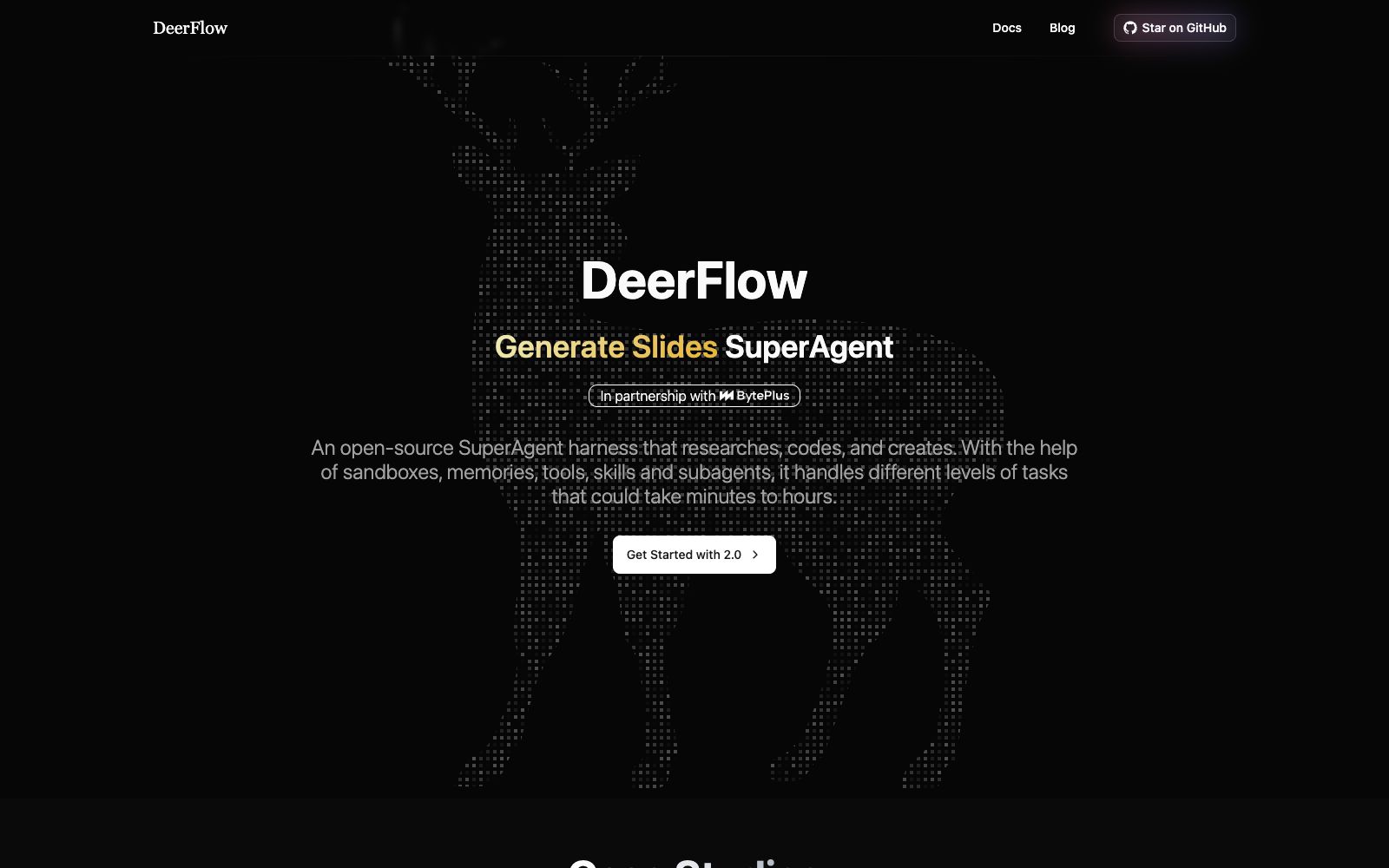

DeerFlow
Open-source SuperAgent framework, equipped with sandboxes, memory, tools and sub-agents for intelligent agents, can independently complete research, code writing and content creation. The official claims it can handle tasks that take several minutes to several hours.
Updated: 2026-10-26
What is DeerFlow?
DeerFlow is an open-source SuperAgent framework, officially described as one that can research, write code, and create content, built on LangChain. Its positioning is not as a chatbot, but as a tool that takes over an entire task that takes dozens of minutes to several hours: providing an agent with a sandbox, memory, a set of tools, and several sub-agents to let it run independently. Version 2.0 focuses on the runtime environment and skill system, rather than just retrieval and summarization.
Who is it for?
- Researchers and strategic roles conducting industry research and competitive analysis who need to organize scattered materials into reports.
- Data analysts who want agents to handle data cleaning, modeling, and visualization on their own.
- Content planning teams that need to transform a long report into web pages, graphic and text content, or video scripts.
- Engineering teams that want to develop an internal agent platform based on open-source frameworks for secondary development.
- Media teams that need to quickly convert research conclusions into publishable content.
Key features
6Sandbox Execution Environment
The official team has equipped DeerFlow with a dedicated "computer" that can execute commands, manage files, run long tasks, and operates within a Docker sandbox. In the examples, you can see dependency installation, code writing, and physics engine running stably at 60 FPS. The sandbox is isolated from the local environment, so installing dependencies or modifying files will not contaminate your own machine.
Progressive Skill Loading
Agent Skills are loaded on demand and only read in when needed, avoiding cluttering the context all at once; you can use the built-in skill library or write your own skill files for expansion. Teams can write their internal processes into skill files and accumulate them into reusable assets.
Memory and Sub-agents
Break down tasks through memories and subagents. The main agent is responsible for planning and summarization, while subagents handle branches such as retrieval, coding, and generation. The results of subagents are fed back to the main process for summarization, preventing the context of long tasks from being overwhelmed by a single point.
In-depth Research
Official cases include conducting special research after watching a Y Combinator video, summarizing a scholar's podcasts from the past six months, performing exploratory analysis on datasets and generating visualizations. The research process leaves behind retrieval and execution records, making it easy to trace the origin of conclusions.
Diverse Output Formats
Research results can be delivered as web pages, comic strips, video scripts, and reference images. Official examples include cross-modal tasks like "Explaining the MOE Architecture Using Doraemon". For cross-modal outputs, manual selection of materials is still required, and the model provides usable first drafts.
AIO Sandbox
The official recommendation is to use an All-in-One sandbox with built-in capabilities such as a browser and Shell, which eliminates the cost of building an environment by yourself. The sandbox supports changing images, and installing dependencies for specific tasks is more convenient than polluting the local environment.
How to use DeerFlow
- First, pick an official example that most closely matches the structure of your task and get it running, then adapt it to your own topic.
- this is much faster than starting from scratch.
- For long tasks, be sure to conduct phased acceptance: ask the agent to deliver an intermediate deliverable for each sub-goal completed, so that you can roll back to the previous checkpoint if it goes off track.
- The code executed in the sandbox is generated by the model.
- when it involves external requests, file writing, and production credentials, isolation is required.
- Do not put real keys into the sandbox.
- The open-source license allows self-deployment and modification, but the user shall bear the compliance responsibilities for model calls and retrieval sources.
- when citing third-party content, the source must be indicated, and the license and data terms shall be verified before commercial use.
- Fix the list of retrieval sources for multiple runs on the same topic to significantly improve the comparability of results.
Traffic & popularity
Data month Sep 2026
DeerFlow receives about 135.4K visits per month and ranks #230,891 worldwide.
Monthly visits
12 monthsTraffic sources
- Direct47.2%
- Referrals23.7%
- Search23.3%
- Social2.9%
- Mail1.8%
- Other1.0%
Top countries
- China33.0%
- United States26.6%
- Singapore7.2%
- India6.5%
- France5.0%
Estimated from third-party traffic data.
Similar tools
 EigentOpen-source desktop multi-agent workspace that enables AI agents to operate browsers and local applications to complete real tasks. The official version supports custom model selection, approval of key steps, and traceability of execution trajectories.
 MemUA layer of personal memory shared by multiple AI agents: Codex, Claude Code, Cursor, etc. share the same readable Markdown memory file, supporting source tracing, memory retrieval, and automatic skill extraction.
 PaperclipAn application that manages AI agents as a team, offering organizational structure, goal alignment, budget control, work order and governance capabilities. The official states that it can integrate with your own agents and also provides a local version for installation.
 KroWorkKroWork is a macOS desktop AI Agent. You can create persistent desktop applications through conversations. The official states that it is built with 20+ Skills, supports autonomous web operation and IM remote control.
 RomeOpen-source agent operating system: describe your goals through conversation, and the Agent can build tools by itself, save actions, retain context and have cross-task reusability. It supports self-hosting and can be connected to your existing cutting-edge coding models and subscription plans.
 Ego LiteA browser designed specifically for AI Agents. After installing one skill, Claude Code, Codex and others can directly drive it to perform web automation. The official claims it can handle hundreds of concurrent tasks, with login status, independent spaces, and data stored locally.