


Novix
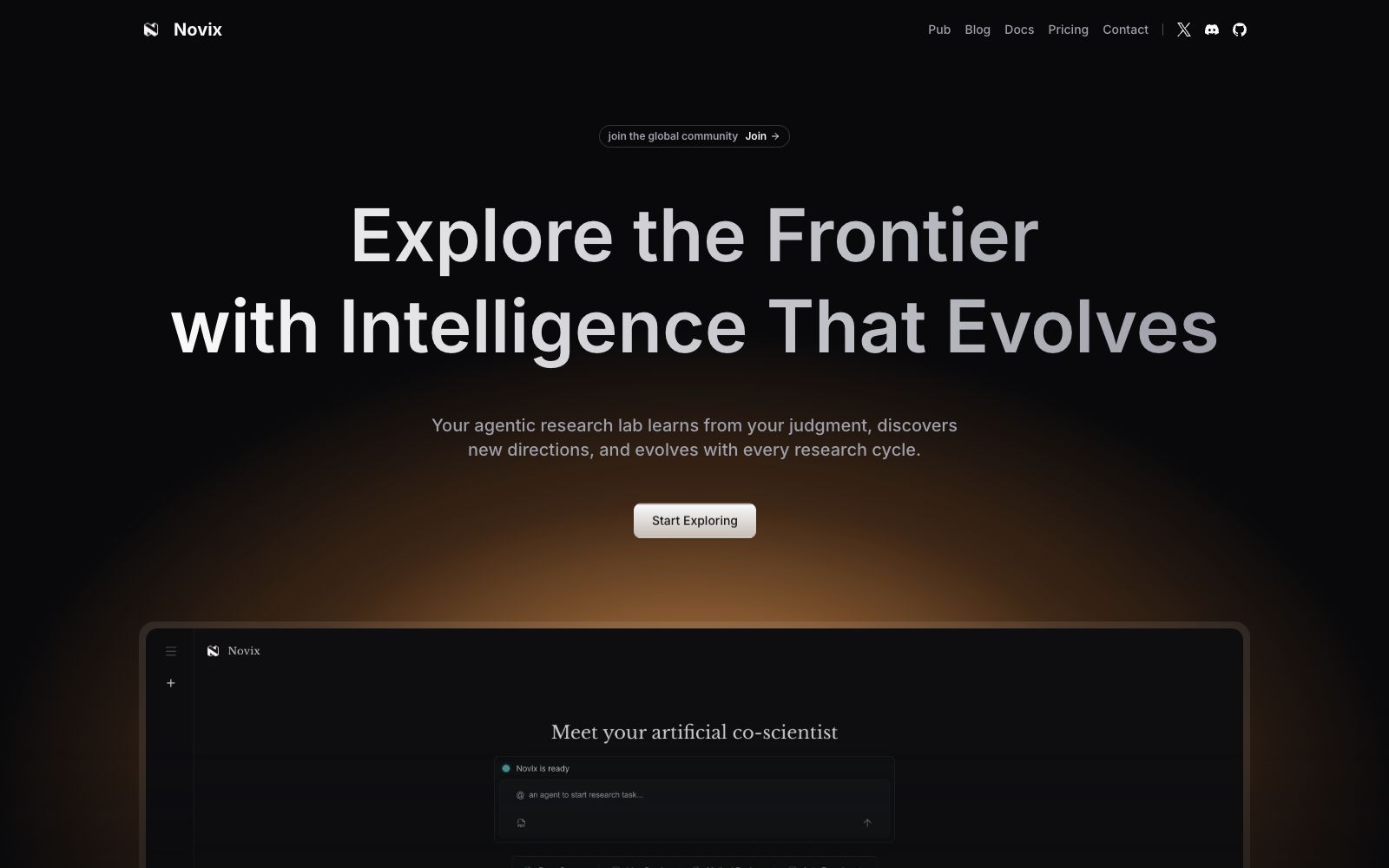
An AI collaborative scientist for researchers, officially said to support from formulating research hypotheses all the way to experimental verification, covering literature sorting, experimental design, data analysis and visualization.
Updated: 2026-10-26
What is Novix?
Novix defines itself as an "AI collaborative scientist," serving researchers rather than copywriters. According to its official description, it covers the entire research process from generating new ideas to experimental verification: it first provides testable hypotheses, then searches for literature to support them, designs experiments, analyzes data, and finally organizes the results into submission-ready charts and graphs. It is more like a collaborator that can handle the preliminary tedious work, with all links sharing the same context, so there is no need to repeatedly explain the project background when asking follow-up questions.
Who is it for?
- Graduate students and postdocs in university research groups: The three most time-consuming tasks are topic selection, literature review, and figure creation.
- Enterprise R&D teams: Need to quickly assess the feasibility of technical routes.
- Interdisciplinary researchers: First build a literature map when entering a new field.
- Scientific research managers and grant applicants: Collate preliminary research into structured materials.
- Authors facing tight submission deadlines: Cut down the time spent on organizing figures and text.
- For grant applications and thesis proposals: Organize the background, research gaps, and innovative points into a structured first draft.
Key features
8Hypothesis Generation
It is claimed to be able to propose new research hypotheses, helping researchers break out of existing frameworks during the topic selection stage.
Literature Scanning and Summary
Automatically retrieves and synthesizes relevant literature, condensing conclusions scattered across different papers into usable background information.
Experimental Design
It is claimed by the official that it can generate detailed experimental protocols, clarifying the steps, variables and control conditions.
Data Analysis
Processes experimental data and provides interpretations, reducing the need to switch back and forth between statistical and visualization tools.
Plotting and Modeling
Generates publishable charts and graphs, and supports the construction and optimization of machine learning models.
Free Trial
It is available for free trial, making it suitable for first verifying its performance in your own field.
Seamless workflow
All stages share the same context, eliminating the need to repeatedly paste background materials across different tools.
Process Traceability
Analysis steps and input data can be retained together, making it easy to review how conclusions were derived.
How to use Novix
- Start with a small, familiar problem to test whether the hypotheses it provides are verifiable, rather than just picking those that "sound novel".
- Be sure to verify the literature conclusions against the original text.
- AI summaries may omit qualifying conditions or confuse similar studies.
- Ask it to first list a set of research questions and then discuss them one by one.
- this makes it easier to identify flaws than to directly ask for a plan.
- Experimental designs and statistical methods should be reviewed by supervisors or peers.
- AI outputs cannot replace methodological review.
- For each citation, request the source and verify it one by one to avoid citing non-existent work.
- clearly label AI-generated content and indicate the use of tools in accordance with journal requirements.
- Redraw the axes and error bars of the generated charts yourself, and verify the data sources and sample sizes one by one before submission.
- When dealing with unpublished data and subject information, first confirm the data usage and confidentiality clauses of the platform.
- academic integrity and submission standards shall be subject to the requirements of the journal.
Traffic & popularity
Data month Sep 2026
Novix receives about 18.3K visits per month and ranks #2,093,750 worldwide.
Monthly visits
12 monthsTraffic sources
- Direct81.6%
- Search13.5%
- Referrals2.0%
- Social1.1%
- Display ads0.6%
- Other1.2%
Top countries
- China80.3%
- United States10.9%
- Iraq5.3%
- France1.7%
- India0.8%
Estimated from third-party traffic data.
Similar tools
 OpenLens AIAn fully automatic multimodal scientific research agent for health informatics research. Upon inputting a research question, it can automatically complete literature review, data analysis, experimental design and code execution, and generate LaTeX-format PDF papers through multi-agent collaboration.
 OpenScienceAn open-source AI scientific research workbench, which the official says can read papers, write code and run experiments. It has built-in free models and also supports connecting to models from any manufacturer, and links to more than 40 scientific databases such as UniProt and PDB.
 CuspAIA UK research company that uses AI to accelerate the discovery of new materials, registered in Cambridge, focuses on semiconductors, energy and climate. It partners with laboratories and industrial counterparts for collaboration through application.
 WisPaperAI academic search tool, officially said to help researchers find relevant literature faster through deep retrieval, track trends by research direction and subscribe to personalized paper Feeds, reducing repeated trial and error in keywords.
 Outset.aiAn AI interview platform for corporate research teams, with AI hosts conducting real-time follow-up questions based on responses. The official states that it can process thousands of interviews in parallel and summarize them instantly, covering market strategies, user profiles, and concept testing.
 MiroMindPositioned as a general-purpose AI research platform, the open-source MiroThinker series focuses on long-chain reasoning. The official claims that it has achieved an average score of 60.2% on the GAIA benchmark, outperforming open-source models.