


Linkup
Linkup is a web search API for AI applications. It provides source-cited online answers, supports search, research and private indexing, and the official claims that it outperforms other models on benchmarks such as SimpleQA.
Updated: 2026-10-26
What is Linkup?
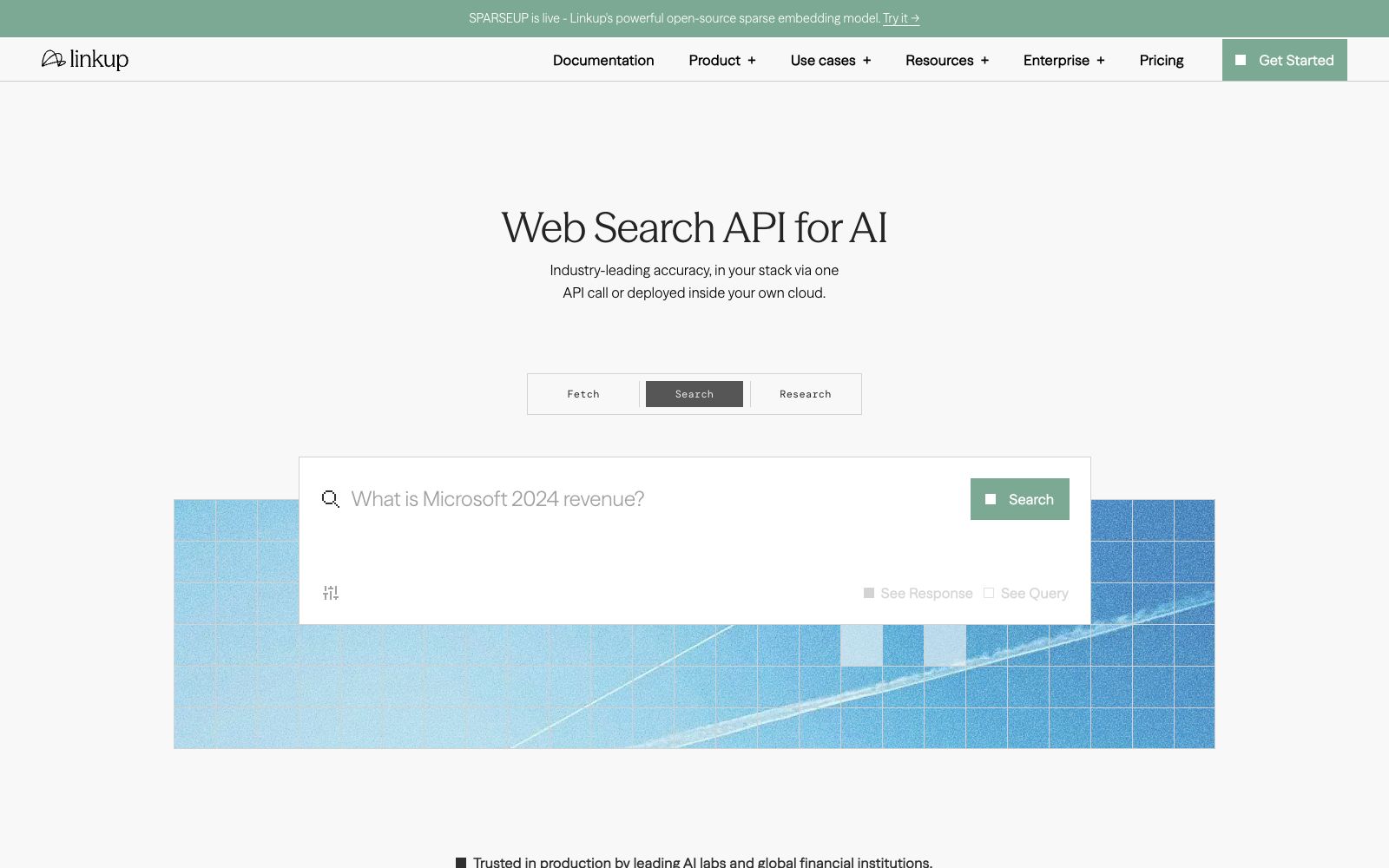
Linkup is a Web Search API for AI applications, and its official website positions itself as "The Web Search API for AI". Unlike directly returning search results to end users, it encapsulates web search capabilities into an API for AI applications, agents and enterprises to call in their own systems, outputting answers based on real sources with citations and full-text fragments. The official website states that it is used in production environments by some AI labs and financial institutions, and performs leading on benchmarks such as OpenAI's SimpleQA.
Who is it for?
- Teams building AI applications and agents that require real-time web connectivity and traceable sources for answers, with a strong emphasis on citeability.
- Development and data teams building enterprise-grade retrieval and research assistants that require stable retrieval quality and metrics.
- Engineers who need to integrate web data into their own knowledge bases or RAG workflows, replacing fragile manual crawling.
- Financial institutions and large enterprises with compliance requirements for data residency and private deployment can use the BYOC solution.
Key features
6Search
Provides web search capabilities for AI applications, returning answers with source citations and full-text snippets. The results are based on credible sources rather than being generated out of thin air.
Research
Provides in-depth research results for complex questions, rather than simple snippet-based answers, making it suitable for due diligence and long-chain reasoning.
Fetch
Crawls information from specified web pages, returns results in sub-second time with leading accuracy, making it easy to incorporate web pages into context.
Private Indexing
Customize indexes, select data sources, and set data freshness to control the scope and specifications of retrieval.
Bring Your Own Cloud
Supports deployment to the user's own cloud environment, meets data and compliance requirements, and avoids data outbound.
One-line Code Integration
Official SDKs and examples for Python, Node.js, cURL, etc., are provided to facilitate integration with existing pipelines.
How to use Linkup
- 1First, use the free credits to get the Search and Research call modes up and running, then compare latency and citation quality before making a selection.
- 2For complex research questions, prioritize the Research API; for simple factual queries, use the Search API to control costs and latency.
- 3For sensitive or regulated industries, evaluate the Bring Your Own Cloud and private indexing solutions to clarify data boundaries.
- 4Official pricing, source coverage and benchmark performance may be subject to change; verify the official documentation and latest updates before commercial use.
Traffic & popularity
Data month Sep 2026
Linkup receives about 26.3K visits per month and ranks #1,236,694 worldwide.
Monthly visits
12 monthsTraffic sources
- Direct43.4%
- Search28.6%
- Social16.1%
- Referrals6.4%
- AI assistants3.8%
- Other1.8%
Top countries
- United States22.5%
- India20.3%
- Germany13.2%
- France4.5%
- Russia2.7%
Estimated from third-party traffic data.
Similar tools
 ExaA search API for AI agents that provides real-time web data, deep research, and structured content through a single endpoint, with highlighted, token-efficient results for Q&A, research, and coding agents.
 PerplexityAI answer search engine: You can get conclusions with cited sources by asking questions in natural language. It supports follow-up questions, multiple retrieval modes and document upload-based Q&A, making it suitable for retrieval scenarios that require checking while searching.
 MiroMindPositioned as a general-purpose AI research platform, the open-source MiroThinker series focuses on long-chain reasoning. The official claims that it has achieved an average score of 60.2% on the GAIA benchmark, outperforming open-source models.
 MeilisearchMeilisearch is an open-source ultra-fast search and AI retrieval platform. It provides full-text, semantic, hybrid and multimodal retrieval, supports vector storage, and can be deployed on the cloud or self-hosted. Officially, it is said to be used by more than 20,000 teams.
 Sharp APISharp API provides more than 30 pre-built AI API endpoints, covering resume parsing, invoice parsing, 80+ language translation and e-commerce copywriting, outputting clean JSON and providing full-language SDKs.
 MemFreeMemFree is a hybrid AI search tool that draws from knowledge bases and the internet. It first indexes web pages, local files, and browser bookmarks before conducting a unified search. It also supports asking questions based on images and generating web pages.