


Latitude
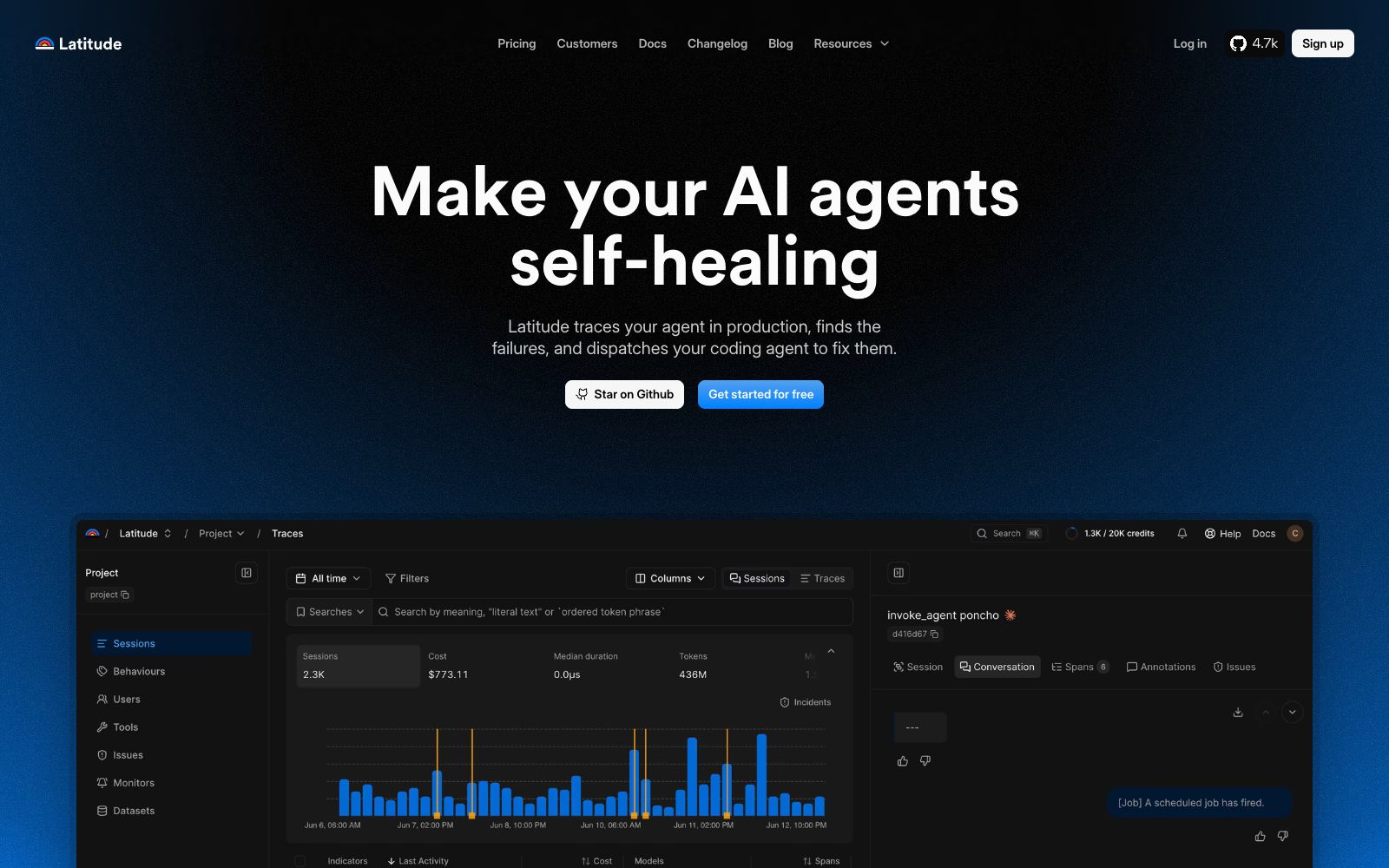
Latitude is an open-source AI Agent observability and monitoring platform that tracks production traces, clusters failure patterns and dispatches repair tasks to coding Agents. The official version states that it is compatible with OTEL and supports custom signals.
Updated: 2026-10-30
What is Latitude?
Latitude is an open-source AI Agent observability and monitoring platform. Its official website states that it enables AI Agents to "self-heal": it tracks the operational trajectories of Agents in production environments, identifies failures, and dispatches repair tasks to your coding Agents. It connects conversational intelligence, failure signals and automatic dispatching, aiming to enable Agent systems to be detected and handled as soon as possible when problems occur, rather than waiting for user complaints. The official website says it is popular among developers and built specifically for Agents.
Who is it for?
- Engineering teams with deployed AI Agents who need production environment tracking and failure detection capabilities.
- Operations leaders who want to directly convert monitoring signals into repair tasks and reduce manual troubleshooting.
- Organizations focused on open source and seeking to self-host observability stacks with a focus on privacy and compliance.
- Product and algorithm teams that need to cluster failure patterns, build datasets, and conduct evaluations.
- A technical leader who wants to automate the closed loop of "problem discovery - repair".
Key features
6Conversational Intelligence
Analyze completed sessions and extract behavioral patterns such as conversation topics, escalations, abandonments, trust breakdowns, retries, and tool failures.
Failure Signal Clustering
Automatically groups and ranks recurring failures, with trends and failure traces attached for easy troubleshooting.
Automatic Alerts
Notifies you when new issues are detected or existing problems escalate, and can integrate with Slack, email, or webhooks.
Agent Dispatch
When signals are detected, send complete context, sample traces, and deep links to Claude Code or Cursor for direct fixes instead of creating tickets.
Compatibility and Labeling
It is claimed to be compatible with OTEL, and supports custom signals, dataset management, manual labeling and advanced filtering.
MCP Integration
The official website provides an MCP Server, making it easy to integrate observability and dispatch capabilities into existing development workflows.
How to use Latitude
- First integrate production traces to discover behavioral patterns, then enable failure clustering and automatic alerts.
- Confirm the context and permissions before dispatching tasks to coding Agents to avoid unexpected issues caused by automatic modifications.
- The collection of user conversation data must comply with privacy and compliance requirements, subject to the official instructions.
- The scope of official features and certifications (such as SOC 2) will evolve, so double-check before making a formal selection.
- For automatic dispatching, it is recommended to first verify it in the test environment before rolling it out to production Agents.
- When getting started, it is recommended to first use the free quota to run through the core workflow, and after confirming that the output quality meets expectations, evaluate whether it is worth upgrading to a paid plan.
Traffic & popularity
Data month Sep 2026
Latitude receives about 21.3K visits per month.
Monthly visits
12 monthsTraffic sources
- Social63.7%
- Direct20.4%
- Referrals7.5%
- Search5.7%
- AI assistants1.6%
- Other1.2%
Top countries
- United States12.7%
- Spain9.0%
- India6.3%
- Brazil5.7%
- Indonesia4.2%
Estimated from third-party traffic data.
Similar tools
 AdalineAdaline is an observability and evaluation platform for AI Agents. It transforms production trajectories into behavior graphs, automatically generates evaluations and synthetic data, and drives autonomous improvement of Agents. According to its official website, it supports release after team approval.
 LangfuseAn open-source (MIT) LLM engineering platform that integrates tracing, evaluation, prompt management and datasets in one place. Based on OpenTelemetry, it continuously improves AI applications with production data and is self-hostable.
 Helicone AIHelicone is an open-source LLM observability and AI gateway platform: request logs, monitoring alerts, policy routing, multi-dimensional segmentation and HQL analysis, access with one line of base_url modification, used by the fastest-growing AI companies.
 ClineOpen-source AI programming agent, officially said to adopt the Plan-then-Act mode to modify code across files and execute bash commands in editors and terminals, supporting MCP extensions and multi-Agent collaboration.
 PhoenixPhoenix is an open-source Agent development and evaluation platform by Arize: visualize every step of the calls, prove the effectiveness of changes through experiments, start locally with one command, support self-hosting, and provide a solid basis for improving Agent quality.
 BrowserOSBrowserOS neo is an open-source local browser for AI Agents. Agents can drive web tasks with your login status, support parallel operation and session replay, and the official states that it is free and data does not leave the local machine.