


Banani
An intelligent interface design tool that generates editable multi-page prototypes from text or reference interfaces, supports extracting layout styles from screenshots and design links, adjusts visuals using prompts, and shares or exports to design and code workflows.
Updated: 2026-10-26
What is Banani?
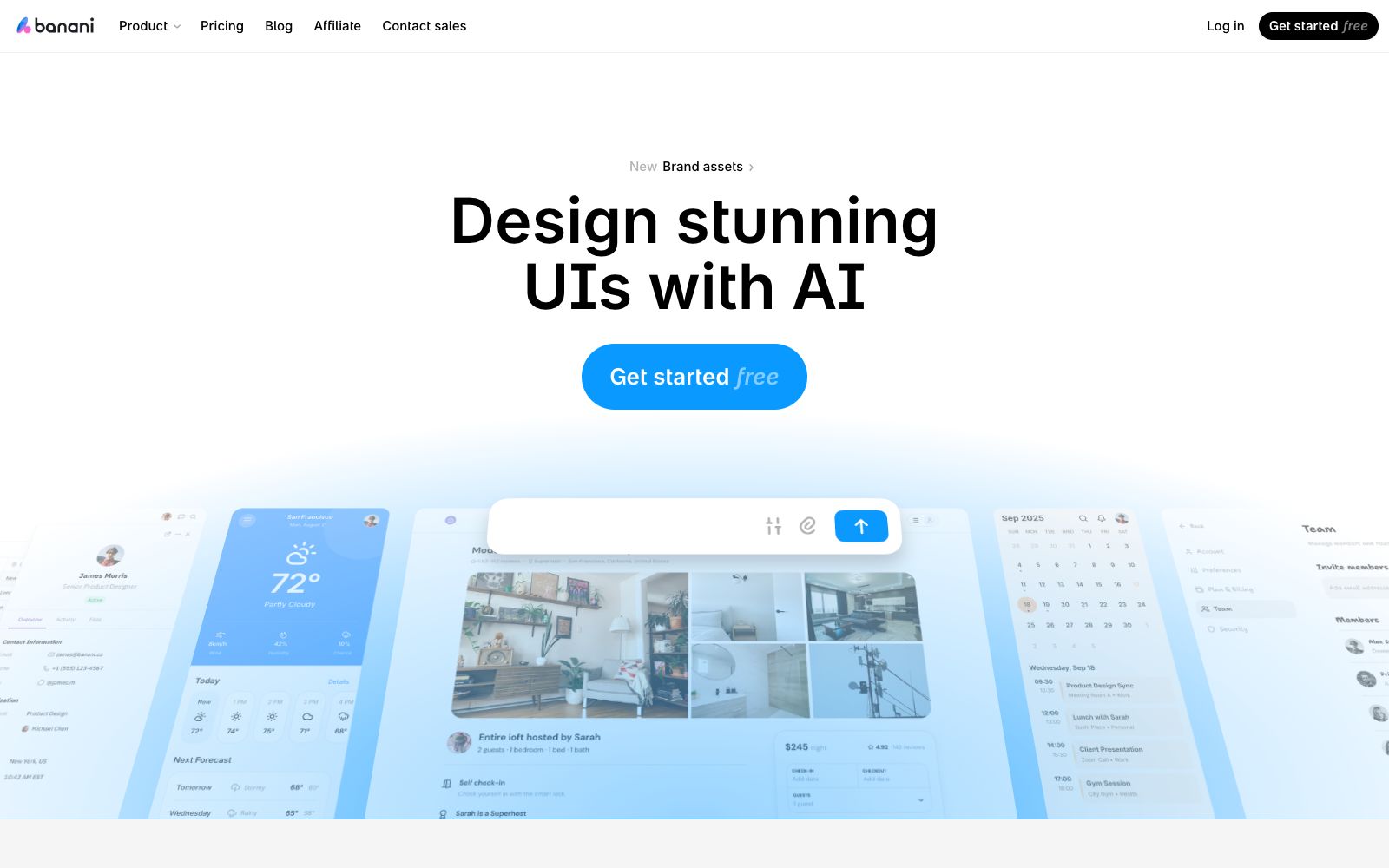
Banani is an AI collaboration tool for interface design. Its official website describes it as a solution for generating user interfaces and prototypes from text. It can transform natural language product descriptions into editable multi-page interactive designs, extract visual styles and layouts from screenshots, images or Figma links, then further adjust them through prompts and design tokens, and finally enter the process of sharing, design or code delivery.
Who is it for?
- Product managers who need to quickly turn product ideas into multi-page prototypes for user interviews and internal reviews.
- UI designers who want to extract visual direction from competitor screenshots or existing web pages and then redesign new solutions.
- Startup teams without dedicated designers who need to clarify page structures and basic styles before development.
- Collaborative teams that share prototype links with clients and colleagues to gather feedback and move on to Figma or code.
Key features
6Generate interactive designs from text
Describe the product in everyday language, and the system can generate editable, multi-page interactive prototypes, which are suitable for quickly converting early requirements into clickable and discussable interfaces.
Create designs from any reference
You can import images, screenshots, or Figma links to extract the visual style and layout within them, which is used to generate new ideas or reconstruct the reference interface.
Your style, instantly
You can ask the AI to make the design more lively, minimalist, or in another style without having to redraw each component one by one.
Adjust colors, fonts and design tokens
In addition to prompt words, users can also manually fine-tune colors, typography and other tokens to make the results fit the product's visual system.
Share and export in one click
You can send links to your entire project or individual pages to collect team feedback, and export to Figma or code when you're ready for delivery.
From wireframes to high-fidelity designs
The official website also emphasizes wireframes and high-fidelity interfaces, allowing teams to first validate the information structure and then gradually improve the visual completeness.
How to use Banani
- Before generating text from words, list user personas, page lists, main tasks, and jump relationships between pages to avoid generating only isolated good-looking pages.
- When using screenshots or design links, clarify whether you want to draw on the layout, colors, or typography, and do not request a one-to-one replication of interfaces protected by copyright or trademarks.
- Start with low-fidelity designs and validate the process in the first round, then unify colors, fonts, and design tokens.
- this is more convenient than modifying the information architecture after creating high-fidelity designs.
- When sharing review links, clearly name each version of the design and gather all feedback within that single version to prevent the development team from working on the wrong design due to scattered comments.
- After exporting to Figma or code, check responsiveness, component states, accessibility, and real data length.
- the usage rights of commercial materials and outputs shall be subject to the official instructions.
Traffic & popularity
Data month Sep 2026
Banani receives about 836.6K visits per month and ranks #50,121 worldwide.
Monthly visits
12 monthsTraffic sources
- Search52.9%
- Direct34.7%
- Referrals5.5%
- AI assistants3.5%
- Social2.7%
- Other0.8%
Top countries
- India14.5%
- United States7.1%
- Nigeria5.7%
- Mexico4.1%
- France3.4%
Estimated from third-party traffic data.
Similar tools
 UX PilotAn AI interface design tool for product teams that can generate wireframes and high-fidelity interfaces from sketches, ideas or requirement documents, supports the reuse of existing design systems, and directs the results to design collaboration and development delivery.
 MasterGo AIA domestic digital interface production platform that provides AI text-to-image prototyping, professional interface design, and design-to-code capabilities. It supports online collaboration between product, design and R&D teams, enterprise asset management, and enterprise-level permission deployment, and is tailored for integrated collaboration scenarios in product design and R&D.
 UizardAn AI UI design tool for product teams that can generate interface prototypes for apps, websites and desktop software using natural language and screenshots. Its official website claims it is as simple as using PowerPoint, making it ideal for quickly validating product ideas.
 FlowstepFlowstep is an AI interface design tool. Officially, it claims to generate multi-screen UIs with prompt words, supports conversational editing or manual modification, and enables exporting code, copying to Figma, and integrating into IDE via MCP.
 VisilyAI interface design software for non-designers enables the creation of high-fidelity wireframes and prototypes from various sources of inspiration. It comes with built-in templates, themes, smart components and icon resources, and supports annotation and team collaboration.
 Tencent Design ArdotAn AI design tool launched by Tencent, it supports text-to-interface generation, image conversion to editable design drafts, vector editing and dynamic layout, and connects design collaboration with development delivery through design systems, permission auditing and code replication.