

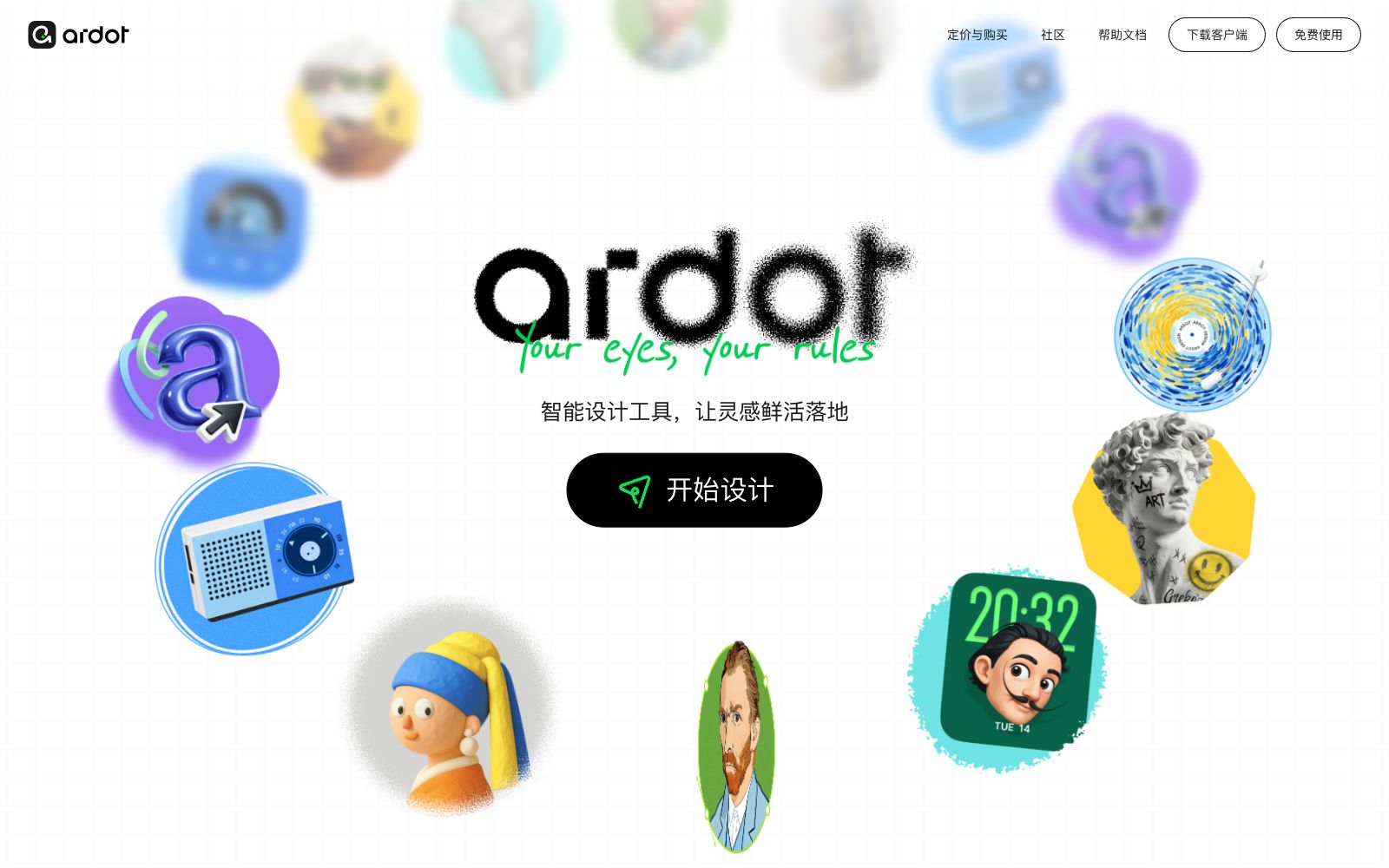

Tencent Design Ardot
An AI design tool launched by Tencent, it supports text-to-interface generation, image conversion to editable design drafts, vector editing and dynamic layout, and connects design collaboration with development delivery through design systems, permission auditing and code replication.
Updated: 2026-10-26
What is Tencent Design Ardot?
Tencent Design Ardot is an AI design tool launched by Tencent for designers and product teams. According to its official website, it allows inspiration to go directly from text to the interface. It integrates text-to-interface generation, image-to-design draft conversion, vector editing, responsive layout, design systems and development annotation into the same workflow. It is available on both web and desktop clients, and also provides collaboration capabilities such as permissions, audits and asset handover for enterprise use.
Who is it for?
- Product managers and startup teams who need to quickly turn product requirements into initial interface drafts and then hand them over to designers for further refinement.
- Professional interface designers and design system teams that require vector editing, responsive layout, and component systems.
- Designers who want to restore editable design drafts from screenshots or links for redesign and solution exploration.
- Domestic enterprise design teams that have management requirements for permission allocation, operation logs, and asset recovery when employees leave the company.
Key features
6Text-to-UI, Generate from Description
Describe requirements in natural language, and AI automatically generates layouts and components to quickly build the initial structure of the interface, suitable for starting with product ideas or page descriptions.
Turn images into design drafts in seconds
After uploading an image, it is intelligently layered and converted into an editable design draft, making it easy to restore reference pages or bring static materials back into the design process.
AI Assistant, stepping in quietly at any time
The official website lists smart renaming, image generation, link-to-interface conversion and AI search, integrating auxiliary capabilities into multiple design stages.
Vector Editing Features and Dynamic Layout System
Supports standard-compliant skew, 3D rotation, and enhanced shape tools, along with grid layout, percentage positioning, and true aspect ratio locking.
Free Design System
Components, colors and text styles can be synchronized globally, combined freely and reused with one click, reducing style drift in multi-person collaboration.
Design to Development Delivery
Visualize dimensions, spacing and styles, review component variants, and copy common code for web, iOS, and Android platforms.
How to use Tencent Design Ardot
- Before generating an interface from text, clarify the page goals, platform dimensions, component scope, and key states first.
- After generation, check the information architecture before refining visual details.
- Image-to-design conversion is suitable for accelerating reconstruction, but after automatic layering, you should still check the text, masks, nesting relationships and component semantics.
- You cannot take visual similarity as structural correctness.
- Before the team is put into use, establish colors, text styles and core components, and all subsequent generation and manual design will follow the same set of design system.
- When delivering to development, check dynamic layouts, component variants, and copied code item by item, and still verify adaptation, interaction, and accessibility performance on real devices.
- Configure the minimum permissions for enterprise projects and retain audit records.
- the commercial authorization of reference images, fonts, images, and code shall be subject to the official instructions, and a recheck shall be conducted before release.
Traffic & popularity
Data month Sep 2026
Tencent Design Ardot receives about 625.4K visits per month.
Monthly visits
10 monthsTraffic sources
- Direct80.6%
- Search10.9%
- Referrals3.5%
- Social3.5%
- AI assistants0.8%
- Other0.8%
Top countries
- China92.2%
- Hong Kong, China2.1%
- United States1.8%
- Taiwan, China1.2%
- Singapore0.7%
Estimated from third-party traffic data.
Similar tools
 MasterGo AIA domestic digital interface production platform that provides AI text-to-image prototyping, professional interface design, and design-to-code capabilities. It supports online collaboration between product, design and R&D teams, enterprise asset management, and enterprise-level permission deployment, and is tailored for integrated collaboration scenarios in product design and R&D.
 UX PilotAn AI interface design tool for product teams that can generate wireframes and high-fidelity interfaces from sketches, ideas or requirement documents, supports the reuse of existing design systems, and directs the results to design collaboration and development delivery.
 PixsoA domestic AI collaborative design tool that integrates whiteboarding, prototyping, UI design and delivery in one. Its official website states that it supports AI one-click generation of UI design drafts and React/Vue code, connects the entire design-to-development pipeline, and can import Figma files.
 QuiverAIQuiverAI is a generative model platform focused on vector design. The official version states that the Arrow 2 model can generate, edit and animate vector graphics, supports converting text and images into SVG, and covers logos, illustrations and icons.
 BananiAn intelligent interface design tool that generates editable multi-page prototypes from text or reference interfaces, supports extracting layout styles from screenshots and design links, adjusts visuals using prompts, and shares or exports to design and code workflows.
 MiaoduoAn AI-driven user interface design tool that supports importing typical interfaces for AI to learn design styles, generating interfaces and components based on text or images, and providing MCP to enable coding tools to understand design drafts and generate front-end code, targeting the collaboration scenario of product, design and research teams.