


AGI-Eval
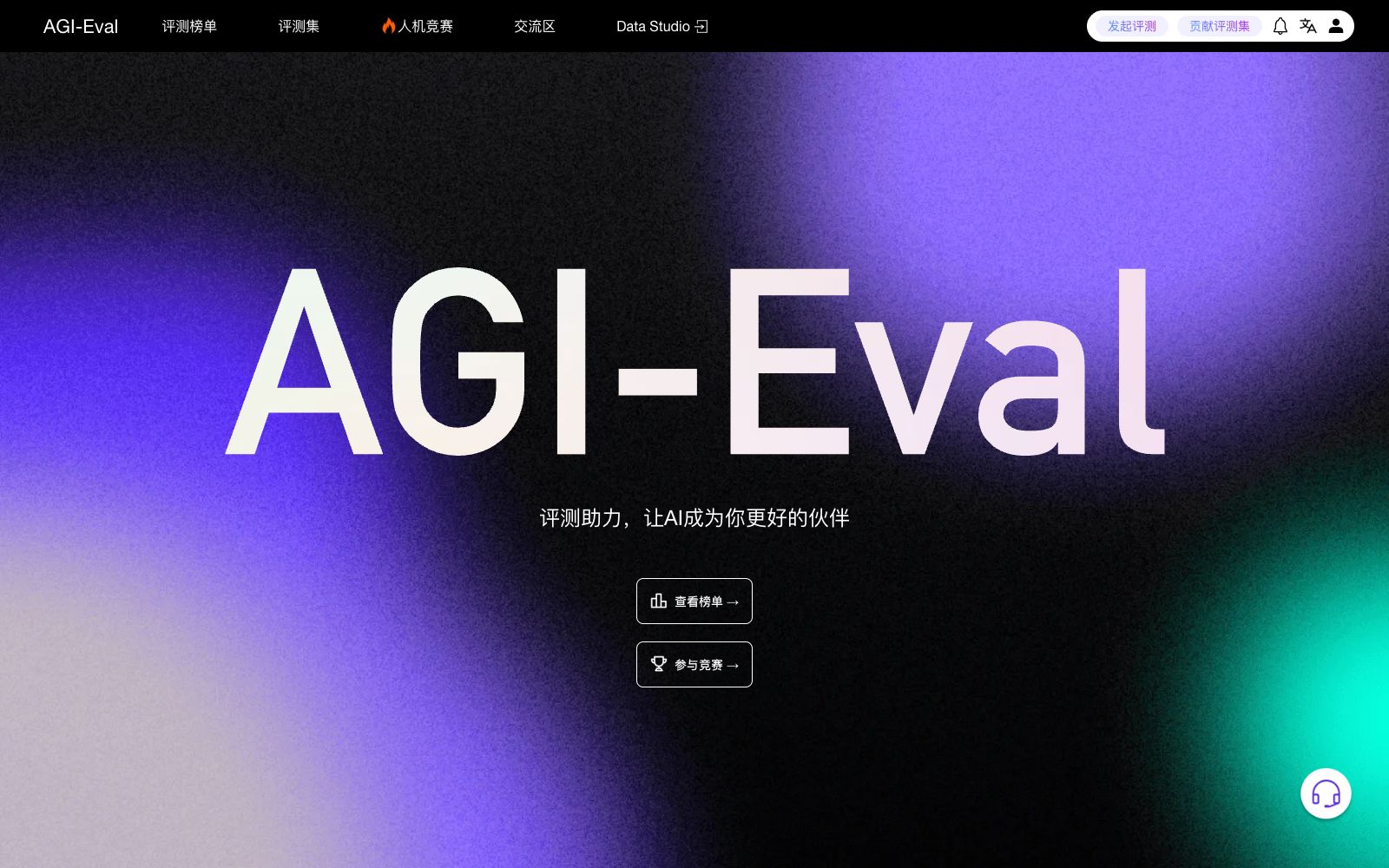
AGI-Eval is a large model evaluation community that provides evaluation leaderboards, evaluation datasets, human-machine competitions and Data Studio, helping selectors understand the strengths and weaknesses of various models with transparent and authoritative scores.
Updated: 2026-10-26
What is AGI-Eval?
AGI-Eval is a capability evaluation community for large models, offering modules such as evaluation leaderboards, evaluation datasets, human-machine competitions, and Data Studio. It provides transparent and authoritative capability score rankings for large language models and multimodal models through a universal evaluation framework. The community also encourages users to co-build evaluation datasets and collaborates with universities and enterprises to promote the development of next-generation evaluation standards, helping users make more informed model selections.
Who is it for?
- Model selectors hope to use the transparent leaderboard to gain an in-depth understanding of the advantages and disadvantages of each model and make wise choices. Selection is no longer based on intuition.
- Universities and research institutions can participate in the co-construction of evaluation datasets, transforming professional domain knowledge into evaluation standards. Academic accumulation finds an outlet.
- Algorithm engineers pay attention to model rankings and capability item scores for horizontal comparison and solution selection reference. The dimension of capability items is more refined.
- Data contributors can continuously supplement evaluation data across multiple domains and dimensions based on more than 500 task tags. The tag system supports fine-grained segmentation.
- Individuals interested in the development of AI can participate in human-machine evaluations, gaining rewards while experiencing cutting-edge technology. Experience and benefits go hand in hand.
Key features
5The model ranking list is based on a universal evaluation scheme, providing comprehensive scores and scores for each capability item for large language models and multimodal models. The data is transparent and updated regularly.
The evaluation datasets are divided into two categories: official platform datasets and user-created datasets. Official datasets cover multiple fields, and users can also contribute professional data. Co-construction expands the coverage.
Human-AI competitions allow users to collaborate with large models to participate in evaluations and explore next-generation human-AI collaborative evaluation schemes. It combines a sense of participation with cutting-edge features.
Data Studio supports individuals in contributing professional domain data, collected through various methods such as single entries, expansions, and Arena. The collection methods are flexible and diverse.
Data review adopts a multi-layered mechanism combining machine review with human review to ensure the quality and credibility of evaluation data. Multiple reviews uphold the bottom line of data.
How to use AGI-Eval
- Before selecting a model, check the full leaderboard and evaluate candidate models from the dual dimensions of overall scores and specific capability items.
- Judging solely by the total score may lead to misjudgments.
- When building your own evaluation dataset, follow the platform's specifications and leverage both automated and manual review mechanisms to ensure the data is credible.
- Compliance with specifications is a prerequisite for the data to be adopted.
- Participating in human-AI competitions allows you to experience the capabilities of models and provide feedback for the construction of the community's evaluation standards.
- This feedback helps refine the standards further.
- Follow the updates from partner institutions and contributors to stay informed about new evaluation datasets and research directions.
- Dynamic updates reflect the cutting edge.
- When interpreting the scores on the leaderboard, you should combine them with the task scenarios.
- a high score does not mean the model is suitable for all businesses.
- Matching the scenario is the key.
Traffic & popularity
Data month Sep 2026
AGI-Eval receives about 21.5K visits per month and ranks #833,492 worldwide.
Monthly visits
12 monthsTraffic sources
- Direct95.9%
- Referrals2.4%
- Search0.9%
- Social0.7%
Top countries
- China81.2%
- United States18.8%
Estimated from third-party traffic data.
Similar tools
 FlagEval LibraThe large model evaluation system and open platform of the Beijing Academy of Artificial Intelligence (BAAI) is officially claimed to cover four evaluation scenarios: language, multimodality, computer vision and speech, and provides rankings, a large model arena, as well as a collection of evaluation methods and tools that combine automatic and manual evaluation.
 SuperBenchThe Comprehensive Capability Evaluation Ranking of Large Models, released by the Tsinghua University Center for Basic Model Research in collaboration with the Zhongguancun Laboratory, promotes fair, open, and systematic large model evaluation and technological progress through bi-monthly reports.
 SuperCLUEThe Chinese large model evaluation benchmark, officially stated, presents model performance through a general capability overall ranking and sub-rankings such as mathematical reasoning, hallucination control, scientific reasoning, precise instruction following, and agent programming, and simultaneously provides model pricing and task planning consumption data.
 Klu.aiAn automatic evaluation platform for cutting-edge models targeting business scenarios. The official website slogan is "Find your cutting edge". Generate evaluation datasets according to the workflow you describe, track model updates, and rerun comparisons of quality and cost each time a new model is released.
 SEAL LLM LeaderboardThe expert-driven evaluation list produced by the labs under Scale AI covers more than 20 benchmarks and over 100 models including agent programming, cutting-edge reasoning and safety alignment. It can be browsed by capability tiers and is continuously updated.
 Artificial AnalysisA benchmark platform for independently evaluating AI models and API service providers, conducting horizontal comparisons based on intelligence indices, output speeds and single-task costs, and covering multi-category rankings such as coding, speech, image and video, as well as comparisons with search service providers.