

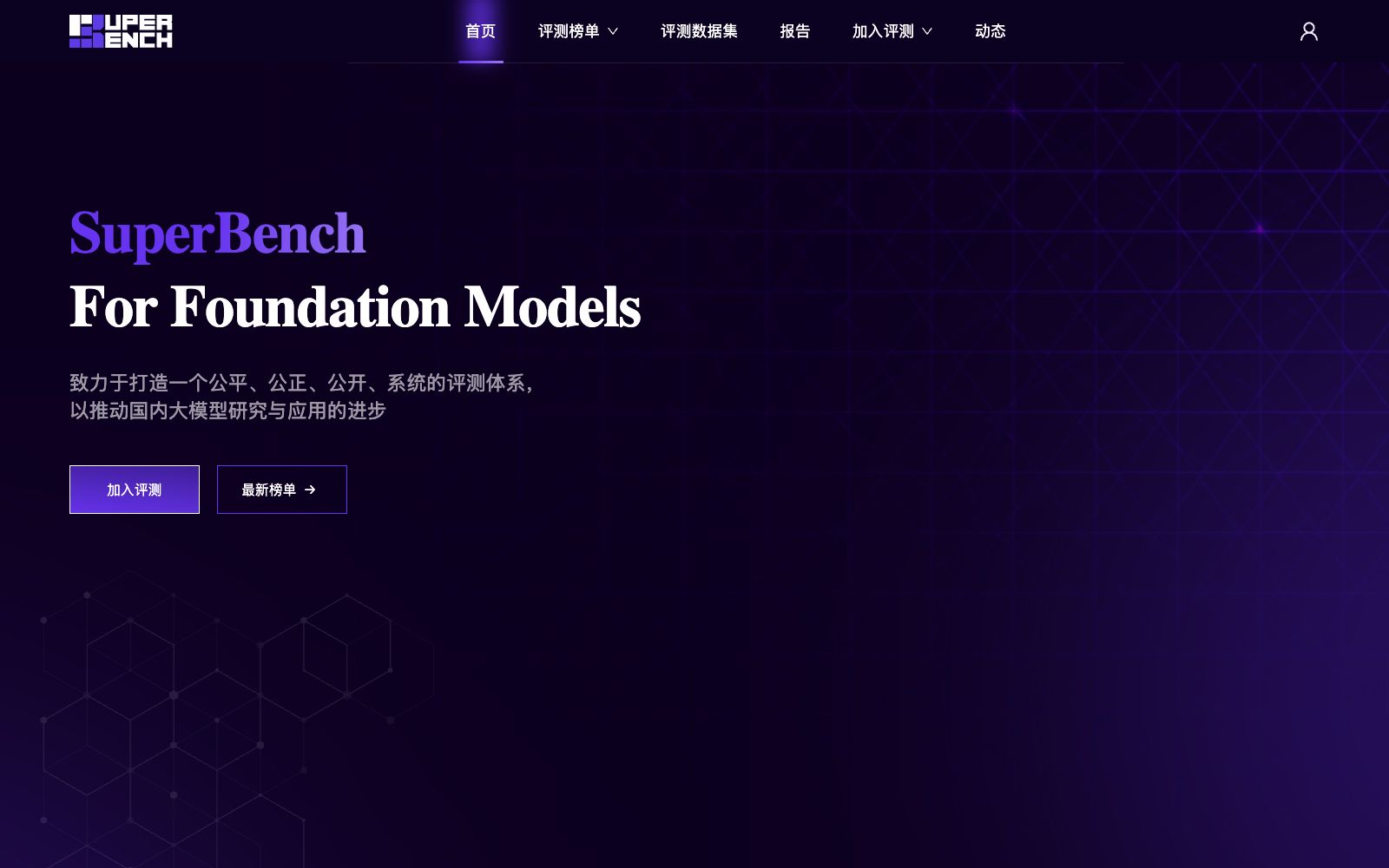

SuperBench
The Comprehensive Capability Evaluation Ranking of Large Models, released by the Tsinghua University Center for Basic Model Research in collaboration with the Zhongguancun Laboratory, promotes fair, open, and systematic large model evaluation and technological progress through bi-monthly reports.
Updated: 2026-10-26
What is SuperBench?
SuperBench is a comprehensive capability evaluation benchmark for large models released by the Tsinghua University Center for Fundamental Models in collaboration with the Zhongguancun Laboratory. It is committed to building a fair, just, open and systematic evaluation system, promoting the progress of research and application of large models in China through bi-monthly reports. As an independent third-party non-profit organization, its evaluation process is traceable.
Who is it for?
- Large model R&D teams can use the leaderboard to horizontally compare the capabilities of mainstream open-source and closed-source models and locate the position of their own models.
- Enterprises in the selection phase can refer to the evaluation results to select models suitable for their own scenarios, reducing trial-and-error costs.
- Universities and research institutions can carry out model research and teaching based on public benchmarks and take the evaluation as a yardstick.
- Practitioners who follow industry trends can track the bi-monthly reports to understand the technological direction and grasp the pace of evolution.
- Procurement parties requiring third-party endorsement can leverage the authoritative ranking to reduce selection risks, make more informed decisions, and facilitate reporting to superiors.
Key features
6Released jointly by Tsinghua University and the Zhongguancun Laboratory, it is an independent third-party non-profit evaluation institution with traceable processes and more credible conclusions.
It took the lead in proposing five native evaluation benchmarks for large models, built a detection platform and independently developed a referee model called CritiqueLLM, making the evaluation more scientific.
Its openness combines open-source and closed-source datasets, and it has subsequently launched public validation sets and closed test sets to prevent rote learning, balancing optimization and anti-cheating needs.
Its dynamism is reflected in the regular refreshment of questions and types, which avoids overfitting and cheating caused by static exam questions and makes the list more durable over time.
Scientifically, a complete evaluation system is designed based on the principles of fairness and openness to ensure objective and reliable results and reproducible methods.
Evaluation results are released in bi-monthly reports. It also keeps track of new mainstream open-source and closed-source models to maintain timeliness and facilitate the retrospective review of historical performance.
How to use SuperBench
- 1First, check the latest leaderboard and evaluation datasets to clarify the performance of each model on different benchmarks before making a judgment.
- 2Align the native evaluation benchmarks with your own tasks, avoid drawing conclusions solely based on the overall score, and scenario matching is crucial.
- 3Pay attention to the dynamically updated questions, understand the design intent of the leaderboard to prevent overfitting, and interpret the scores correctly.
- 4For in-depth evaluations, you can contact the team to join the benchmark and get more tailored test results instead of just relying on the public leaderboard.
- 5Take the bi-monthly reports as a periodic reference, continuously track the evolution trend of model capabilities, and seize the upgrade window.
- 6Use the public validation set for model optimization, but avoid taking the closed test set as a practice test to ensure the fairness of the evaluation.
Traffic & popularity
Data month Sep 2026
SuperBench receives about 5.7K visits per month.
Monthly visits
12 monthsEstimated from third-party traffic data.
Similar tools
 FlagEval LibraThe large model evaluation system and open platform of the Beijing Academy of Artificial Intelligence (BAAI) is officially claimed to cover four evaluation scenarios: language, multimodality, computer vision and speech, and provides rankings, a large model arena, as well as a collection of evaluation methods and tools that combine automatic and manual evaluation.
 AGI-EvalAGI-Eval is a large model evaluation community that provides evaluation leaderboards, evaluation datasets, human-machine competitions and Data Studio, helping selectors understand the strengths and weaknesses of various models with transparent and authoritative scores.
 SuperCLUEThe Chinese large model evaluation benchmark, officially stated, presents model performance through a general capability overall ranking and sub-rankings such as mathematical reasoning, hallucination control, scientific reasoning, precise instruction following, and agent programming, and simultaneously provides model pricing and task planning consumption data.
 SEAL LLM LeaderboardThe expert-driven evaluation list produced by the labs under Scale AI covers more than 20 benchmarks and over 100 models including agent programming, cutting-edge reasoning and safety alignment. It can be browsed by capability tiers and is continuously updated.
 Artificial AnalysisA benchmark platform for independently evaluating AI models and API service providers, conducting horizontal comparisons based on intelligence indices, output speeds and single-task costs, and covering multi-category rankings such as coding, speech, image and video, as well as comparisons with search service providers.
 Klu.aiAn automatic evaluation platform for cutting-edge models targeting business scenarios. The official website slogan is "Find your cutting edge". Generate evaluation datasets according to the workflow you describe, track model updates, and rerun comparisons of quality and cost each time a new model is released.