


Agent Cloud
An open-source enterprise RAG and data access platform, according to its official website, can synchronize files and business data from more than 260 data sources, perform segmentation, embedding and vectorized storage, support self-hosted or cloud-based deployment, and enable teams to securely query internal data using private models.
Updated: 2026-10-27
What is Agent Cloud?
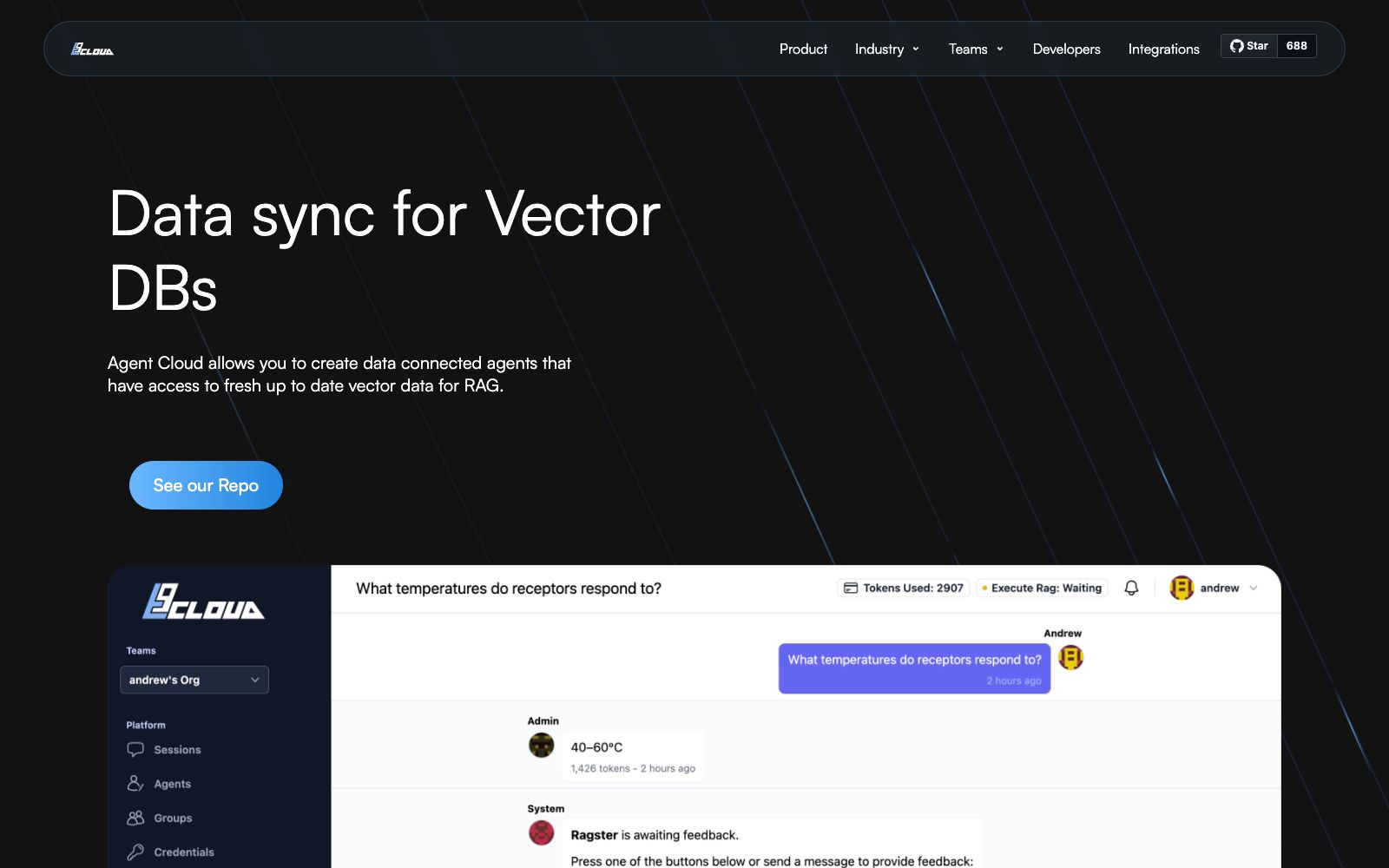
The official website positioning of Agent Cloud is "Open source platform to talk to your data". Developed by RNA Digital, it is licensed under AGPL 3.0. The official website emphasizes that its core is to connect the entire RAG link from data access to vector storage and then to dialogue applications: it has a built-in Airbyte data pipeline, Qdrant vector database and multi-model support. It can be either self-hosted or used in the cloud version. The official states that it is suitable for enterprise scenarios where data is not allowed to leave the intranet.
Who is it for?
- Enterprises and development teams that require private deployment and do not want to hand over internal data to external SaaS
- IT and data teams who want colleagues to directly query databases, documents or internal knowledge using natural language
- Engineering teams that need to integrate multiple data sources for unified knowledge retrieval and retain source citations
- Developers who value open source licenses and wish to extend the software or contribute code
Key features
6Multi-source Data Synchronization
The official website states that the built-in data pipeline supports more than 260 sources, covering databases, files, document systems, etc., and allows selecting the synchronization scope by table or field.
Chunking and Embedding
The official website states that it supports basic character-based chunking and semantic chunking for files. For embeddings, you can choose OpenAI models or open-source models like BGE, as well as the local fastembed.
Vector Storage
The official website states that the self-hosted version uses the Qdrant vector database, and the cloud version can directly build indexes on the synchronized data for retrieval.
Conversational Applications & API
The official website states that after data synchronization, you can create Agent sessions to query data or integrate with enterprise internal systems via API.
Model-Agnostic
The official website states that it can integrate with OpenAI and Azure OpenAI, as well as local Ollama or LM Studio's OpenAI-compatible endpoints.
Data Permissions
The official website emphasizes that enterprises can control who can access which AI applications within the organization, avoiding sharing data that should not be accessible to everyone.
How to use Agent Cloud
- 1For self-hosting, first check the hardware requirements on the official website: The Docker version requires at least 16GB of memory, and Windows users should use WSL.
- 2Start with Airbyte for data access, first sync a database or upload a PDF to verify the chunking and embedding effects.
- 3For the embedding model, you can first choose OpenAI's text-embedding-3-small or open-source models like BGE. The official website states that switching does not require additional configuration.
- 4After setting up the vector database, first create a read-only Agent session to verify that the answers can correctly reference the original documents before expanding the scope of use.
- 5For secondary development, refer to the contribution guide in the GitHub repository. The official website states that you can participate by submitting feature requests or pull requests.
Traffic & popularity
Data month Sep 2026
Agent Cloud receives about 2.4K visits per month and ranks #4,717,579 worldwide.
Monthly visits
12 monthsTraffic sources
- Direct41.3%
- Search32.8%
- Referrals10.7%
- Social6.2%
- Mail3.2%
- Other5.7%
Top countries
- Canada100.0%
Estimated from third-party traffic data.
Similar tools
 Lexiang Knowledge BaseTencent Lexiang is an enterprise AI knowledge base and intelligent knowledge management platform under Tencent. Based on the DeepSeek large model, it provides multimodal document analysis, AI question answering, Agent construction and MCP docking capabilities.
 MeilisearchMeilisearch is an open-source ultra-fast search and AI retrieval platform. It provides full-text, semantic, hybrid and multimodal retrieval, supports vector storage, and can be deployed on the cloud or self-hosted. Officially, it is said to be used by more than 20,000 teams.
 LIVVOLIVVO is an enterprise conversational AI platform: its official website states that it can collect online and offline conversations, convert them into deliverables such as retrievable knowledge, decisions, action items, reports, and presentations, and support the synchronization of business systems.
 Vanna.aiOpen-source SQL agent framework that enables users without SQL knowledge to query various corporate business systems in natural language. It includes built-in user-level permission and quota management, ready-to-use UI components, and supports multiple databases and multi-turn conversations.
 DifyDify is an open-source LLM application development platform for production-grade Agentic workflows. It enables the building of Agents, knowledge pipelines (RAG) and workflows on a unified canvas, and supports cloud, VPC or self-hosted deployment.
 TabbyOpen-source self-hosted AI coding assistant offering code completion, a question-answering engine, and in-line chat. The official states it supports deployment on consumer-grade GPUs, requires no external databases or cloud services, and keeps data within your own environment.