


Abridge
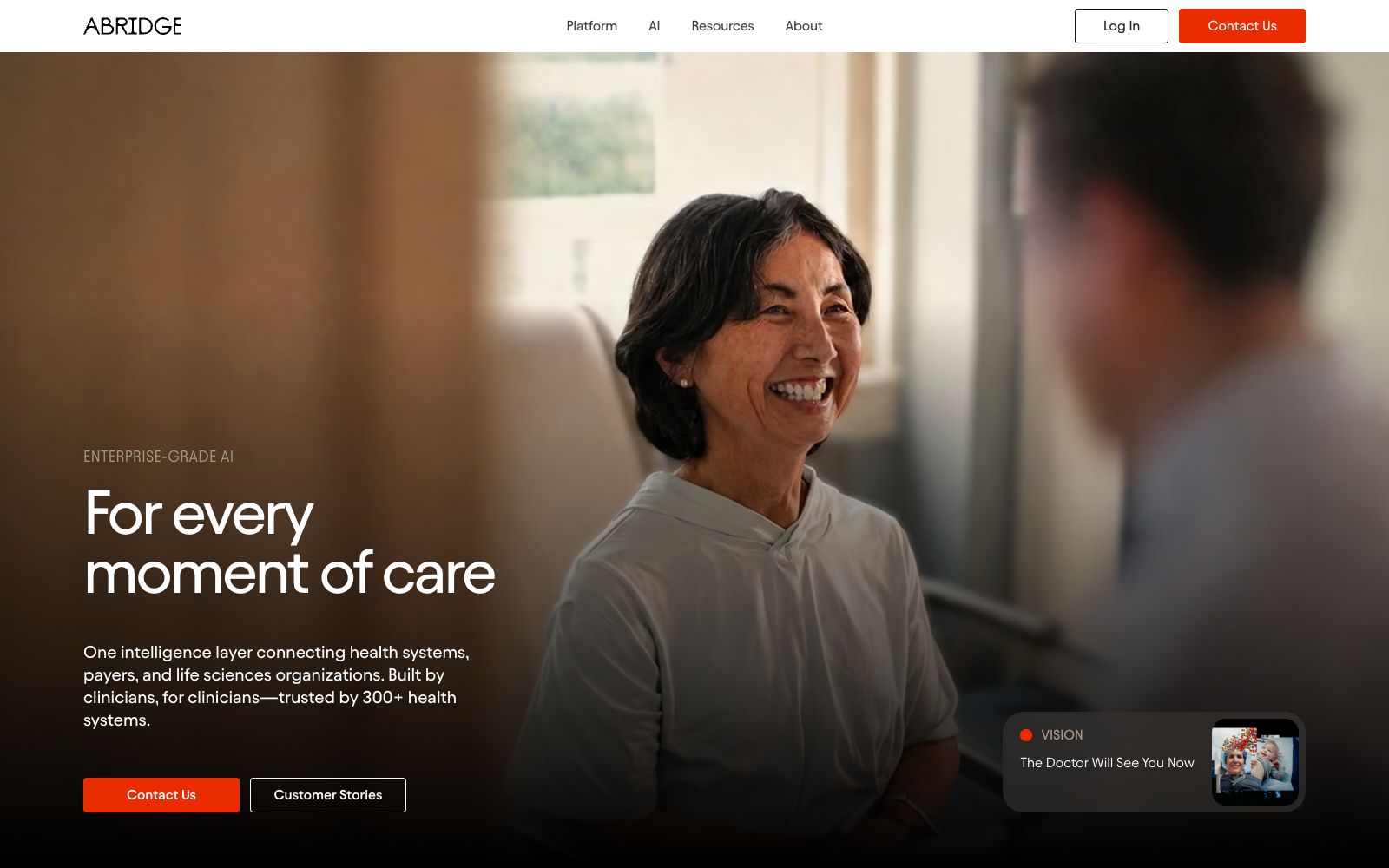
Abridge is a generative AI clinical documentation tool for doctors. It real-time generates structured medical records, coding and summaries during doctor-patient conversations. It is built by clinicians for clinicians, and the notes need to be reviewed by doctors.
Updated: 2026-10-26
What is Abridge?
Abridge is a generative AI medical documentation tool for clinical scenarios, positioned as "providing an intelligent layer for every moment of diagnosis and treatment". Developed by clinicians for clinicians, it is officially claimed to be trusted by more than 300 healthcare systems. Unlike general transcription, it captures doctor-patient conversations in real time during the interaction, and automatically generates structured medical records, coding and patient-friendly summaries after consultations, freeing doctors from the burden of writing medical records.
Who is it for?
- Ambulatory and inpatient physicians overwhelmed by paperwork who want to reduce the time spent on medical record writing.
- Nurses and multidisciplinary teams who need to convert conversations into compliant medical records.
- Healthcare institutions and management teams looking to boost physician satisfaction and reduce professional burnout.
- Payers and RCM teams that focus on medical record quality, coding completeness, and the revenue cycle.
- Large healthcare systems that already have an EHR and wish to add an additional layer of AI documentation capabilities.
Key features
6Ambient Clinical Documentation
Captures patient-doctor conversations in real-time during visits to generate accurate, structured clinical notes, allowing clinicians to focus on their patients rather than screens.
Pre-visit Preparation
Compiles the patient's medical history, previous visits, and relevant context before the appointment, allowing clinicians to have full background information at their disposal upon entering the room without having to search for it temporarily.
Clinical Decision Support During Consultation
Clinical decision support prompts appear during the conversation, gaps in care are identified, and prescriptions are assisted, helping doctors stay focused on the patient rather than the screen.
Post-visit Output
Automatically completes final notes, refines coding, orders, and patient-friendly summaries for doctors to review, bill, and follow up, which the company says significantly reduces the burden of note-writing.
Multi-specialty & Multilingual
Covers more than 40 specialties, supports 28 languages, and offers specialty-specific versions such as Abridge for Nurses (named one of TIME's 2025 Best Inventions).
Scalable Evidence
The company states that it supports over 100 million clinical consultations annually, has won the 2025 and 2026 Best in KLAS awards, and has released data such as a 78% reduction in cognitive load and an 83% decrease in the effort of taking notes.
How to use Abridge
- 1Notes are generated by AI and still need to be reviewed and signed by doctors. Do not submit drafts as final documents, and manual verification of key diagnosis and treatment information is essential.
- 2Conduct a pilot in a small range of specialties first, confirm its compatibility with the hospital's EHR, templates and billing rules, and then promote it hospital-wide.
- 3Focus on privacy and compliance: Ensure that deployment complies with requirements such as HIPAA, and that patient informed consent and the scope of recording are agreed in advance.
- 4Use the time saved by AI for doctor-patient communication rather than simply compressing office visits; improvements in burnout stem from a sense of presence rather than speed.
- 5Evaluate based on your hospital's actual retention rate and time spent on note-taking, and do not solely rely on the vendor's benchmark data.
Traffic & popularity
Data month Sep 2026
Abridge receives about 549.4K visits per month and ranks #78,432 worldwide.
Monthly visits
12 monthsTraffic sources
- Direct57.9%
- Search31.7%
- Referrals3.9%
- Social3.0%
- Mail2.3%
- Other1.2%
Top countries
- United States86.8%
- Vietnam2.5%
- South Korea1.9%
- Brazil1.5%
- India1.3%
Estimated from third-party traffic data.
Similar tools
 NablaNabla is a clinical environment-oriented AI assistant that automatically converts doctor-patient conversations into structured medical records, and provides clinical voice dictation as well as E/M and ICD-10 coding suggestions. The notes and coding need to be confirmed by doctors.
 Lyrebird HealthA clinic recording assistant for clinicians, which real-time converts consultation dialogues into structured medical records, synchronizes bidirectionally with EMR, and automatically generates referral letters and care plans, suitable for general practice and specialized departments.
 FreedAI medical record assistant for independent clinics organizes consultation dialogues into notes that can be synchronized with electronic medical records, provides coding suggestions and cited clinical Q&As, helping doctors spend less time writing medical records.
 Senyi IntelligenceA medical big data and artificial intelligence enterprise, it is officially stated that it uses four product lines: AI clinics, clinical auxiliary decision-making and quality control, hospital operation management, and clinical research to help hospitals conduct medical record quality control, build specialized disease databases, and carry out multi-center scientific research collaboration.
 TempusTempus is an AI precision medicine company founded by Eric Lefkofsky. It provides gene sequencing, the Tempus One assistant and the Lens platform, and uses multimodal data to assist oncologists in decision-making.
 HeidiAn AI medical assistant for clinic consultations can sort doctor-patient conversations into medical records, retrieve guidelines and literature and mark sources during diagnosis and treatment, while emphasizing compliance. It is suitable for outpatient doctors and residents.