


Zed
Zed is a high-performance multi-person code editor created by the authors of Atom and Tree-sitter. Written in Rust, it supports parallel editing with AI agents and in-line assistants, enables real-time collaboration for teams, and is ideal for developers who value speed and collaboration.
Updated: 2026-10-26
What is Zed?
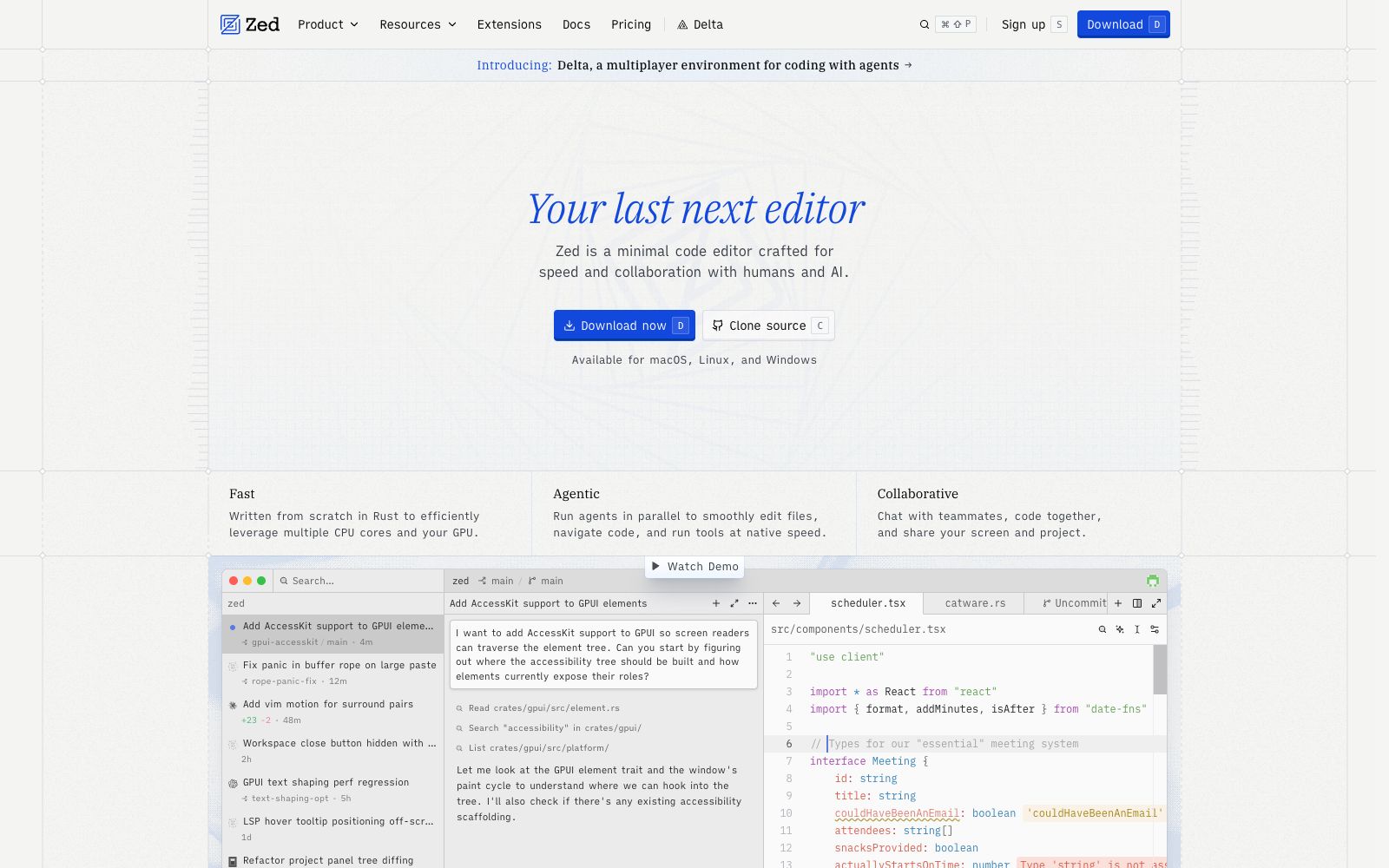
Zed is a high-performance, collaborative code editor for multiple users, officially self-described as "Your last next editor". It is built by the authors of Atom and Tree-sitter. Unlike most editors based on Electron, it is written from scratch in Rust, which, according to the official, can fully utilize multiple CPU cores and GPUs to speed up the process. Zed places "humans" and "AI" in the same collaboration model: it allows real-time collaborative coding with teammates, screen and project sharing, and also enables AI agents to edit files in parallel, browse code and call tools. The official website has also launched Delta, a multi-user environment for "coding with agents".
Who is it for?
- Developers who pursue the responsiveness of code editors and are tired of laggy experiences
- Long-time users who already use Atom or value the syntax capabilities of Tree-sitter
- Remote teams that need real-time pair programming and project sharing with teammates
- Engineers who want AI agents to edit code in parallel and reduce repetitive manual work
- Geeks who love open source and are willing to participate in the expansion ecosystem
Key features
6Agentic Editing
The official claims that multiple agents can run in parallel to edit files, navigate code and run tools at native speed, leaving repetitive code modifications to the agents.
Edit Prediction
The edit prediction feature provides subsequent completion suggestions while writing code, reducing mechanical input based on the current context.
Inline Assistant
The in-line assistant answers questions and modifies code directly within the editor without switching to a separate chat window, preserving context.
Any Agent, Any Tool
The official claims it supports any agents and tools, integrating external AI capabilities into the editing workflow rather than being tied to a single model.
Real-time Collaboration
Chat with teammates, code together, and share screens and projects, making it ideal for distributed teams to work on the same files in parallel.
Language Services & Extensions
Supports LSP, Outline view and text/line operations, with an ever-growing extension ecosystem that covers daily editing needs.
How to use Zed
- It is recommended to first download the version corresponding to your system (the official website provides macOS, Linux, and Windows versions).
- Use the inline assistant for the first round of code Q&A and rewriting, then gradually try Agentic Editing to hand over large-scale refactoring to parallel agents.
- Edit Prediction provides suggestions by default, and once you get used to it, you can use it as regular completion.
- For collaboration scenarios, first create a shared project and invite teammates to the same file.
- real-time collaboration is more efficient than sending patches back and forth.
- Zed is an open-source editor, but its AI capabilities depend on the models and tools you configure.
- Parallel agents will consume more context and quota, so it is recommended to run with a single agent first before enabling parallelism.
- Platform functions and model access methods may be adjusted, so please check the official website instructions again before use.
Traffic & popularity
Data month Sep 2026
Zed receives about 640.1K visits per month and ranks #86,795 worldwide.
Monthly visits
12 monthsTraffic sources
- Search46.4%
- Direct33.0%
- Referrals9.4%
- Social8.4%
- AI assistants2.0%
- Other0.8%
Top countries
- China18.0%
- United States15.3%
- India5.5%
- Indonesia4.9%
- Germany3.9%
Estimated from third-party traffic data.
In these collections
Similar tools
 CodeBuddy IDETencent Cloud's AI code editor for the overseas market, powered by self-developed large code models, provides code completion, error diagnosis, technical Q&A and performance optimization, covering the entire development process from design drafts to deployment verification.
 GroqGroq's in-house LPU chip-powered inference cloud runs open-source models such as Llama and Mixtral with ultra-low latency. It has a low migration cost for OpenAI-compatible APIs, and the company claims it processes trillions of tokens per week.
 MagicPathThe official website of MagicPath positions itself as a collaborative workspace for humans and AI agents, focusing on design and coding scenarios. Its key labels are Design, AI and Programming. The website also has a product blog where you can learn about usage.
 OpenCodeOpenCode is an open-source AI programming agent that can write code in terminals, IDEs and desktop clients. It supports LSP, multi-session parallelism and 75+ models, and prioritizes privacy without storing code.
 AIOProductOSThe official positioning of AIOProductOS is the operating system for product companies: it puts customer feedback, revenue, tasks and code into the same customer record, sorts tasks by revenue value, supports synchronization of more than 100 connectors, and allows hiring AI teammates to perform real tasks. It is priced in tiers starting from $199 per month.